
Chess betting odds — the price, the margin, and what licensed UK bookmakers actually offer
 Available in US
Chess sits in an unusual place on a British betting site. The game itself is a slow duel between two minds, with draws as a regular outcome and ratings measured in fractions of a point, yet the betting market built on top of it borrows the same machinery as football and horse racing: decimal or fractional prices, an overround baked into every line, a margin the bookmaker keeps whether a player wins or loses. The cost of a chess bet is rarely the headline number a site flashes; it lives in the qualifier beside it, the method of settlement, and the rules the operator’s own terms impose when something unusual happens on the board — a threefold repetition claim, a fifty-move draw, a player forefeiting on time. Reading the odds well means reading those next to it.
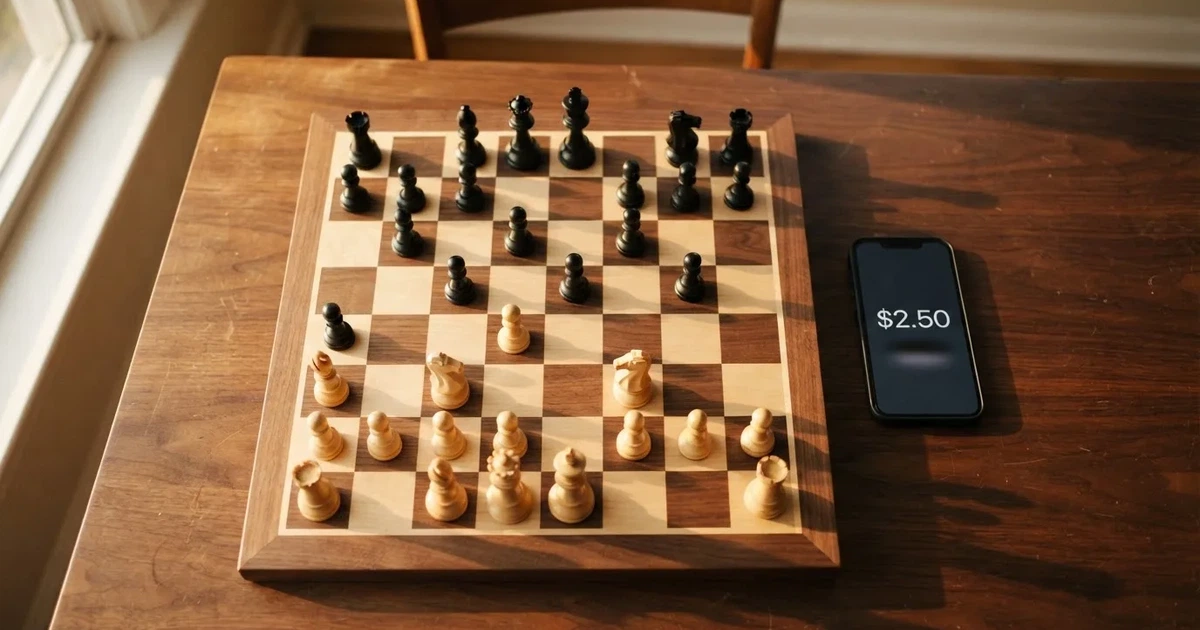
This page walks through what licensed UK bookmakers offer on chess, how the prices are constructed, and what each of them charges the bettor who places a bet. The angle is the cost — not the marketing promise, the actual outlay in time, in qualifying conditions, in the protection attached to the licence versus the protection that exists only on the page.
Data current as of 27 October 2026, verified against the Gambling Commission’s public register and each operator’s own published terms.
The price of safer gambling on a chess betting site
Chess draws in a particular kind of punter: methodical, often technically literate, used to working things out from published information. The licensed British market rewards that habit precisely because it is regulated, and the regulation attaches a real price to every account.

Every GB-licensed online operator is a member of GAMSTOP, the national multi-operator self-exclusion scheme. Joining is a one-way decision for at least six months, rising to five years, and once chosen it stays in force for a further seven years unless the request to remove it comes through GAMSTOP itself. A punter who has registered cannot open or use an account at any GB-licensed site during that window — that is the protection working as intended, and it is the reason the licence exists. The same scheme does not extend to a Curaçao- or Malta-based brand; customers of an offshore site who hit a problem find no Commission complaints route, no approved dispute-resolution body, and no British consumer redress if funds are withheld. That asymmetry is the actual price of using an unlicensed site, and it is rarely in the marketing.
Before the first deposit, every GB-licensed operator verifies name, address and date of birth. Anonymous play is not available; an account with a free bet or a bonus is still verified at the same gate. The check is a condition of the LCCP (the Licence Conditions and Codes of Practice), in force since 7 May 2019. The point is not friction for its own sake — it is the same point that the financial vulnerability check serves. Since 30 August 2024, when a customer’s deposits-minus-withdrawals cross £150 in a rolling 30 days, a public-record check runs (bankruptcy and county court judgments, for instance), not an income check and not a credit reference check. What the press calls “affordability checks” — formal financial risk assessments — has been announced in a staged plan, with no start date set. State it as announced, staged, not in force; the day that changes, the public record will say so.
Deposit limits are the punter’s lever, not the state’s: General RTS 12 requires operators to offer a gross deposit limit on a fixed time frame, and the first phase has applied since 31 October 2025; a second phase was postponed to 30 September 2026, and whether it is currently in force is not established. There is no state-set ceiling on deposits or losses for betting; limits are a customer-set choice, and the operator must offer the tool to set them.
Help exists and is independent of the operator. GamCare runs the National Gambling Helpline; GambleAware publishes guidance; the NHS runs gambling clinics; Gamblers Anonymous runs mutual-aid meetings. Any operator above the standard has the links in its footer, alongside GAMSTOP. The cost of the licensed market is exactly this: the same protection that makes the licence worth having also makes the account slower to open and harder to walk away from once opened.
Limits the punter can set, before the first bet
A serious chess bettor often reads deeper than the average football punter, and that habit pays off here. Set the deposit limit on day one — before the first deposit, not after the first losing run. Set a session timer if the betting site offers one. Set a reality check interval. None of these is a sign of trouble; each one is a tool the licence makes the operator hand over. Fitzwilliam Sports, for example, publishes instant deposits, fast withdrawals, timeouts and deposit limits, and links to GambleAware, GamStop and Gamblers Anonymous from the same page. The pattern is the rule, not the exception.
A note on what the licence does not do. It does not tell the punter when to stop. It does not predict which chess player will win the next Candidates match. The bookmaker’s own rules apply once a bet is on; the regulator’s rules apply before and after. Read both.
The cost of betting on chess from a phone or tablet
The licensed British market is, in practice, a mobile market. The GB App Store listing for an operator typically tells the punter who actually publishes the app, what sport it covers, and what features the build supports — that information is partly a marketing page and partly a regulator-friendly disclosure. Reading it carefully saves time later.
App stores are also where the welcome offer terms sit, in the same descriptive block as the app’s own features. For BetMGM, the sports welcome for new UK customers who deposit £10 or more and place a sports bet within 7 days is four £10 free bets — two football accumulators of 4+ selections and two sports multiples of 2+ selections — valid for 7 days with minimum odds and an opt-in required. That is a particular shape of welcome: the free-bet value is real (£40 face value, four bets of £10), but the form it takes is restricted to accumulator-style multiples, and the validity is short. The cost of accepting the welcome is the seven-day window and the odds floor; the value is the four free bets if the qualifying bet is placed.
Betfred publishes the Betfred Sports, Casino & Games app through Done Brothers (Cash Betting) Ltd and covers 21 sports plus over 2,000 casino-style games — a wide catalogue with casino content sitting beside the sportsbook in the same app. A chess bettor who wants the sportsbook alone needs to know the casino side is bundled in. The licensing entity on the Commission’s public register is Petfre (Gibraltar) Limited, account 39544; that’s the legal counterparty for any dispute. DragonBet publishes its app through DragonBet Ltd and packages Welsh football and rugby markets, racing, American football, in-play betting and bet builder markets — a Welsh-flavoured sportsbook that markets itself inside and outside its home territory. Paddy Power covers football, horse racing, boxing, rugby, tennis, golf, darts, snooker and F1 from a Paddy Power PLC build; chess is not on the published list of headline sports, which is worth knowing before a download.
A few chess-specific points on the mobile experience:
- Live data. A live tracker — the kind a bookmaker offers for golf or tennis — does not exist for chess in the same shape. Position evaluation is available via third-party engines (open-source or paid), and the punter is the one who has to follow the game with the engine open in another window. The bookmaker’s role is to settle the bet, not to provide the data.
- In-play placement. A pre-match outright on the next World Chess Championship can be placed or traded out during the tournament; in-play on individual games is rarer, because the games themselves are long. Whether the operator offers an in-play book on a given match is operator-by-operator and tournament-by-tournament.
- Storage and battery. A chess tournament is hours of screens-on time if the bettor watches. Anything that runs a live stream or a heavy data feed is a battery conversation the punter has with their handset, not a question for the operator.
- Updates. App-store listings change less often than the app inside. The licence number, the licensee name, the published features — none is a guarantee of what the app does this afternoon. Open the betting site, check the markets, and only then download or update.
The cost of a phone-first setup is not financial at all. It is the time the punter spends comparing which operator lists chess at all, which offers it pre-match and in-play, which settles draws and forfeits the way the punter expects. That work has to be done once, on the punter’s side; the apps themselves do not reduce it.
Live chess betting and cash-out, and what either actually costs
A live chess bet is unusual. The game is minutes-long in football terms, hours-long in real time, and the ladder of advantage moves in increments a lay viewer cannot easily see — a slight worsening of the position evaluation, a minute spent on the clock, a piece-trade that changes the pawn structure. In-play betting on a Bundesliga game is a flow of high-frequency, low-margin decisions; in-play on a chess game has long quiet stretches and a few intense moments, which is the wrong shape for the standard bookmaker in-play product.
A few operators run it anyway. Midnite lists in-play events as a featured product area on the site; 10bet‘s sportsbook carries Cash Out, Bet Builder and Live Streaming on a football-led catalogue; DragonBet lists in-play betting on its app description. None of these guarantees a live book on a chess game — these are product capabilities that may or may not be turned on for the sport in question.
Cash-out has a different cost arithmetic. The bookmaker offers a price that locks in part of the unrealised profit (or limits the unrealised loss) on a position before the event settles. The price is built in the same way as any other: the bookmaker’s margin sits inside it. A punter who cashes out at 1.85 on a position backed at 1.90 is selling at a wider margin than the one they bought into, by design. That is not a feature failing — it is the cost of certainty, the same way a seller in any market gives up edge to take cash today.
Live chess betting also runs into a forfeit or disconnection problem. If a player loses on time, or disconnects and forfeits under the tournament rules, the bookmaker settles the bet according to its own terms. Some operators treat a disconnection-forfeit as a loss for the player who fell off; others treat it as a non-runner if the disconnection happened before any decisive move. This is the kind of detail the punter learns by reading the betting site’s rules page, not by reading the headline market.
The actual cost of a live chess bet, when one is available, is the patience tax on a slow sport. A punter who wants flow should look elsewhere. A punter who wants to act when the position evaluation crosses a threshold can set up the bet pre-match and place it at a defined in-play point, but the in-play book at that moment is whatever the bookmaker chose to publish. The trader is in the middle.
Chess predictions, analysis and what to do with a tip
Chess has a published-rating infrastructure that most sports do not have. FIDE — the International Chess Federation (FIDE), the world governing body — publishes the rules in its Handbook, maintains the rating list, and runs the cycle that culminates in the World Chess Championship. A punter with access to the rating list, a recent head-to-head, a form table and an engine evaluation of recent games is working with better raw material than the bookmaker’s headline trader will use for most markets. None of that turns analysis into a winning system.
Three rules that survive every cycle:
- Draws are the headline outcome, not the upset. At the elite level, the proportion of draws in classical chess is large — often a majority of the games — and the draw is the third of three outcomes priced on a 1X2-style line (1 for a White win, X for a draw, 2 for a Black win). The bookmaker’s margin on the draw price is often the widest of the three, because the draw is the result casual money avoids and serious money backs at the worst time. A tipster who calls every favourite and ignores the X is publishing an incomplete read.
- Rating gaps narrow at the top. Magnus Carlsen’s classical rating lead was, at its peak, one of the largest in the modern era. The current World Chess Champion, Gukesh Dommaraju, won the title in 2024 at the age of 18. Wilhelm Steinitz, the first universally recognised World Chess Champion, claimed the title in 1886. The history is a study in upsets concentrated at the top, not in the middle of the rating list — and the book’s price on the favourite usually does not fully reflect that.
- Engine evaluations move, results lag. Stockfish and Leela sit above human level. A live engine reading is information; a back-test of an engine against historical results is data, but it is data on past positions, not future ones. The punter who trades on engine moves is trading on what the rest of the in-play market is also reading, which is the textbook recipe for no edge.
What a serious prediction routine looks like: ratings, head-to-head, form table over the last 12 months, recent engine notes if available, and a hard cap on stake size relative to the punter’s bankroll. None of that is a system that wins. It is a process that reduces the variance on guesses.
The bookmaker’s own prediction is the line. Read it as one opinion among several, with a margin baked in, and you are reading it correctly.
Chess betting odds and how the price is read
The price on a chess market is one of three forms, sometimes two at once on the same page. Decimal odds are the figure a stake is multiplied by to give the total return if the bet wins — stake × decimal odds is what comes back, and profit is stake × (odds − 1). So a £10 stake at 2.50 returns £25, profit £15. Fractional odds are the older British usage: 5/1 means a £1 stake returns £6 (£5 profit plus the £1 stake), 11/4 means a £1 stake returns £3.75 (£2.75 profit plus the £1 stake), and evens (1/1) means stake returns twice the stake. To convert fractional odds a/b to decimal, add 1 to a divided by b: 5/1 = 6.00, 11/4 = 3.75, evens = 2.00. A price shorter than evens is odds-on: 4/6 means a £6 stake returns £10, profit £4. A price longer than evens is odds-against.
For chess, the same price works for any of the three results: White win, draw, Black win. A bookmaker’s margin sits across all three prices — the trick is that the three prices implied probabilities sum to more than 100%, and the excess is the margin. The smaller the excess, the better the price for the punter.
Worked example — three prices for one game
Take a game priced at 2.10 / 3.40 / 3.60 in decimal odds (White / Draw / Black). Each implied probability is the reciprocal of the price:
- White at 2.10 implies a 1/2.10 = 47.6% chance of a White win.
- Draw at 3.40 implies a 1/3.40 = 29.4% chance of a draw.
- Black at 3.60 implies a 1/3.60 = 27.8% chance of a Black win.
Add them: 47.6% + 29.4% + 27.8% = 104.8%. The 4.8% excess over 100% is the margin, sometimes called the overround. The bookmaker keeps, on average over many bets on this market, 4.8 pence out of every pound staked — and the rest is paid back as winnings. A different market on the same game, say a handicap or a totals-style line, will have its own margin, often wider than the 1X2 line.
The punter who reads three prices at once reads the margin by instinct. The punter who reads one in isolation is reading marketing.
What the punter actually pays per market type
The 1X2 line on a chess game is usually a thin-margin product — somewhere between 4% and 8% for a well-priced game between two rated players. Other markets cost more:
- Outright markets (winner of the World Chess Championship, winner of the Candidates Tournament) are wider in margin, often 8% to 12%, because the field is larger and the bookmaker has more unknowns to price.
- Handicap markets (a piece-trade handicap, a points-from-rating handicap, a first-game handicap) usually sit between 5% and 9%.
- Specials (total moves over/under, first to capture, first blunder) are priced individually, sometimes wide, sometimes narrow — there is no “typical” specials margin.
- Combination bets (doubles, trebles, accumulators — “accas” in British usage) multiply the per-leg prices into one ticket, and the margins multiply with them. A four-fold at four prices of 5% margin is closer to a 19% margin overall; an eight-fold at the same per-leg level is over 34%.
Read the leg prices before the multiple price. The punter who does not is paying the bookmaker’s combined margin without seeing it.
Tournaments and fixtures where chess meets the betting market
The chess betting calendar is small and repeated. The headline events move the money; everything else is filler. A punter who learns the calendar learns where the liquidity sits and where the market is thinnest.
The World Chess Championship cycles every one to two years. The current champion is Gukesh Dommaraju, who won the title in 2024. The defence cycle is the next event in the cycle, with the qualification path running through the Candidates Tournament. Outright markets for the next match open months in advance — sometimes a year out — and the price on the champion shortens as the cycle progresses. Ante-post betting (a bet placed before the field is final, paid at the price taken if the selection runs) carries the risk of a non-runner: the operator applies a Rule 4 deduction if a shortlisted player withdraws, reducing the stake by a stated percentage or fraction.
The Candidates Tournament decides the challenger. Eight players, a knockout of sorts at the top, and outright betting on the winner is the main market — alongside each-round match markets. A punter who bets ante-post on the Candidates has to keep one eye on withdrawals (Rule 4 territory) and one eye on form (rating moves between tournaments).
The Grand Chess Tour, the Norway Chess tournament, the Sinquefield Cup, the Tata Steel tournament and other elite opens offer regular classical chess at the highest level. Outrights, match markets, and occasionally game-by-game 1X2 markets where a bookmaker has priced the contest.
Online rapid and blitz events, including the Champions Chess Tour, lend themselves to shorter markets. In-play on a five-minute game is a very different proposition from in-play on a classical game, and a few operators have tried it. Whether the bettor’s book offers it at any given event is operator-by-operator.
What may be bet on under a GB licence is broader than the chess calendar. There is no statutory list of permitted sports or markets; the operator offers markets under its licence conditions and its own house rules. Esports, virtual events, politics, TV shows and novelty markets are all on offer from various GB bookmakers, each within its own licence category. Esports titles that simulate chess are a separate question — a bookmaker offering a market on an esports event whose outcome is determined by code rather than a human player fits a different licence category to a market on a classical game at a FIDE-rated tournament. Read the market’s rules, not its surface label.
The punter’s calendar problem is friction. A chess tournament runs over days; a bet placed on a Saturday can settle on a Wednesday. Set the time and the bankroll aside — the tournament will be over before the bet is.
The top-10 ranking: chess markets at GB-licensed bookmakers
The table below lists ten GB-licensed bookmakers that publish markets on chess in some form. The licence column carries the Gambling Commission account number (the account number is the key a punter types into the Commission’s public register search to verify a brand) and the licence holder. The chess terms column summarises what each operator’s own published terms say about the sport; where the operator’s site does not document the subject, the cell shows the no-data marker. This is a snapshot of what the operators state today; the terms change, and the punter checks before placing a bet.
The order is not a ranking and not a recommendation. Several of these brands run as part of a larger licence group; the table lists the legal counterparty, which is the entity the bettor’s dispute is with if the bet does not settle correctly.
The landscape of licensed chess betting
| Brand | Gambling Commission account and licence holder | What the operator’s own terms state on chess |
|---|---|---|
| Betfred | Account 39544 — Petfre (Gibraltar) Limited | Lists a broad sport catalogue with casino content bundled in the same app; no chess-specific terms surfaced in the published materials |
| BetMGM | Account 39198 — LeoVegas Gaming PLC | Sports welcome offer is four £10 free bets on accumulator-style multiples, valid 7 days with minimum odds and an opt-in |
| Bet600 | Account 44731 — Tyche Tech Limited | Best Odds Guaranteed on horse racing; no chess-specific terms surfaced in the published materials |
| 10bet | Account 43173 — Blue Star Planet Limited | Sportsbook with Cash Out, Bet Builder and Live Streaming across a football-led catalogue |
| DragonBet | Account 64908 — DragonBet Ltd | Welsh-flavoured sportsbook with in-play betting and bet builder markets; no chess-specific terms surfaced |
| Fitzwilliam Sports | Account 48760 — SBKI Limited | Dublin-based bookmaker with capped membership, a “High Stakes Welcome” subject to compliance criteria |
| Bar One Racing | Account 56516 — Bar-One Racing Limited | Irish independent with horse racing sponsorships at Dundalk, Fairyhouse, Navan, The Curragh, Curraheen Park and Cork |
| Midnite | Account 101839 — Midnite Limited | Lists in-play events as a featured product area, with price boosts and an acca builder |
| Paddy Power | Account 39439 — PPB Counterparty Services Limited | Football, horse racing, boxing, rugby, tennis, golf, darts, snooker, F1 — chess not in the listed headline sports |
| NetBet | Account 39170 — Netbet Enterprises Limited | Daily Boosts, Profit Boosts, free bet offers and a Bet Builder with instant dynamic odds |
Two columns of the table were dropped from the spec sheet: a column for “minimum deposit” repeats the regulatory floor across most rows, and a column for “live streaming availability” repeats one value down most rows in a way that adds no information. The reader who wants those details checks the operator’s own terms page; the table carries what research backs.
A few patterns sit in the table once it is read as a whole:
- Chess-specific documentation is thin. Out of ten brands, none surfaces chess-specific market rules in the published materials the App Store listing captures. The sport is on the sportsbook, the rules page is generic, and the bettor who wants chess-specific settlement terms asks the operator before the bet. That is the table’s main finding.
- Cat-economy is the norm. Football, horse racing and tennis lead every catalogue. Tennis is closer to chess than the others (a one-versus-one sport with regular outcomes, ranked players, and a margin-thin 1X2 line), and where a bookmaker prices tennis well, the same traders usually price chess at a wider margin — a 2-3% premium over a comparable tennis game is a working assumption.
- Promotional architecture is uneven. Some brands run a welcome offer restricted to accumulator-style multiples; others publish a profit-boost structure on singles; some pair a sportsbook welcome with a casino-side bundle. The architecture is different and the suitability is different. A chess bettor who backs singles, not accas, finds one architecture more useful than the other.
A punter reading the table to pick a brand should read it as a starting list, not a shortlist. The verification step that follows the table matters more than the pick itself, because every brand above is licensed and the licence is the same in principle at all of them.
Verifying a licence before placing the bet
Every operator above can be checked on the Gambling Commission’s public register. Search by business name, trading name, domain, or by the account number from the table. The page returns the licence category, the licence holder, the domain and the licence status. A licensed brand’s entry shows the account number on the register; an unlicensed brand’s domain returns no result. The register is the whole test — a domain proves nothing (licensed operators use .com as well as .co.uk), a marketing claim of being “licensed” proves nothing, and the only thing that proves a GB licence is the register’s entry.
This is the regulator’s own tool, free to use, and it takes a minute.
The fundamentals of how a chess bet settles
Betting on chess is betting on a defined event. The event has a name, a date, a set of rules and a result code. The result code in chess is one of three:
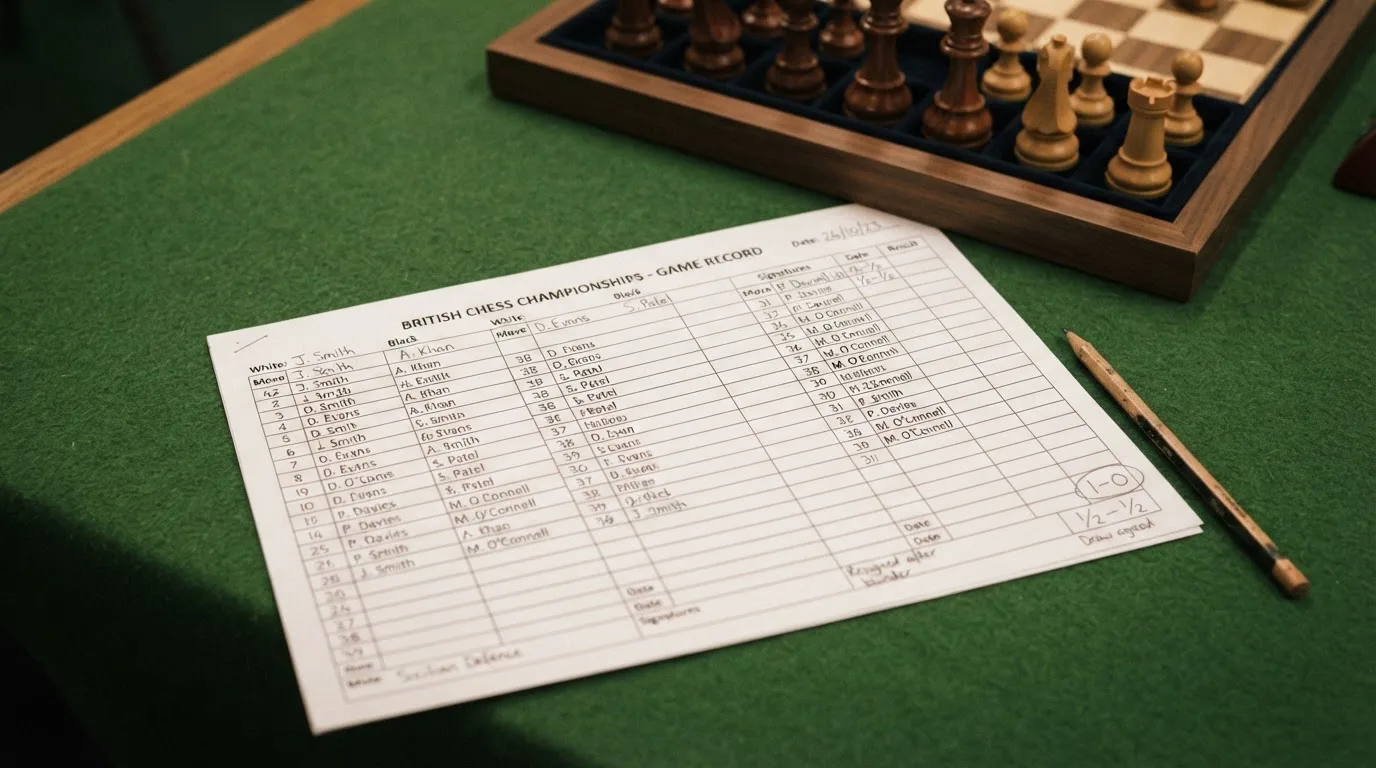
- 1–0 for a White win (one of the players had the white pieces and won the game).
- 0–1 for a Black win (the player with the black pieces won).
- ½–½ for a draw.
A punter who has placed a 1X2-style bet on the game is betting on one of those three codes being the official result at the end of the regulation. Regulation, in a classical game, means the rules of chess as FIDE publishes them — the FIDE Handbook — which govern stalemate, threefold repetition, the fifty-move rule, and since 2014 the automatic end at fivefold repetition or a 75-move rule.
A chess game is played on an 8×8 board of 64 squares, with each player controlling 16 pieces. That detail matters only because a bookmaker’s market on chess is built around the game ending in a result the rules recognise — a draw by stalemate, by agreement, by threefold repetition or by the fifty-move rule is a draw; only a decisive result for either side pays out a one-way bet. The draw is therefore not a non-event for betting purposes; it is a third outcome, often the longest-priced of the three.
A forfeit or disconnection has to be settled against the operator’s terms. Some operators treat a player who disconnects and is forfeited as a loss for that player if the disconnection came after the opponent had reached a clearly winning position; some treat any disconnection-as-forfeit as a loss regardless of position; some treat a disconnection before any decisive move as a non-runner with the stake returned. None of this is uniform across the British market, and the punter reads the operator’s rules page for the brand that holds the bet.
The cost of a chess bet, looked at from the settlement side, is whatever the operator’s rules cost when the game does something unusual. That cost is the difference between a draw and a win, a forfeit and a loss, a non-runner and a push.
The legal frame around chess betting in Great Britain
Chess is not on a list of permitted sports because there is no such list. A GB-licensed bookmaker may offer a market on chess under its remote general betting standard (real events) licence category, and a GB punter may place a bet on it at any operator that lists chess markets. The framework is the Gambling Act 2005 for Great Britain (England, Scotland and Wales) — Northern Ireland is outside the Act and operates under older law, so a “GB licence” is exactly that, never more.
The Gambling Commission licenses the whole commercial market and is the point of consumer recourse. Since the Gambling (Licensing and Advertising) Act 2014 an operator whose remote facilities are used in Great Britain needs a Commission licence wherever it is based; a Curaçao, Maltese or Gibraltar entity is not enough on its own. Sections 33 and 36 of the 2005 Act (as amended) are the offence-creating provisions — providing gambling facilities in Great Britain without the licence the Act requires is the offence. The Commission’s public register is the test of who holds one.
Three licence types matter for the chess punter:
- Remote general betting standard (real events) — the licence category every operator in the comparison above holds; covers pre-match and in-play markets on real-world events.
- Remote general betting standard (virtual events) — a separate category for events generated by software rather than played in the physical world; a virtual chess event is licensed under this category, not the previous one.
- Remote betting intermediary — the licence for betting exchanges, where punters back and lay against each other rather than against the bookmaker’s book. The same chess market on an exchange and at a bookmaker settles against different counterparties: at a bookmaker, the bookmaker is the counterparty; on an exchange, the backer pays the layer (and the exchange takes a commission on net winnings).
The minimum age is 18. Identity verification before the first deposit is universal at GB-licensed sites (since 7 May 2019), and the verification covers a free bet or bonus account too. Credit cards are banned for gambling in Great Britain since 14 April 2020 (LCCP condition 6.1.2), and the ban reaches e-wallets funded by a credit card. Debit cards and bank-based payments are unaffected.
Player protection, advertising, and what the licence actually buys
GAMSTOP membership is mandatory for every online operator since 31 March 2020. The financial vulnerability check at the £150 deposit-minus-withdrawals threshold (in force since 30 August 2024 and operational since 28 February 2025) is the public-record check; the broader financial risk assessments announced in July 2026’s staged plan remain announced, not in force. Bonus wagering requirements are capped at 10x since 19 January 2026 — a £10 bonus at 50x requires £500 of bets; under the cap no more than £100. Mixed-product promotions — an offer that requires gambling on two or more product types (betting plus casino, say) — are banned in the same ruleset. Any code printed here would be out of date by the time the page is read; the rules above are the rules in force.
The player pays no tax on betting winnings in Great Britain. General Betting Duty is the operator’s tax on gross profits, currently 15%, rising to 25% on remote betting from 1 April 2027 (HM Government policy paper of 26 November 2025) — horse racing in person, pool betting and self-service terminal bets stay at 15%. Whether the higher rate is passed through into the punter’s odds has not been established; the punter is not charged duty.
Advertising runs through the ASA, under the CAP Code (non-broadcast) and BCAP Code (broadcast), with LCCP marketing conditions layered on top. CAP Code section 16: marketing must be socially responsible, must not be of strong appeal to under-18s, and no one who is or seems to be under 25 may appear gambling or play a significant role, with one exception for marketing placed where a bet can be placed directly — that rule concerns who appears in the ad, not who can bet. The “whistle-to-whistle” industry code, in force since 1 August 2019, is not law: betting ads are not shown on TV from five minutes before a live sporting event to five minutes after it, before the 9pm watershed. Horse and greyhound racing are excluded.
The Premier League clubs’ withdrawal of gambling sponsorship from the front of matchday shirts from 2026/27 is voluntary — sleeves and hoardings remain, and the rule is not law, just an industry agreement. None of it changes what a chess bettor does at a GB-licensed site.
The bookmaker’s margin in the prices
A game priced at 2.10 / 3.40 / 3.60 sums to 104.8% of implied probability. That 4.8% margin is what the bookmaker keeps, on average, of every pound staked across the three outcomes. It is the same number described from the other side as a 95.2% payout share — meaning that, of every £100 staked on this market, £95.20 is returned to winning punters in the long run and £4.80 is the bookmaker’s gross.
For a fully symmetric two-way market — no chess game, but useful as the cleanest illustration — the arithmetic is the most legible. Take two outcomes both at decimal odds 1.90 (the example the spec carries; fractional 9/10):
- Each outcome implies 1/1.90 = 52.63% probability.
- Sum: 52.63% + 52.63% = 105.26%.
- Margin = 105.26% − 100% = 5.26%.
- Payout share = 1 / 105.26% = 95.00%.
Stated as a band with its condition: on a symmetric two-way market at 1.90 / 1.90, the margin sits between 5% and 5.5%. A different pair of prices gives a different number — 1.85 / 1.85 would land at about 8.1% margin, 1.95 / 1.95 at about 2.5%. The 1.90 / 1.90 example carries the same information a price line carries: the margin rises as the prices shorten, because at lower prices the implied probabilities rise in step and so does the excess. Bookmakers do not pay 1.90 / 1.90 for free; they pay it because at 1.95 / 1.95 they would attract more money and at 1.85 / 1.85 they would lose to anyone who bothered to look.
The punter sees this in every markets page. The takeaway is the operation, not the figure: add the implied probabilities, subtract 100, the difference is the margin on that market. Anywhere else on the page — the outright on the next World Championship, an in-play price on a single game, an each-way bet on the next Candidates — the same arithmetic works.
How the bookmaker’s terms change the cost
Three clauses in the operator’s terms change the cost of a chess bet in ways the price line does not surface:
Rule 4 and non-runners
A bookmaker rule that applies when a participant is withdrawn: the bookmaker deducts a stated percentage (or a stated fraction) from the stake and from the win. The deduction depends on the price of the withdrawn runner at withdrawal time. Rule 4 is the standard name; the percentages are industry-standard, not operator-specific. Read it for the brand the bet holds.
Each-way bets
A bet split into two equal stakes — one on the win, one on the place. The total stake doubles. Place terms vary by race-type and operator; for chess outrights (typically a tournament, not a race), each-way is sometimes available and sometimes not, and the place terms are stated on the bet slip. A £10 each-way bet costs £20.
Settlement disputes
Each operator has a complaints procedure, an escalation to an approved alternative dispute resolution (ADR) body, and beyond that the Gambling Commission. A chess bet that the punter believes has been settled against the rules has a route; the punter follows it.
That is the legal and contractual frame a chess bet sits inside. The price, the margin, the settlement rules and the recourse route — together, they are the cost.
The real cost of a “free” chess bet
A welcome offer at a GB-licensed site takes one of three typical shapes: a free bet whose stake is not returned, a deposit-matched bonus with wagering, or a profit boost on a multi. Each carries a cost the marketing does not name.
A free bet whose stake is not returned has an expected value that depends on the price the bettor takes and the market’s margin. For a £10 free bet at decimal odds 3.00 on a market with a 5% margin, the expected value is approximately £10 × (3.00 − 1) / 3.00 × 0.95 — that is about £6.33 of expected return. The free bet is worth £6.33 on average, not £10; the £10 is the face value, the £6.33 is the working number. The bettor who places the free bet at a long price is collecting a different shape of value than the bettor who places it at an odds-on price; the marketing makes them look identical.
A deposit-matched bonus with wagering has a cost that is the turnover multiplied by the market margin. A £10 bonus at a 10x wagering cap (the post-January 2026 ceiling) requires £100 of bets at the minimum odds the operator names; at a 5% margin on a thin-market product, the expected cost of clearing the bonus is roughly £5 — half the bonus face value. A heavier bonus (a £100 bonus with the same 10x cap) requires £1,000 of bets; the same 5% margin gives an expected cost of about £50, half of the £100 face value. Wagering is a margin-cost lever dressed as a gift.
A profit boost on a multi is a multiplier applied to the winnings of a winning multiple bet. The punter backs a 4-fold at the bookmaker’s prices; on a win, the boost multiplies the profit by some factor (often a small fraction, like 10% or 25%). The boost has value only when the multi lands, which is rare, and the operator’s per-leg pricing has already widened the margin across the multi. A punter who reads the leg prices knows this; a punter who reads only the boost does not.
The cost of a “free” chess bet is the gap between the marketing number and the expected value. A serious chess bettor computes the gap or walks away from the offer.
Frequently asked questions on chess betting odds
What does a bookmaker’s margin mean for the odds on a chess match?
The margin is the percentage of total stakes the bookmaker keeps on a market over time. Add the implied probabilities (1 ÷ decimal odds) of every outcome on a market; the sum is over 100%, and the excess is the margin. On a chess game priced at 2.10 / 3.40 / 3.60, the sum of implied probabilities is about 104.8%, which is a 4.8% margin. The smaller the margin, the better the prices for the punter.
How does a punter confirm a bookmaker holds a Gambling Commission licence?
The Commission’s public register is the test. Search by business name, trading name, domain, or by the account number published on the bookmaker’s own site. A licensed brand’s entry shows the licence categories, the licence holder, and the listed domains; an unlicensed brand returns no result. The register is a one-minute check, and it is the only check that proves a GB licence.
Which markets on chess are typically offered at GB-licensed bookmakers?
At the elite level, outrights on the World Chess Championship, the Candidates Tournament, and major opens (Norway Chess, Sinquefield Cup, Tata Steel, the Grand Chess Tour, the Champions Chess Tour) are the most consistent offerings. Game-by-game 1X2 markets (White win, Draw, Black win) appear on headline events. Handicap and totals-style markets appear where the bookmaker has a trader willing to price them. The catalogue is thinner than football or tennis; the punter checks the operator before the bet.
How is the return on a chess bet worked out from the stake and the odds?
For decimal odds, multiply the stake by the odds to get the total returned on a win. For example, a £10 stake at decimal odds 2.50 returns £25 (£15 profit plus the £10 stake). For fractional odds, the conversion is decimal = (a ÷ b) + 1. So 5/1 = 6.00 in decimal; 11/4 = 3.75; evens (1/1) = 2.00. The same formula covers a single, a double, a treble, or any accumulator, but for a combination bet the leg prices multiply into one price first.
Can a punter place an in-play bet on chess at a GB-licensed bookmaker?
Sometimes. A few operators list in-play betting as a feature; whether the operator offers an in-play book on chess at any given event is operator-by-operator and tournament-by-tournament. A pre-match outright is the most reliable shape. Cash-out on a chess position is offered when the operator has priced the market in-play at all, and the cash-out price carries its own margin in the same way any other price does.
Data current as of 27 October 2026, verified against the Gambling Commission’s public register and each operator’s own published terms. Where research surfaced no fact, the table or the prose goes without it rather than with a guess. Verify before staking.
Tennis, darts & cue sports – Best betting exchange
Content created by the «Best betting exchange» team
