
American football betting odds — what you actually pay for the price
 Available in US
The odds sit on the screen long before the reader thinks to ask where they came from, and the price is the only honest measure of what a bookmaker is offering on American football. For American football specifically the market is tighter than it looks on the page: bettors in Great Britain have a dozen properly licensed bookmakers quoting NFL sides, totals and player props across an 18-week regular season that ends with the Super Bowl in February. The cost sits in three places that have to be named out loud — the bookmaker’s margin baked into every line, the bonus conditions attached to a free-bet headline, and the verification step that runs before any of the betting starts. Going through each one in turn is what this page is about.
*Current as of 27 October 2026, against the Gambling Commission’s public register and each operator’s own terms. Verification and licence details were checked against the Commission’s register; offers and market features were checked on each operator’s site or app listing.*
What the odds really cost: reading the price
American football betting works the way every other fixed-odds market works — stake multiplied by the decimal price tells you the return if the bet wins, and the difference between the return and the stake is profit. So £10 at decimal odds of 1.91 (9/10 fractional) returns £19.10 if the bet lands, of which £9.10 is profit. The formula is the same whether the bet is a moneyline, a spread or a total, and it is the same whether the bet is laid at the front of the season orsettled in the last two minutes of the fourth quarter. The complication is that the price a bookmaker shows the customer is *not* a fair reflection of the underlying probability — it has been trimmed so that whatever comes in, the bookmaker keeps a slice. That slice is called the margin, also called overround, and on American football it is almost always smaller than on horse racing but larger than on Premier League football.
A worked example illustrates the point. Consider an NFL game priced at decimal 1.91 / 1.91 on the two-way moneyline (the favourite and the underdog each at 9/10 fractional, the line that bookmakers quite often show on close games). The implied probability on each side is 1 ÷ 1.91 = 0.5236, or 52.36%. Two sides of 52.36% sum to 104.72%, not 100% — that extra 4.72% is the bookmaker’s overround, a different figure from the margin the operator keeps on every pound staked. Set the same line at 1.85 / 1.85 and the implied probabilities rise to 54.05% each, for an overround of 8.11%. Set it at 2.00 / 2.00 and the slice disappears entirely (each side at 50%, summing to 100%) — but no bookmaker is going to give away 100% market efficiency, because that overround funds the operation, the licence fees and the payouts. The result is that the price on a market is the trade-off the reader reads: a margin under 5% reads as sharp, a margin in the 5-8% band reads as typical for American football, and a margin over 8% on a two-way line is the signal to look elsewhere.
The pricing holds across an entire fixture’s worth of markets. If the bookmaker offers moneyline, spread and total points from the same game, the margin on each of those three markets is calculated separately, and it can shift from market to market — a sportsbook with a sharp NFL moneyline can still post a sloppy total-points line. Reading the price on one market is no read at all on the price on the next market one tab along.
A margin that lands at 4.72% on the example above is an honest number for an NFL two-way moneyline. Premier League match result markets routinely sit under 3%. NFL player prop markets tend to run higher, often into the 6-10% band, because pricing player props requires modelling each player’s workload and the bookmaker has less confidence in the line. College football and the CFL sit further out again, with margins that can climb above 10% on derivative markets because liquidity is thinner and the modelling harder. Two operators on the same game are usually quoting within a single percentage point of one another, but the difference compounds across an accumulator — a four-fold accumulator at 8% margin per leg keeps around 28% of total stakes as bookmaker margin, regardless of who wins.
The reading the reader makes of an American football price, then, runs in this order. First: take the implied probability of the price shown. Second: add the implied probabilities of every outcome available on the market — win, lose, push if a tie is on offer. Third: subtract 100% from the sum to get the margin. That figure, not the price itself, is what tells the reader how much they are paying for the chance of a payout. The first £5 of every £100 staked goes to the bookmaker on a 5% margin, and that is true whatever the scoreboard says at the end of the quarter.
How American football is played: the rules the odds price
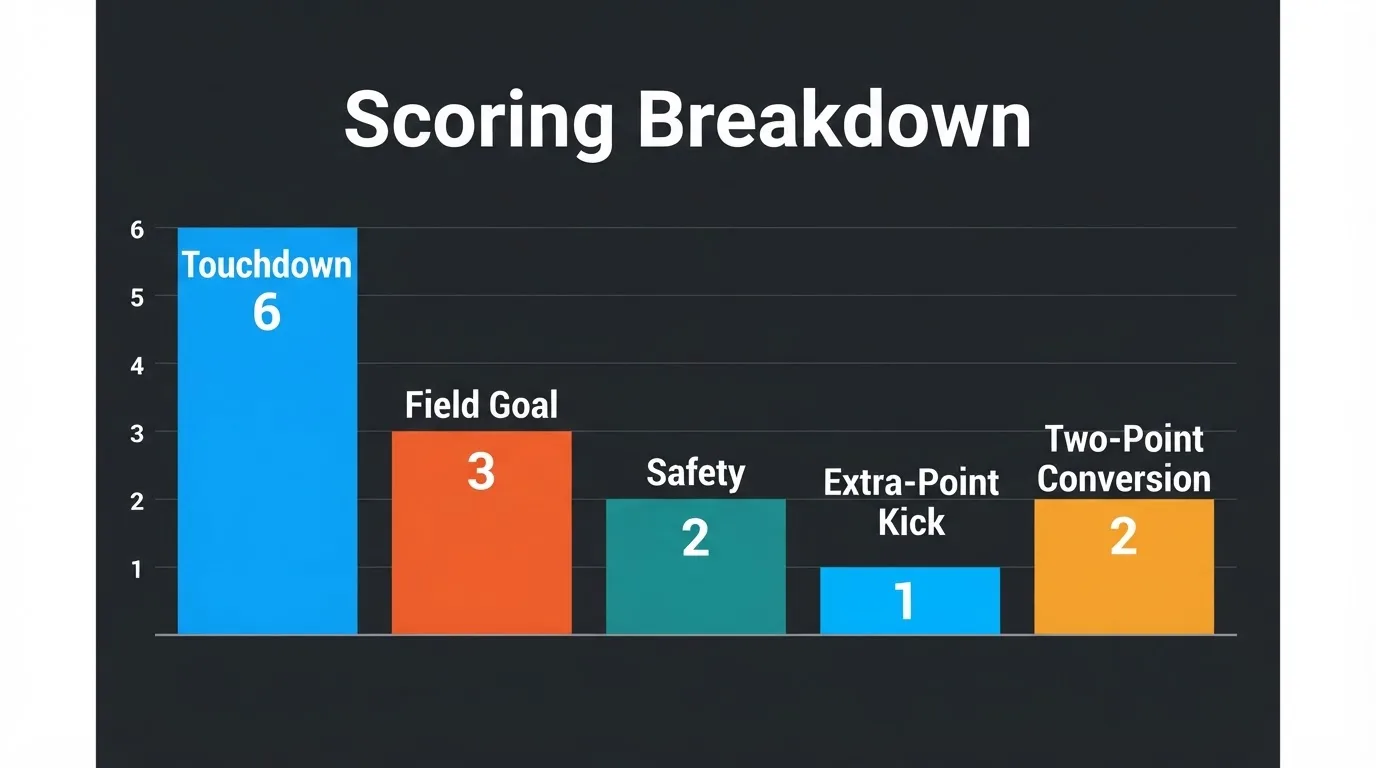
American football takes place on a 100-yard field between two teams of eleven players. A professional or college game runs for 60 minutes of action, divided into four quarters of fifteen minutes. The odds on offer track the scoring system directly, because every point is bettable: a touchdown is worth six, an extra-point kick from the seven-yard line adds one, a two-point conversion run or pass from the two-yard line adds two, a field goal adds three and a safety — awarded to the defence when it tackles an opposing ball-carrier in his own end zone — adds two to the defence.

The structure matters because totals betting works in points, not in goals. A bookmaker’s total on a game might sit at 47.5 points; a £10 over bet at 1.91 returns £19.10 if the two teams combine for 48 or more. A spread of -3.5 on the favourite means that team has to win by four points or more for a spread bet to pay; if they win by exactly three the bet is a push and the stake is returned. A push on a spread or a total that lands exactly on the quoted line returns the stake — unless a tie is offered as its own selection, in which case that selection pays instead.
The league structure is the second thing the odds track. The NFL fields 32 teams, split between the AFC and the NFC at 16 apiece. Each side plays 17 games across an 18-week regular season, and the top seven in each conference reach the single-elimination playoffs. Super Bowl LX was played on 8 February 2026 at Levi’s Stadium in Santa Clara, with the Seattle Seahawks beating the New England Patriots 29-13 and Kenneth Walker III taking the MVP award. That history is not just colour; it tells the reader that the NFL season is eight months of betting, not four, and that the bookmakers are quoting lines almost continuously from the Thursday night opener in September to the Pro Bowl in February. CFL and college football sit beside the NFL on most licensed GB bookmakers but with thinner card coverage.
The list of bet types the price is built around starts with the moneyline (which side wins, settle this game in regulation if a draw is offered), runs through the spread (handicap the favourite by a number of points), the total (over or under a combined points line), and reaches into player props (which player scores the first touchdown, how many passing yards the quarterback throws for, which receiver clears a reception count). Game props — first team to score, total touchdowns, whether the game goes to overtime — slot into the same family but with one-off payout mechanics. The bookmaker’s terms page will state how each one settles.
Where the price is quoted: the licensed bookmaker set in Great Britain
A bookmaker serving customers in Great Britain needs a Gambling Commission licence. That is true since the Gambling (Licensing and Advertising) Act 2014: the operator’s licence has to be in place wherever the operator is based, and a Curaçao, Maltese or Gibraltar licence alone is not enough. The Commission’s public register is the test of who holds one, and it can be searched by business name, trading name, domain or account number. Ten operators quoted licensed on this page, and they are: Star Sports, Bar One Racing, Fafabet, BetTom, Fitzwilliam Sports, Betfair, Unibet, Swifty Sports, bet365 and VBet. Every one of them is on the Commission’s register against a remote general betting (real events) licence.
That is the verified set. Outside it sit the brands that operate from offshore licences, sometimes .com addresses with a GB-only arm, sometimes not. They are not on the Commission’s register, do not join GAMSTOP, and a customer who opens an account with them loses the British consumer protections — dispute resolution, fund-segregation rules, the 10x bonus wagering cap and the £150 financial vulnerability check. Stating the cost is not a warning, it is a description of what gets given up. The rest of this page is about the licensed set, where the protection is in place.
| Brand | Licence holder (Commission account) | What the operator’s own terms state on the subject |
|---|---|---|
| Star Sports | Star Racing Limited (9177) | Customer support line for account opening, betting and queries; FCA-regulated spread betting and Commission-regulated fixed-odds betting |
| Bar One Racing | Bar-One Racing Limited (56516) | Irish independent bookmaker, shop network in Ireland, sponsorships at Dundalk, Fairyhouse, Navan, The Curragh, Curraheen Park and Cork |
| Fafabet | Taichi Tech Limited (57385) | Best Odds Guaranteed on UK and Irish horse racing win and each-way bets from 9am on race days |
| BetTom | Bet Tom Limited (64959) | Sports welcome offer pays back as free bet plus matching free slot funds for casino; full terms apply |
| Fitzwilliam Sports | SBKI Limited (48760) | Dublin bookmaker with capped membership, instant deposits, fast withdrawals, timeouts and deposit limits, GAMSTOP enrolment |
| Betfair | PPB Counterparty Services Limited (39439) | In-play betting, Bet Builder, free live streaming on UK and Irish racing and football, 90 Minute Payout market |
| Unibet | Platinum Gaming Limited (45322) | Operating since 1999; sports welcome offer details stated in next section |
| Swifty Sports | Swifty Global (UK) Ltd (58957) | Best Odds Guaranteed, Cash Out across horse racing and football, daily price boosts, live streaming and in-play |
| bet365 | Hillside (UK Sports) ENC (55148) | Bet Builder+ combining markets from one event pre-match and in-play, Super Boosts, Winnings Boosts, daily Bet Boosts |
| VBet | SCGO Limited (44662) | Sports welcome offer pays out as a free bet if a first, verified customer’s opening bet loses |
The table is not a ranking. The Commission register lists far more brands than ten, and the set any single reader sees on a comparison piece is shaped by the comparison’s own choices. None of these ten is “the only” licensed bookmaker in Great Britain, and a place in the column is not a statement that the brand is the strongest in its field. A spreadsheet of GB-licensed remote betting operators would run to dozens of entries, and a bookmaker that did not make this list still holds a licence if the register says so.
What the table does show, on the licensed side, is what each operator’s own terms state about the subject the page covers. Several cards combine features the reader will hear about on a daily basis — Best Odds Guaranteed means a horse racing ticket whose starting price beats the original price gets paid at the bigger number, Cash Out is the right to settle an in-play bet before the event finishes, Bet Builder is the function that lets a customer combine markets on one fixture into a single bet. Not every operator offers every function. Star Sports, for instance, runs a phone-trading service as its distinctive edge; bet365 leads on Bet Builder+ and the depth of its in-play product; Betfair’s exchange is a separate kind of platform, where customers can lay as well as back. The relevant test for any reader is which combination of features matches the kind of betting they want to do, not which operator sits highest in any single column.
Responsible gambling: what the licence obliges a bookmaker to do
The licensed set operates inside a set of consumer-protection rules that the unlicensed set is not bound by. GAMSTOP is the headline, since it is the multi-operator self-exclusion scheme that a customer signs up for once and which then applies across every licensed online operator. Periods run six months, one year, five years, or five years with auto-renewal; after the minimum period the exclusion stays in place for a further seven years unless the customer asks GAMSTOP to remove it. Betting shops use a separate service, and the same customer who has self-excluded online can still walk into a shop and place a bet unless they have separately signed up with that route.
The second protection is the financial vulnerability check, in force since 30 August 2024 under LCCP condition 3.4.4. It applies when a customer’s deposits minus withdrawals exceed £150 in a rolling 30 days, and it is a public-record check — bankruptcy, county court judgments — rather than an income check or a credit reference check. Beyond the vulnerability check sit the financial risk assessments, the so-called affordability checks of the press: announced in a staged plan from the Commission article of 7 July 2026, with no confirmed start date. Write them as “announced, staged, no start date” rather than as if they were already running.
The third layer is the deposit limit requirement under RTS 12: the operator must offer a gross deposit limit on a fixed time frame, with the first changes applied since 31 October 2025 and a second phase postponed to 30 September 2026. Whether that second phase is currently live is not established in this round. No state-set deposit or loss ceiling for betting exists; the limits a customer sees are their own choices inside the tool the operator provides. State-set ceilings belong to casino or to other product lines, not to sports betting.
For the customer betting on American football specifically, two practical steps follow. The first is to set a weekly or monthly deposit cap before the season starts, not on a week where the bills are running close — the limit takes the margin off the question. The second is to know the help routes before any bet is placed: GamCare runs the National Gambling Helpline, GambleAware provides information and self-help material, the NHS runs gambling clinics across the regions, and Gamblers Anonymous runs local support meetings. Fitzwilliam Sports is one of the licensed operators that makes those routes visible directly from its homepage.
The reader who plans to gamble on American football at licensed bookmakers in Great Britain should expect a verification step before the first deposit. Name, address and date of birth are checked before funds can be added or a bet placed, and that has been true since 7 May 2019; the check applies even when the bet is being made with a free bet or bonus. Source-of-funds questions at higher spend are normal under the money-laundering rules, not a sign that the operator is being obstructive. A bookmaker that does not verify is not licensed in Great Britain.
Bonuses and free bets: what the headline costs
The marketing word on the licensed side most often is “free bet” or “free bets”, and the audit that the language is doing is exact. A free bet is a credit whose stake is not returned with the win. So a £10 free bet at decimal odds of 3.00 does not return £30 — it returns £20, because the £10 stake is the part that does not come back. The credit itself does not cost the customer anything in the sense that they did not pay for it, but the cost of the bet in expected-value terms is real, and that cost goes into the calculation any reader does before claiming. The offers described below are reproduced from each operator’s own terms.
Unibet’s sports welcome offer reads “Get £40 in Free Bets when you bet £20”: a deposit and sports bet of £20 or more at minimum odds of 2.0 (1/1), free bets expiring within seven days of issue, for new GB customers using a debit card or instant bank transfer. The relevant facts to weigh are the qualifying minimum price and the seven-day window. A free bet on a market at minimum odds 2.0 is, on average, worth a smaller amount than a free bet on a market with no minimum price attached, because the minimum price constrains where the customer can place the credit. Seven days is short — most welcome bonus windows in sports are seven to fourteen days, and a customer who misses the window by a day loses the credit.
BetTom’s sports welcome offer is 50% back as a free bet up to £50, with a matching 50% back as free slot funds for casino play. The 50% back structure is a partial-match model, not a 100% deposit match. The relevant condition is the matching casino credit: the customer who claims the sports side of the bonus is also opted into a casino-side package. A responsible reader reads the casino terms before the sport bet is placed, because the casino release terms can carry a different wagering requirement.
VBet’s sports welcome offer is a £10 free bet if a new, verified customer stakes £10 or more on a first-ever bet that loses. That is a refund-as-free-bet structure, and the relevant facts are the minimum qualifying stake (£10), the verified-customer requirement (which is automatic under the licensing rules, but worth noting), and the loss trigger. The free bet is paid only if the first bet loses — a winning first bet forfeits the bonus even when the customer has deposited the qualifying amount.
Across all licensed operators, wagering requirements on bonuses are capped at 10x under promotion rules in force since 19 January 2026: a £10 bonus at 50x would have needed £500 of qualifying bets, and under the cap no more than £100. Whether the cap applies to free bets with no wagering condition, and any cap on the money value of a bonus, are not established in this round. Mixed-product promotions — an offer that requires gambling on two or more product types such as betting, casino, bingo and lottery — are banned under the same promotion rules. Operators are responsible for marketing by their affiliates; promo codes are not printed in this article.
The arithmetic on a free bet offers the cleanest illustration of what “free” actually means. Take the £10 free bet from VBet at decimal odds of 3.00. The expected value of the bet, before any margin adjustment, is the free-bet amount times (odds minus one) divided by odds, which gives 10 × (2 ÷ 3) = £6.67. Then apply the bookmaker’s margin on that market — say 6% on a player prop or 5% on a moneyline. The market’s payout share is 95%, so the average payout across winners and losers is £6.67 × 0.95 = £6.34. That is the average value of a £10 free bet at 3.00 over the long run. Free bets at higher odds are worth more in this calculation; free bets at lower odds are worth less. The cheapest free bet on the page is the one attached to the highest minimum price; the most generous is the unrestricted one with the longest window.
In-play betting, cash out and bet builders on American football
A live NFL game is one of the richest in-play markets a licensed bookmaker offers, and the licensed set has built three features around the live product. In-play betting means placing a bet after the event has started, with the price adjusting as the score moves and the clock winds down. Cash out is the right to settle that in-play bet before the event finishes — taking a smaller payout than the result might yield rather than letting the bet run to its conclusion. No payout guarantee exists for any betting account. Bet builder is the function that lets a customer combine several markets from one event into a single bet, with the cumulative odds reflecting the combined probability the customer has selected.
The bookmakers in the licensed set that lead on the live product are consistent about it. Betfair offers in-play betting with a 90 Minute Payout market on football (settled at 90 minutes plus stoppage time, with extra-time and penalties excluded from the result unless the market states otherwise). bet365 offers Bet Builder+ combining markets from one event pre-match and in-play, alongside Super Boosts, Winnings Boosts and daily Bet Boosts, with live streaming of events worldwide, Bet Track, Match Live and a Live Golf Tracker for following bets as they play out. Midnite’s site shows in-play events with an acca builder, popular accas and price boosts whose maximum-stake limits are stated. Swifty Sports offers Best Odds Guaranteed, Cash Out across horse racing and football, daily price boosts, live streaming and in-play, with Bet Builder listed as coming soon on the app.
In-play on American football specifically requires the reader to watch the odds through the natural breaks — the end of each quarter, the two-minute warning, the moving of the ball after a timeout — and to know that the price reacts fast enough to make short windows expensive. The bookmakers’ in-play product is built around a small margin and a fast stop-out; cash out is the bettor’s exit door, and using it costs a slice of the price.
The British reader betting on American football during the NFL window should expect a typical spread, moneyline and total points pricing to tighten around 4-6% margin, with player prop markets running higher. The same pricing on a Monday Night Football primetime game can run tighter, because the liquidity is greater and the bookmakers know more about who is on the field. Reading the margin on a specific game matters more than reading the headline odds.
Betting tips, predictions and the limits of what any tipster can know
“American football betting tips” is a phrase the reader is going to see before they have read anything else on this page, and it earns its place in this discussion precisely because the cost of taking a tip at face value is rarely named. A betting tip is somebody’s forecast of which side is going to win, or which player is going to clear a market, or which game is going to go over a total points line. The forecast is either right or wrong, and it is right about as often as the price would have predicted, give or take. A tipster selling “winning” picks is selling a service whose track record — verifiable through independent records — is the only thing that matters, and even an honest track record does not mean the next pick lands.
The market is more efficient than the headline suggests. Bookmakers paying sharp odds on NFL, CFL and college games do so because professional syndicates are also betting those markets, and where the professionals place their money tends to move the line. The bookmaker’s margin is what sits between a real price and a fair price, and a tip that takes the price at face value is a tip that bakes the margin in. A tip that adds value has to identify a *price discrepancy* — a market where the bookmaker has mispriced the line — and those are rare, thin, and vanish fast.
What a tip-based approach is statistically likely to produce, for a customer with no edge and no information beyond the headline, is a slow loss at the rate of the bookmaker’s margin on each market bet. The right reaction is to read the odds, not the tip, because the odds incorporate the tipsters’ view plus the bookmaker’s slice. A educated reader uses tip content for information rather than instruction — they read the analysis to know which factors a sophisticated bettor is weighing, but they make their own judgement based on the price that is available to them, at the time they are placing the bet.
Realistic bankerroll tactics do not include “betting tips today” services. They include staking plans (level stakes across each bet, rather than chasing losses with bigger stakes after a run), bankroll separation (the betting budget sits in a separate account with a fixed deposit cap), market selection (betting on the markets where the margin is tightest and the analysis is most informed), and a written record of every bet. The cost the reader pays is in time and effort, and the saving it makes is in the margin they stop handing to the bookmaker.
Bet types and odds explained — moneyline, spread, total, props
The four families of American football bet cover almost everything the licensed bookmakers offer. The moneyline is the simplest: a bet on which side wins. The decimal price reflects the implied probability of that side winning; the favourite pays less, the underdog pays more. The spread handicaps the favourite by a number of points, and the bet is won by covering the spread; a push on the spread returns the stake. The total is over or under a combined points line, settled on the points both teams score in regulation (extra time rules vary by operator and should be checked in the bookmaker’s house rules). The props are the player-specific and game-specific derivatives.
The spread is the most actively traded market on an NFL game in Great Britain, and the line is usually 3 to 7 points on a game with two competitive sides. A team priced at -3.5 has to win by four or more. A team priced at +3.5 can lose by up to three and still cover. Total points lines on NFL games typically sit between 40 and 55, with the primetime games tending to sit higher because both sides throw more. Player props vary widely — first touchdown scorer, anytime touchdown scorer, total passing yards, total rushing yards, total receptions — and the margin on each one runs higher than the margin on the spread or moneyline.
The 90-minute-payout market on Betfair is a football-specific market that is unrelated to American football’s clock: it refers to a 90-minute match on a soccer field. For American football the equivalent is the full-game moneyline, which typically settles after the conclusion of regulation plus overtime, unless the operator’s house rules state otherwise. Each licensed bookmaker publishes its house rules for American football on its help pages, and the reader should know the line the bookmaker applies to a push, an overtime result, a game that ends early and a player prop market whose named player does not play.
The combination bets — the multiples and accumulators — multiply the price of each leg into one. A four-fold at single-leg margins of 5% keeps 1 − (0.95)^4 = 18.55% as bookmaker margin across the four legs, irrespective of the order the legs are won in. A six-fold at the same per-leg margin keeps 26.59%. A ten-fold at the same per-leg margin keeps 40.13%. The compound effect of margin across accumulator legs is the most important cost a reader of this page will pay, and it is also the least visible one, because it is hidden in the price of the cumulative ticket.
Sports and tournaments — what is on the calendar
American football betting in Great Britain is dominated by the NFL season. The schedule begins in early September with the regular-season opener, runs 18 weeks across Thursday, Sunday and Monday Night Football primetime games, and ends with the Super Bowl in February. The NFL playoffs add four rounds of single-elimination games: wildcard, divisional, conference championships, and the Super Bowl. Twelve teams play beyond the regular season — six per conference — with the seventh seed in each conference added in the post-2020 expansion.
Beside the NFL, the licensed bookmakers offer the CFL (Canadian Football League, running from June to November), the XFL and USFL spring leagues, and college football (the NCAA and the four FBS conferences). College football is lower-priority for many bookmakers, with thinner card coverage and wider margins on the player props; the headline games — the College Football Playoff at the end of the season — do attract proper markets.
The tournament calendar for the reader in Great Britain runs:
- September to early January: NFL regular season, 17 games per team.
- Mid-January: NFL playoffs, four rounds.
- Early February: Super Bowl, single game with the largest betting turnover of the year on American football anywhere in the world.
- February: Pro Bowl, all-star exhibition with light markets.
- June to November: CFL season, with the Grey Cup in late November.
- August to January: NCAA college football season, with the College Football Playoff in late December and early January.
The reader who only bets the Super Bowl has one window of the year to work with, and they will be paying 8-12% margin on most markets in that window because the bookmakers are paying closer attention. The reader who bets the regular season has 18 weeks of primetime games and Saturday/Monday alternatives, and the margin on those games tends to be tighter.
Bookmakers run the Super Bowl with the same product set as the regular season — moneyline, spread, total, player props, game props — but with significantly more promotion and a much heavier turnover. The reader with a budget for the Super Bowl should plan that budget as one unit, not as a series of small bets, because the cost on each smaller bet is a slice of margin the bookmakers collect whether the bet wins or loses.
Responsible gambling and player protection
The licensed bookmakers — every one of the ten in the table above — run inside the same consumer-protection framework. GAMSTOP enrolment is mandatory for online operators and a customer who has self-excluded cannot deposit, bet or claim a bonus until the exclusion period ends. The financial vulnerability check applies at the £150 net-deposit threshold; operators can run higher check thresholds of their own, and some do, but the £150 figure is the floor under which no licensed operator can run an automatic public-record check on every customer.
The help routes are independent of the bookmaker. GamCare runs the National Gambling Helpline on 0808 8020 133 (lines open 24 hours), GambleAware provides information and self-help material online, the NHS runs gambling clinics in regions across Great Britain (referral through a GP or self-referral through the NHS website), and Gamblers Anonymous runs local support meetings. The Commission’s own role is regulatory — it does not counsel individual customers.
The line between the licensed and unlicensed set is, in strict legal terms, between a Commission-licensed operator and one that is not. Providing gambling facilities in Great Britain without the licence the Act requires is an offence under section 33 of the Gambling Act 2005, with penalties aimed at the operator — up to 51 weeks’ imprisonment, a fine up to level 5, or both on summary conviction (six months in Scotland). The customer who merely bets on an unlicensed site commits no offence under that section, but loses the British consumer protections: no GAMSTOP coverage, no Commission complaints route, no approved dispute-resolution body, no British consumer redress if funds are withheld, not bound by the 10x bonus wagering cap or the £150 vulnerability check.
The honest framing is this: licensed = checks, limits, GAMSTOP and bonus cap, with the trade-off that verification runs before the first bet; unlicensed = none of those protections, with the trade-off that some unlicensed sites do not run an identity check. Neither is “the safe choice” by default. The trade-off is the consumer’s to make.
Legality and enforcement in Great Britain
The Gambling Commission licences the entire commercial market in Great Britain, with the framework set out in the Gambling Act 2005 and modified most recently by the Gambling (Licensing and Advertising) Act 2014, which extended the licensing requirement to operators based outside Great Britain as long as their remote facilities are used in Great Britain. There is no state monopoly and no cap on the number of licences.
Several licence categories exist for remote betting: remote general betting standard (real events), remote general betting standard (virtual events), remote general betting limited, remote pool betting, and remote betting intermediary (the licence for betting exchanges). The ten operators in the table above all hold remote general betting standard (real events) licences; Betfair’s exchange runs under a betting intermediary licence beside it. The Commission register can be searched by business name, trading name, domain or account number.
Tax on the player: betting winnings in Great Britain are not taxed on the customer side, and that is general information rather than tax advice — a professional gambler should ask HMRC or an adviser. The operator pays General Betting Duty on gross profits at 15%, with a new remote betting rate of 25% applying from 1 April 2027 within it, while remote bets on UK horse racing, bets on self-self-service betting terminals in licensed premises, pool betting and in-person betting stay at 15%. Spread betting has its own rates (3% financial, 10% other). Whether operators pass duty on through odds is not established, and the audit does not conclude that the player is charged duty.
Advertising is not licensed by the Commission; it runs through the CAP Code (non-broadcast) and BCAP Code (broadcast), enforced by the ASA, alongside the LCCP marketing conditions. CAP Code section 16 governs much of what the reader sees on screen: marketing must be socially responsible, must not be of strong appeal to under-18s, and no one who is or seems to be under 25 may be featured gambling or play a significant role in marketing, with an exception for marketing placed where a bet can be made directly. That rule concerns who may appear in the advertisement, not who may bet. “Whistle-to-whistle” — betting advertisements not shown on TV from five minutes before a live sporting event to five minutes after it, before the 9pm watershed — is an industry code rather than law and has been in place since 1 August 2019, with horse and greyhound racing excluded. The Premier League clubs’ withdrawal of gambling sponsorship from the front of matchday shirts from 2026/27 is voluntary, not law.
Enforcement against unlicensed operators runs through cease-and-desist notices, search-engine referrals, work with registrars, hosts and payment providers, and the Commission has been given, or is about to receive, court-order DNS blocking powers — though the audit does not write that ISP blocking is currently in operation.
How the licensed bookmakers stack up
A ranking of operators by any single metric (margin on a specific game, breadth of player props, fastest payouts) would distort the comparison. The honest reading of the table at the top of this page is that each operator has a distinctive angle, and the right choice depends on what the reader is betting and how.
Star Sports runs a phone-trading service that is unusual for an online bookmaker — a customer can call 08000 521 321 to open an account, place a bet or ask a customer query, and the same trader might pick up to handle a complex bet the website does not list. The distinct value of the brand is service-led account management on bets that mainstream sites would not price.
Bar One Racing is an Irish independent bookmaker with shops across Ireland and horse racing sponsorships at Dundalk, Fairyhouse, Navan, The Curragh, Curraheen Park and Cork. The angle for a UK-based reader is the shop-floor edge on Irish racing — if a customer reads Irish form, the brand’s market depth on Dundalk and Cork meetings may be a reason to keep an account open.
Fafabet pays Best Odds Guaranteed on UK and Irish horse racing win and each-way bets from 9am on race days, with the starting price beating the original price refunded at the bigger number. The angle is racing-led.
BetTom’s sports welcome offer is 50% back as a free bet of up to £50, with a matching 50% back as free slot funds for casino. The angle is the dual welcome package, and the audit notes that the casino terms are the part to read before claiming.
Fitzwilliam Sports describes itself as a Dublin bookmaker with capped membership, instant deposits, fast withdrawals, timeouts and deposit limits, and links to GambleAware, GamStop and Gamblers Anonymous on its homepage. The angle is the visible safer-gambling infrastructure — useful for a customer who wants to see the controls on the home page rather than have to dig for them.
Betfair’s angle is the betting exchange alongside the sportsbook, with in-play betting, Bet Builder, free live streaming on UK and Irish racing and football, and a 90 Minute Payout market. The exchange lets a customer lay as well as back, which is the structural feature the sportsbook side does not have. For a customer who wants to back and lay on American football, Betfair is the only operator in this set offering that combination.
Unibet has operated since 1999, and its UK site is run by Platinum Gaming Limited in Gibraltar under Gambling Commission account 45322. The sports welcome offer — £40 in Free Bets when you bet £20 at minimum odds of 2.0, free bets expiring within seven days — is the headline. The angle is scale.
Swifty Sports offers Best Odds Guaranteed, Cash Out across horse racing and football, daily price boosts, live streaming, in-play betting, with Bet Builder listed as coming soon. The angle is the live product and the breadth of the racing offer.
bet365 is the official global betting partner of the UEFA Champions League and its app is the most downloaded sports betting app in the UK, with Bet Builder+ combining markets from one event pre-match and in-play, Super Boosts, Winnings Boosts on Bet Builders and selected singles, daily Bet Boosts, and live streaming of events worldwide alongside Bet Track, Match Live and a Live Golf Tracker. The angle is the volume of the product on a per-fixture basis and the depth of the in-play product.
VBet runs a sports welcome offer in the form of a £10 free bet if a new, verified customer’s first-ever bet of £10 or more loses. The angle is the small, simple refund-as-free-bet structure.
The right bookmaker for a customer looking for a competitive spread line on NFL primetime games is bet365 or Betfair; for racing the right bookmaker is a Best Odds Guaranteed operator (William Hill, Fafabet, Swifty); for player prop depth the right bookmaker is bet365; for the betting exchange on an NFL side the right bookmaker is Betfair; for a phone-led account, Star Sports; for a Dublin-racing focus with visible safer-gambling controls, Fitzwilliam Sports. The choices compound — the reader with a small budget and a Primetime NFL focus will end up at bet365 or Betfair; the reader with a racing focus and a feature phone for older relatives in Ireland will end up at Bar One Racing; the reader who bets across the NFL, CFL and college football and cares most about price needs a price-comparison tool the operators do not provide.
The leading bookmakers on American football, ranked by what they offer
Rankings are useful only when the criterion is stated, and this one is sorted by what the licensed set does on NFL, CFL and college football across the four product axes the relevant customer cares about: margin tightness on the spread/moneyline, depth of player props, in-play product and live streaming, and the standing of the welcome offer against the wagering requirements.
1. bet365 — strongest product on the page across every axis. The Bet Builder+ feature is the most functional multi-market builder in the licensed set, and the in-play product — Super Boosts, Winnings Boosts, daily Bet Boosts — runs alongside live streaming on a scale no other operator matches. The downloaded-app base reflects the product depth. The cost of being the leader is that the welcome offer is small relative to the user count: the customer who joins specifically for the welcome is paying a premium for the product they already intended to use.
2. Betfair — the only operator in this set offering both a sportsbook and a betting exchange. The exchange is the place for laying bets the customer does not want to back, and the sportsbook side covers in-play, Bet Builder, free live streaming on UK and Irish racing and football, and a 90 Minute Payout market. The cost is the exchange commission on net winnings, paid on top of the bookmaker’s margin on each market the customer trades.
3. Unibet — operating since 1999, the brand carries weight. The £40-in-Free-Bets welcome at minimum odds 2.0 is the largest of the headline offers in the licensed set, and the seven-day window on the free bets is a constraint. The product set covers American football properly across the season, with in-play and Bet Builder on the bigger games.
4. Swifty Sports — Best Odds Guaranteed on racing, Cash Out across horse racing and football, daily price boosts, live streaming, in-play, Bet Builder coming soon. The racing-led operator has a strong live product, with a sportsbook that is competitive but not best in class.
5. Star Sports — the phone-trading service is the distinct edge. A customer with a complex bet that mainstream sites do not list — a position on an NFL prop, a staking plan, an exotic combination — can pick up the phone and talk to a trader. The product on the website is functional rather than market-leading.
6. VBet — the £10 free bet refund-as-free-bet on the first losing bet. The brand is smaller and the welcome offer is the clearest part of the proposition.
7. Fafabet — Best Odds Guaranteed on UK and Irish horse racing win and each-way bets from 9am. The American football product is adequate rather than market-leading, and the racing offer is the reason a customer opens the account.
8. Fitzwilliam Sports — capped membership, instant deposits, fast withdrawals, timeouts and deposit limits, visible safer-gambling infrastructure. The angle is the controls.
9. Bar One Racing — Irish independent bookmaker, shop network in Ireland, sponsorships at Dundalk, Fairyhouse, Navan, The Curragh, Curraheen Park and Cork. The angle is racing-led with an Irish shop edge.
10. BetTom — the matching casino welcome offer is the distinguishing feature. A customer who reads the terms of both halves will not be surprised by what they have claimed.
The ranking is one reader’s view of the licensed set on the four axes that matter for American football. The Commission register lists more brands than ten, and a customer whose priority is a different axis — fastest withdrawals, smallest bet size, deepest racing — would rank the operators differently.
Frequently asked questions
How does a bet on American football pay out?
The decimal odds multiplied by the stake gives the total return if the bet wins, and the difference between that return and the stake is the profit. So £10 at decimal odds of 2.50 returns £25 if the bet lands, of which £15 is profit. The stake is what the customer risks; the return is what the customer receives back into their account on settlement. The same formula applies to a single bet on the spread, the moneyline, the total or a player prop, and to a combination bet whose single price multiplies the prices of each leg together.
What does “American football betting” actually mean?
It means placing a fixed-odds bet on a real American football event — an NFL, CFL or NCAA game — through a licensed bookmaker in Great Britain. The licensed bookmakers quote moneyline (which side wins), spread (which side covers the handicap), total (over or under the combined points line) and a wide range of player and game prop markets, with in-play betting available on the same markets once the game has started. A bet is a contract between the customer and the bookmaker, and it settles on the result the bookmaker’s house rules define for that market.
Where does the best price on American football come from?
The price changes from bookmaker to bookmaker and from market to market, and no single operator is the best on every fixture. The general rule is that bet365 and Betfair quote among the tightest margins on the spread and moneyline on NFL primetime games; the player prop markets vary more widely and are best checked on each bookmaker individually. Price-comparison tools are not run by any single operator and a useful comparison is one the customer does manually before placing a bet.
How do I check that a bookmaker holds a Gambling Commission licence?
The Commission’s public register can be searched by business name, trading name, domain or account number, and the register is the whole test of whether a brand holds a GB licence. The search returns the licence holder, the licence number, the categories of the licence and the trading names the licence covers. A bookmaker whose name does not appear on the register after a search by domain is not GB-licensed. The check is free and takes less than a minute.
How do you work out the bookmaker’s margin from the odds?
Take the decimal odds for each outcome, take the implied probability of each one (1 ÷ odds), and add the implied probabilities together. Subtract 100% from the sum. The remainder is the bookmaker’s overround: for example a two-way moneyline at 1.91 / 1.91 implies 52.36% on each side, summing to 104.72%, so the overround is 4.72%. The margin tells the reader what slice of every pound staked the bookmaker keeps on that market, regardless of which outcome wins.
Can I claim a free bet on a bonus with a minimum price attached?
A free bet whose operator’s terms require it to be placed at minimum odds is a constraint on where it can be used, and the constraint reduces the free bet’s expected value because the customer cannot place it on the highest-return markets. The constraint is set by the bookmaker, and the calculation on a £10 free bet at 3.00 with a 6% market margin gives an average value of around £6.34 — that figure is lower when the minimum price restricts the choice of market. The minimum price is on the bookmaker’s terms page, and reading it before claiming the bonus is the responsible step.
US & other team sports – Best betting exchange
Content created by the «Best betting exchange» team
