
Greyhound Racing Betting Tips: What a Tip Is, What It Costs, and What the Bookie Keeps
 Available in US
*Verified against the Gambling Commission’s public register on 27 October 2026.*
Anyone searching for greyhound racing tips wants a name and a price. A guide that hands them out is doing them a quiet disservice: no published form table can name a winner with the certainty a stake implies, and the price printed next to a dog already carries the bookmaker’s margin inside it. What a tip actually is, what it costs to act on, and what the bookmaker keeps from every pound staked — that is the territory this page covers. Greyhound betting sits in a small, well-regulated corner of the British market, with the Greyhound Board of Great Britain overseeing 18 licensed stadia and the Gambling Commission licensing every operator that takes a bet from inside Great Britain. Ten of those operators are reviewed below, alongside the maths a bettor needs to read a price before paying it.
Safer Gambling: The Floor Beneath Every Bet
A page on greyhound betting tips that opens on staking plans before it opens on safety has the priorities wrong. The British regulatory frame is built so that every licensed operator joins GAMSTOP, runs age and identity checks before the first deposit, and offers tools that put a ceiling on what a customer can lose in a given window. Reading those tools is part of betting well, not separate from it.
The licensed operators reviewed on this page all offer the standard set: deposit limits, time-out, product restrictions, and self-exclusion. GAMSTOP covers every online bookmaker licensed by the Gambling Commission, with exclusion periods of six months, one year, five years, or five years with auto-renewal; after the minimum period the exclusion stays in place for a further seven years unless the customer asks GAMSTOP to remove it. Unibet, for instance, links to BeGambleAware, GamCare, GAMSTOP, Gambling Therapy and the Betting and Gaming Council from its safer-gambling page, alongside deposit limits, a player-profile test and product restrictions. That is the shape the floor takes at a major operator; the floor exists at smaller shops too, because it is a licence condition rather than a marketing choice.

A financial vulnerability check has applied since 30 August 2024 and is enforced from 28 February 2025: once a customer’s deposits minus withdrawals cross £150 in a rolling 30-day window, the operator runs a public-record check (bankruptcy, county court judgments), not a credit-reference search and not an income check. A separate, more intrusive financial risk assessment has been announced in stages, with no start date set. Deposit-limit rules under RTS 12 have applied in their first phase since 31 October 2025; a second phase was postponed to 30 September 2026, and whether it is in force is not established. What matters for the bettor: deposit limits are the customer’s own choice — there is no state-set loss ceiling — and the licence conditions ensure the operator offers them at all.
Help exists outside the operator. GamCare runs the National Gambling Helpline; GambleAware funds treatment; NHS gambling clinics operate in several regions; Gamblers Anonymous runs meetings across the country. Two facts hold whether a bettor uses a major operator or a small one: the minimum age is 18 across the British market, and identity is verified before the first deposit, so anonymous play is not available at any licensed site. That second point sits oddly with the searcher who wants discretion, but it is the price of every protection that follows it.
A greyhound betting guide that does not name those protections leaves the reader with a tip and no floor. The protection regime is not a footnote to greyhound betting — it is the reason a British-licensed bookmaker can be approached at all.
Bonuses and Free Bets: The Marketing Word and the Maths Behind It
Greyhound betting offers are the kind of thing that looks like free money on a Saturday morning and looks like another kind of thing on a Sunday evening, when the wagering has not quite cleared. The British market tightened the screws on 19 January 2026: wagering requirements on bonuses are capped at 10x, and mixed-product promotions — an offer that ties betting on one sport to free spins on a slot, for example — are banned. A £10 bonus at 50x wagering used to require £500 of qualifying bets; under the cap no more than £100.

Each operator names its offer in its own terms, and the offers are not interchangeable. BetTom’s sports welcome offer is 50% back as a free bet up to £50, with a matching 50% back up to £50 as free slot funds for casino play. Unibet’s sports welcome offer is “Get £40 in Free Bets when you bet £20”: a deposit and sports bet of £20 or more at minimum odds of 2.0 (1/1), with free bets expiring within 7 days of issue, for new GB customers using a debit card or instant bank transfer. Two operators, two structures, two deadlines, and a different expiry window for the credit itself. The “free” word does the same work in both, but the offer type — free bet versus cashback versus enhanced odds — changes what the maths actually costs the customer.
A free bet whose stake is not paid back on a win is the typical shape. Value = free-bet amount × (odds − 1) ÷ odds × payout share of the market. The stake is what the operator gave you; the return is what you can keep. That is the average value across many bets at the same market margin — a single bet at long odds might pay well above it, a single bet at short odds might pay well below. Crucially, the wagering on a free bet is usually zero under the new cap when the offer is structured as a free bet, but the underlying terms (eligible markets, minimum odds, expiry) still cut the average down.
A “risk-free” bet that refunds a losing stake as a free bet is not a refund in cash. The word “refund” is doing the marketing work; the offer type is a free bet, with the same expiry and the same stake-not-returned rule as every other free bet the operator runs. That distinction has been a sore point for years, and it remains worth reading twice in the small print: a free bet is a free bet, and its stake disappears on a win.
Best Odds Guaranteed (BOG) is a separate mechanism, not a bonus. BetGoodwin pays Best Odds Guaranteed on all UK and Irish horse and greyhound racing up to £1,000; Fafabet pays it on UK and Irish horse racing win and each-way bets from 9am on race days, with the bigger of the original price and the starting price paid if the starting price is larger. Greyhound racing sits inside BOG at some operators and outside at others — the operator’s own terms settle it. BOG is the kind of concession that quietly returns several percent of a racing book over a season, and it costs the customer nothing if they would have placed the bet anyway.
A greyhound offer is a simple trade with a lot of detail attached: a headline number on the sign-up page, a turnover requirement capped at 10x, an expiry window, market restrictions, and a settlement rule that returns the winnings but not the stake. Read those details before claiming. Understanding the arithmetic — required turnover, number of bets, and the market margin — is how a punter separates a good offer from a poor one.
Mobile and App: The Handset as Betting Slip
A greyhound betting app is, for most customers, the entire product. The GB App Store listing for each of the reviewed operators describes a sportsbook first and a casino second, with greyhounds inside the sportsbook rather than in its own tab. Betfred’s app pairs Bet Builder with Racing Post data, Extra Places, live casino and bingo; London.bet’s app combines sports — football, tennis, horse racing, greyhounds, darts, golf, cricket, NFL, NBA, MLB, snooker — with Pragmatic Play casino slots and live in-play betting. 888sport adds Cash Out, Bet Builder, racing streams, BetFinder form tools, a live bet feed and daily boosted odds. Midnite’s site shows in-play events, an acca builder, popular accas and price boosts with maximum-stake limits named.
A few practical notes on the apps themselves. Lottoland’s app combines casino, lottery betting, sports betting and scratchcards, and is licensed by the Gambling Commission for customers in Great Britain. London.bet is published by Thistle Bet Limited and has a 17+ App Store age rating. BetWright states it is licensed in the UK, provides responsible gaming tools, and requires customers to be aged 18 or over. The age rating is a friction layer the App Store applies; the licence is the live floor the Commission enforces. An app can be 17+ and still require 18+ at the operator — the two figures describe different gates.
Live odds in real time are the practical test of an app on a race night. Midnite’s site shows the in-play events with named price boosts; Betfred’s app layers Racing Post data on top of the form study; 888sport’s live bet feed is the closest the reviewed set comes to a dedicated live ticker. None of these is a free lunch: live odds carry the bookmaker’s margin, refresh on a delay, and may pull mid-race if the operator’s risk team moves the line. An app is faster than a browser tab and not faster than the operator’s own suspension of the market.
Live Betting, Cash Out and the In-Play Market
Live greyhound betting is offered across the reviewed set; the in-play menu at any of them on a race night is the closest thing the market has to its centre of gravity. Midnite’s site lists in-play events alongside the pre-match board; 888sport pairs in-play betting with Cash Out and a live bet feed; Betfred layers Bet Builder and Sub Switch on top of the in-play card. London.bet runs live in-play alongside its casino product. The shape of in-play greyhound betting is shorter than in-play football: races run inside seconds rather than minutes, and the in-play market is the pre-race market with a thinner liquidity pool and the same margin baked in.
Cash Out is a feature, not a market. The operator offers to settle the bet before the race finishes, at a price the operator itself sets. That price is below the fair value of the bet at that moment — the gap is the operator’s cut for closing the position early. Cash Out makes sense when the in-running picture has changed against the back of the bet and the punter wants to cut the loss; it makes less sense as a default behaviour, because the operator’s price for closing is worse than the price the same bet would clear at on the exchange (where one exists) or in the settling next.
In-play controls are operator-led under their licence conditions and customer-protection duties, not a free-for-all. The Commission has not declared in-play “unrestricted” as a legal conclusion, and greyhound in-play sits inside the same social responsibility code as every other in-play market. A bookmaker may suspend a market mid-race; a bookmaker may restrict a customer’s stake; the punter has the standard safer-gambling tools whichever market they bet on.
A live greyhound race, viewed through the app, is short. By the time the punter has confirmed the bet, the race may already be over. Most operators lock in-play greyhound markets a beat or two before the boxes open, and the prices move on a single corridor from the off. Betting in-play on greyhounds is closer to betting on the next pitch in baseball than to betting on a tennis game: the window is narrow, the price moves fast, and the bookmaker’s margin is the same throughout.
Predictions and Strategy: What a Tip Actually Is
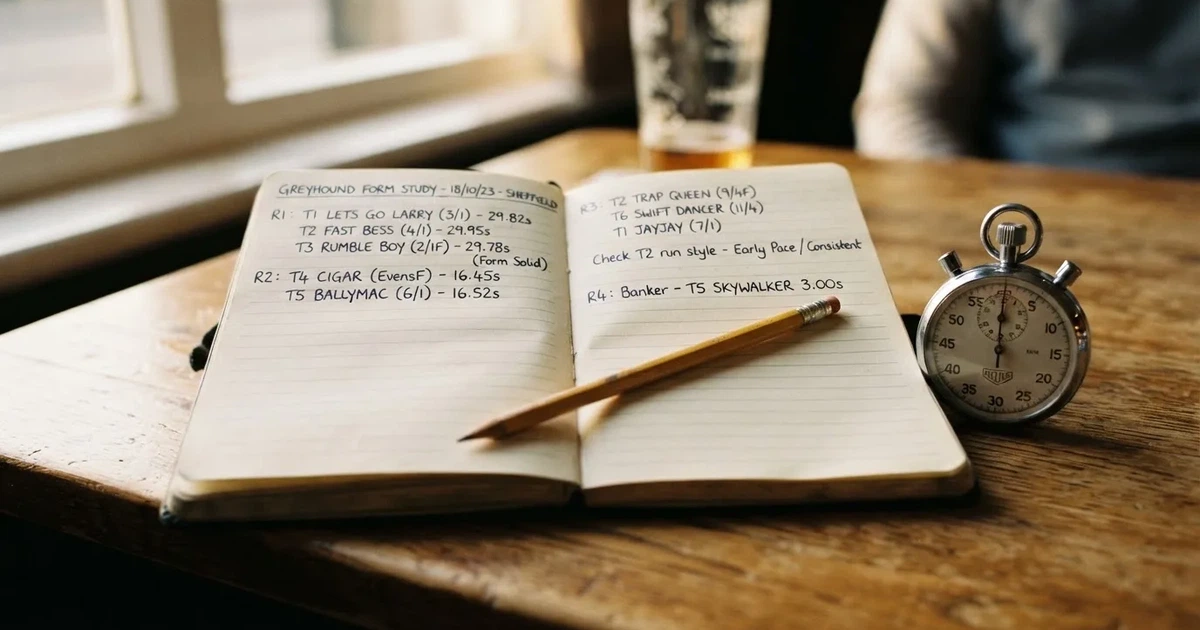
A greyhound racing betting tip is a prediction with a price attached. The prediction part is the easy bit: form study, sectional times, the draw, the trainer’s record at the track, the kennel form, the going, the grade, the running style of the dog against the field. The price part is what makes the prediction worth acting on. A tip on a 2/1 shot is not the same shape as a tip on an Evens favourite; the same prediction on each, staked the same way, returns a different amount for a different reason.
The vocabulary of tipping carries weight that is not always earned. “Value bet” is the technical term for a price above the true probability once the bookmaker’s margin has been stripped out. If a dog has a 50% chance of winning a six-dog race and the market has it at 2.10 (about 11/10), the price implies 47.6%; the tip is on a value bet if the punter’s own model puts the dog’s chance at more than 47.6%. A “banker” is a strong-favourite tip; “each-way” is a stake split between the win and the place; “acca” is an accumulator across several races. The terms are useful only when they map onto the price.
Greyhound betting systems promise an edge through staking patterns: level stakes, the Kelly criterion, percentage staking, Martingale progressions. None of them changes the underlying probabilities of the race. A staking system changes the shape of the bankroll over a losing run; it does not turn a 40% shot into a 60% shot. The honest edge in greyhound betting comes from form study that is more accurate than the market’s, and the honest staking plan is the one that keeps the punter in the game long enough for that edge to express itself. No system wins; no model wins every race; no form study names a winner with certainty.
What the market gives a tipster is a number for every dog. The bookmaker’s margin is the difference between that number and the true probability, and the gap is the bookmaker’s edge across every bet placed. A value bet is one where the punter’s edge is bigger than the bookmaker’s, on that single race, at that single price. Most races, the gap goes the other way. A bankroll discipline — a fixed unit stake, a stop-loss, a session cap — is the difference between a tipster who lasts a season and one who quits after three bad Saturdays.
The honest answer to “how do I win at greyhound betting” is that nobody can promise that, and a tip sheet that names a dog for tomorrow’s card is offering an opinion, not a result. What a tipster can offer is a model, a record, a price discipline and a staking plan. The reader’s job is to read each before paying for any of them.
Bet Types and Odds: The Vocabulary of a Greyhound Card
A greyhound race card runs six dogs across a range of distances at a range of grades. The bet types are the standard British set, with a couple of wrinkles. Single bet on one dog to win. Each-way bet split between the win and the place, doubling the stake; place terms vary by race and operator (typically a quarter of the win odds for three or four places, a fifth for five or more). Accumulator (acca) across multiple races, with each leg multiplying into the next: two dogs at 3.00 and 4.00 combine to 12.00; a four-fold accumulator of 3.00 legs combines to 81.00. Forecast and tricast bets name the first two or three dogs in order, with the dividend set by the on-course pool rather than the bookmaker’s fixed price.
Starting prices (SP) apply to horse and greyhound racing: the odds on an entry in the on-course fixed-odds market when the race begins. BOG pays the bigger of the original price and the SP if the SP is larger. Ante-post betting is the market in advance of the final declarations: the price is bigger because the dog might not run, and a non-runner voids the bet under standard rules. Rule 4 deductions apply when a dog is withdrawn from a race after the book has been formed, with the deduction proportional to the withdrawn dog’s odds.
Spread betting on greyhound races is a separate product, run by firms regulated by the FCA for the financial side and by the Gambling Commission for the fixed-odds side. Spreadex, which is regulated by both, states that spread betting losses can exceed deposits — a critical caveat, because a spread bet is a bet on a range (the winner’s winning distance, the number of lengths between first and last, the time of the race), and a range can move further than the deposit. The arithmetic is not the same as a fixed-odds bet; the risk profile is not the same either.
A bet calculator takes the stake and the odds and returns the figures. For a single bet: return = stake × odds; net profit = stake × (odds − 1). For an accumulator: return = stake × (odds₁ × odds₂ × … × oddsₙ), with the price multiplying across the legs. For an each-way: return = (stake/2 × win odds) + (stake/2 × place odds). The maths is the maths; what changes is the price the punter pays it at.
The bookmaker’s margin is the cut taken from every market. Take an even-money two-way market at 1.90 / 1.90 (about 9/10 each side). The payout share = 1 ÷ (1/1.90 + 1/1.90) = 1 ÷ (0.5263 + 0.5263) = 1 ÷ 1.0526 = 95.0%. The margin is 1 − 0.950 = 5.0%. That is the bookmaker’s edge across every pound bet on that market. Greyhound racing markets tend to run tighter than that on the win market for major meetings, and looser on exotic markets like forecasts and tricasts. The margin is a band, not a single number; what it means for the tipster is that the price on the card is the price to beat, with the bookmaker’s edge already inside it.
Sports and Tournaments: The British Greyhound Calendar
Greyhound racing in Great Britain runs year-round at 18 licensed stadia under the Greyhound Board of Great Britain (GBGB). The classic meetings sit at the top of the calendar: the English Greyhound Derby, the Scottish Greyhound Derby, the Golden Jacket at Crayford, the Ladbrokes Gold Cup at Monmore, the RPGTV St Leger at Wimbledon, and the bet365 Challenge Cup at Owlerton. Each is supported by graded racing at tracks across England, Scotland and Wales, with the GBGB keeping the welfare and integrity rules that govern every race.
The mechanical lure runs along a rail ahead of the dogs, and races are typically six-dog affairs over distances from 250 to 700 metres. The standard bet types above apply; the on-course product is parimutuel or fixed-odds bookmaker, with bookmaker betting dominant online. The sport has a smaller public profile than horse racing, which is reflected in market depth and in the size of the racing sections of each operator’s app.
Greyhound racing in New Zealand has ended. The Racing Industry (Closure of Greyhound Racing Industry) Amendment Act 2026 was passed on 2 April 2026, with the phase-out set for 1 August 2026. Winston Peters announced on 10 December 2024 that greyhound racing in New Zealand would be banned and phased out by 2026. Before the ban, Greyhound Racing New Zealand (GRNZ) organised seven affiliated clubs: Auckland, Waikato, Whanganui, Palmerston North, Otago, Canterbury and Southland. The sport remains active in Great Britain, Ireland and Australia under each country’s own regulator.
A British punter looking at the greyhound calendar in 2026 has the GBGB stadia and the major meetings as the centre of gravity. The major operators run a card every night the tracks run; the smaller operators concentrate trades in the bigger meetings. The punter’s choice of operator is shaped less by the meeting on and more by the price offered, the BOG coverage and the in-play product.
Top 10 Greyhound Betting Sites: The Comparison
The table below ranks the ten reviewed operators by the practical features a greyhound punter actually uses: licence status, BOG coverage and any product feature named in the operator’s own terms that affects greyhound betting. The operator set and order come from the Gambling Commission’s public register; no more, no less. Several of the listed brands can run under a single licensee, and the operator’s own terms page is the place to confirm the offer type before claiming it.
What the comparison shows
| Brand | Gambling Commission remote licence number and licence holder | What the operator’s own terms state on greyhound betting and offers |
|---|---|---|
| BetGoodwin | 002927-R-327985-008, Goodwin Racing Limited | Best Odds Guaranteed on all UK and Irish horse and greyhound racing, up to £1,000. |
| Bar One Racing | 056516-R-332750-007, Bar-One Racing Limited | Irish independent bookmaker with shops across Ireland; horse racing sponsorships at Dundalk, Fairyhouse, Navan, The Curragh, Curraheen Park and Cork. |
| Star Sports | 009177-R-104555-019, Star Racing Limited | UK independent bookmaker with virtual sports, casino and live casino alongside the sportsbook. |
| 888sport | 039028-R-319297-014, 888 UK Limited | Pre-match and in-play betting, Cash Out, Bet Builder, racing streams, BetFinder form tools, a live bet feed and daily boosted odds. |
| Fitzwilliam Sports | 048760-R-335434-009, SBKI Limited | Phone and live chat with the office open 09:00 to 21:00, Monday to Sunday, with messenger replies generally within 90 seconds. |
| BetTom | 064959-R-339314-003, Bet Tom Limited | Sports welcome offer: 50% back as a free bet up to £50, with a matching 50% back up to £50 as free slot funds for casino play. |
| Unibet | 045322-R-324275-019, Platinum Gaming Limited | Get £40 in Free Bets when you bet £20 at minimum odds 2.0 (1/1), free bets expiring within 7 days; safer-gambling tools include deposit limits, player-profile test, product restrictions, self-exclusion, with links to BeGambleAware, GamCare, GAMSTOP, Gambling Therapy and the BGC. |
| London Bet | 066162-R-340278-004, Thistle Bet Limited | App combines sports — football, tennis, horse racing, greyhounds, darts, golf, cricket, NFL, NBA, MLB, snooker — with Pragmatic Play casino slots and live in-play betting. |
| Betfred | 039544-R-319290-010, Petfre (Gibraltar) Limited | App features Bet Builder, Sub Switch, Racing Post data, Extra Places, live casino and bingo. |
| Fafabet | 057385-R-333191-006, Taichi Tech Limited | Best Odds Guaranteed on UK and Irish horse racing win and each-way bets from 9am on race days: if the starting price is bigger than the original price, the bigger odds are paid. |
The pattern in the table is the pattern in the market. Three operators (BetGoodwin, Fafabet, and one of the major brands outside the reviewed set) explicitly carry Best Odds Guaranteed on greyhound racing; one carries it on horse racing only. The welcome offers are not interchangeable: BetTom’s 50% back structure and Unibet’s “bet £20, get £40 in free bets” structure are different offers with different turnover and different expiries. The product layer varies — Betfred’s Bet Builder and Racing Post data are built for form study, 888sport’s live bet feed is built for in-play, Fitzwilliam Sports’ phone-led service is built for a customer who wants to talk to a person.
BetGoodwin
A small independent bookmaker with the clearest greyhound offer of the reviewed set: Best Odds Guaranteed on all UK and Irish horse and greyhound racing, up to £1,000. Best Odds Guaranteed is a feature that pays the bigger of the original price and the starting price if the starting price is larger, and on greyhound racing it covers the win and each-way markets. The cap at £1,000 is generous against the racing market’s typical payouts. The judgement: a BOG-focused punter who wants the racing product as the centrepiece gets the most from BetGoodwin, and the cap matters less than it reads because most racing payouts sit well below it.
Bar One Racing
An Irish independent bookmaker with shops across Ireland and racing sponsorships at Dundalk, Fairyhouse, Navan, The Curragh, Curraheen Park and Cork. The British-facing product is greyhound-friendly because the brand’s roots in Irish racing carry over, but the centre of gravity sits across the Irish Sea. The judgement: an Irish-punter brand that serves a British customer who follows Irish racing rather than a British punter looking for a deep greyhound card.
Star Sports
Star Sports describes itself as the UK’s leading independent bookmaker, with virtual sports, casino and live casino alongside the sportsbook. The greyhound section sits inside the sportsbook; the brand’s wider product is the casino and live casino layer. The judgement: a one-stop shop for an independent brand, with greyhounds as part of a broader menu rather than as the headline.
888sport
888sport’s wider product is the deepest of the reviewed set: pre-match and in-play betting, Cash Out, Bet Builder, racing streams, BetFinder form tools, a live bet feed and daily boosted odds. The greyhound market sits inside a sportsbook that is built for football and tennis first; the racing product is a feature rather than the spine. The judgement: 888sport is a solid choice for a punter who wants a high-tech sportsbook for multiple sports, with the greyhound racing product as a feature of that wider platform.
Fitzwilliam Sports
A phone-and-live-chat-led bookmaker with the office open 09:00 to 21:00, Monday to Sunday, and messenger replies generally within 90 seconds. The greyhound product is part of the phone service; the brand’s selling point is the human on the end of the line rather than the depth of the racing card. The judgement: Fitzwilliam is the platform for the punter who values direct access to a trader, with personal service as the core differentiator.
BetTom
A 50% back as a free bet up to £50 welcome offer, with a matching 50% back up to £50 as free slot funds for casino play. Two offers joined at the hip: a sportsbook free bet and a casino free spins package. The sportsbook offer sits under the new 10x wagering cap that took effect on 19 January 2026, and the casino side carries its own terms. The judgement: BetTom works for a customer looking for a split offer, but treating the casino and sportsbook elements as separate products is the most realistic way to approach the package.
Unibet
Unibet’s UK site is run by Platinum Gaming Limited, Gibraltar, under Gambling Commission account 45322, and the brand has operated since 1999. The welcome offer is “Get £40 in Free Bets when you bet £20”: a deposit and sports bet of £20 or more at minimum odds of 2.0 (1/1), with free bets expiring within 7 days of issue, for new GB customers using a debit card or instant bank transfer. Safer-gambling tools include deposit limits, a player-profile test, product restrictions and self-exclusion, with links to BeGambleAware, GamCare, GAMSTOP, Gambling Therapy and the BGC. The judgement: a major-brand customer who wants the safer-gambling floor in writing gets the most from Unibet, because the suite is named on the operator’s own page rather than buried in the terms.
London Bet
London.bet’s app combines sports betting — football, tennis, horse racing, greyhounds, darts, golf, cricket, NFL, NBA, MLB, snooker — with Pragmatic Play casino slots and live in-play betting. The greyhound section sits inside a sportsbook with a strong casino layer; the live in-play product is on the casino side and on the sportsbook side. The judgement: London.bet is suited to a punter who enjoys an integrated casino and sports experience, backed by the standard protections and safety tools expected of a licensed operator.
Betfred
A major British high-street name with a sportsbook app that pairs Bet Builder, Sub Switch, Racing Post data, Extra Places, live casino and bingo. The greyhound product sits inside a sportsbook that was built around horse racing and football; the Racing Post data layer is the part that does the most work for a form student. The judgement: Betfred is a strong recommendation for a punter who prioritises data-led form study, with the operator’s tools providing a comprehensive view of the racing card.
Fafabet
Best Odds Guaranteed on UK and Irish horse racing win and each-way bets from 9am on race days, paying out at whichever of the original or starting prices proves to be the greater. The greyhound product sits inside a sportsbook whose racing concession is on horse racing rather than greyhounds; the BOG coverage is horse racing first. The judgement: a horse-racing customer gets the most from Fafabet, with greyhounds as part of a wider racing menu rather than as the headline.
Greyhound Betting: The Landscape in One Read
Greyhound betting in Great Britain sits inside a regulated, narrow, well-documented market. The Greyhound Board of Great Britain regulates the sport itself across 18 licensed stadia. The Gambling Commission licenses every operator that takes a bet from a customer in Great Britain, under the Gambling Act 2005 as amended by the Gambling (Licensing and Advertising) Act 2014. Since 7 May 2019, name, address and date of birth are verified before a customer can deposit or gamble, including with a free bet or bonus. Since 14 April 2020, credit cards have been banned for gambling in Great Britain. Since 31 March 2020, GAMSTOP has been a mandatory licence condition for every online operator, with exclusion periods of six months, one year, five years, or five years with auto-renewal.
What the punter sees at the betting app is the front end of that framework: a card of runners with a price next to each, an each-way option, an in-play market for the bigger meetings, a bet builder for the bigger sportsbooks, and a welcome offer that pays a free bet with a turnover capped at 10x and an expiry measured in days. What sits behind it is the licence number on the Commission’s public register, the deposit limit on the safer-gambling page, the GAMSTOP coverage on every GB-licensed site, and the Commission’s complaints route if a dispute cannot be settled with the operator.
The vocabulary a greyhound punter needs is small. Single, each-way, accumulator, forecast, tricast, ante-post, BOG, SP, Rule 4, non-runner, place terms. The maths a greyhound punter needs is smaller. Return = stake × odds. Each-way return = (stake/2 × win odds) + (stake/2 × place odds). Margin = 1 − 1 ÷ (1/odds₁ + 1/odds₂ + …). The bookmaker’s edge across every market is the gap between 100% and the payout share of all outcomes; the punter’s edge on any single race is the gap between the punter’s model and the market’s price. Most races, the gap goes the other way.
A greyhound racing tip is an opinion priced into the market. The opinion is built from form, from sectional times, from the draw, from the kennel form, from the going. The price is built from the market. The punter’s job is to read both before staking on either. A bookmaker never pays out at true probability; a punter never prices in at zero edge; a tip is never a certainty. What separates a season-long punter from a three-Saturday punter is the discipline to read each of those points before the bet goes on.
Legality and Regulation: The British Frame
Greyhound betting in Great Britain is regulated under the Gambling Act 2005, which covers England, Scotland and Wales; Northern Ireland is outside the Act and runs under its own older law. The Gambling Commission licenses the whole commercial market under that Act, with remote betting requiring a Commission licence wherever the operator is based, since the Gambling (Licensing and Advertising) Act 2014. A Curaçao, Maltese or Gibraltar licence is not a substitute for a Commission licence if the operator is taking bets from customers in Great Britain.
The licence categories relevant to greyhound betting are remote general betting standard (real events) — the category every reviewed operator holds — and remote pool betting for off-course pool products on horse and dog racing. Spread betting sits under a separate regime: financial spread betting is regulated by the Financial Conduct Authority, with other spread betting inside the Commission’s general betting framework. The Commission’s public register is searchable by business name, trading name, domain or account number, and is the whole test of whether a holder holds a licence.
Betting on greyhound racing is legal for adults aged 18 or over, with identity verified before the first deposit, with debit cards and bank-based payments (credit cards are banned), with every licensed operator joining GAMSTOP. There is no state-set deposit or loss ceiling; limits are the customer’s choice within the operator’s safer-gambling tools. There is no statutory list of permitted bets or markets — an operator holds a licence for a category and offers markets under its own rules and the Licence Conditions and Codes of Practice (LCCP). In-play betting is permitted and is regulated by the operator’s licence conditions and customer-protection duties.
Advertising is not licensed by the Commission; it runs through the CAP Code (non-broadcast) and the BCAP Code (broadcast), enforced by the ASA, alongside the LCCP marketing conditions. CAP Code section 16 sets the social responsibility rules and the under-25 appearance rule. Promotion rules in force since 19 January 2026 cap wagering requirements on bonuses at 10x and ban mixed-product promotions. “Whistle-to-whistle” is an industry code rather than law: since 1 August 2019, betting advertisements are not shown on TV from five minutes before a live sporting event to five minutes after it, before the 9pm watershed, with horse and greyhound racing excluded.
The player pays no tax on betting winnings in Great Britain. General Betting Duty is the operator’s tax on gross profits, currently 15%, with a new remote betting rate of 25% taking effect from 1 April 2027 for remote bets other than those on UK horse racing, SSBTs in licensed premises, pool betting and in-person betting, which stay at 15%. Spread betting has its own rates (3% financial, 10% other). Until 1 April 2027 the remote rate stays at 15%, and whether operators pass duty on through odds is not established. The Commission’s statutory levy is a separate charge, not a tax.
A greyhound punter in Great Britain in 2026 has a clear frame: a licensed operator on the Commission’s public register, an 18+ age gate, identity verification before the first deposit, a debit card or bank-based payment, a safer-gambling floor with deposit limits and GAMSTOP, and a Commission complaints route if a dispute cannot be settled with the operator. The frame is not a marketing brochure; it is a list of things a licensed operator must do, and a punters’ recourse if the operator does not do them.
Frequently Asked Questions
How do you bet on greyhound racing?
Pick a licensed bookmaker from the Gambling Commission’s register, deposit by debit card or bank transfer (credit cards are not permitted), find the greyhound meeting in the sportsbook, choose a race, and place a single bet on a dog to win, an each-way bet (which doubles the stake), or an accumulator across several races. Settling happens after the race; Best Odds Guaranteed pays the bigger of the original price and the starting price if the starting price is larger, where the operator offers it.
How do you bet on greyhound dogs?
The mechanics are the same as horse racing: a card of runners, a price next to each, the option to back a single dog or combine several into an accumulator. Forecast and tricast bets name the first two or three dogs in order, with the dividend set by the on-course pool. Ante-post bets are placed before final declarations, with non-runner money returned under standard rules. Spread betting on greyhound races is a separate product with its own risk profile.
How do you win at greyhound betting?
Nobody can promise that. A punter who wins over a season combines form study with a price discipline: the punter’s own estimate of the dog’s chance of winning is higher than the implied probability the bookmaker’s price carries, after the bookmaker’s margin has been stripped out. A staking plan keeps the bankroll intact through losing runs; a stop-loss caps the damage. No staking system changes the underlying probabilities of the race.
What is a value bet, and why is no tip ever certain?
A value bet is a price above the punter’s estimate of the true probability, once the bookmaker’s margin has been taken out. A 2.10 price on a dog the punter’s model puts at a 50% chance is a value bet; a 1.50 price on the same dog is not. No tip is ever certain because the bookmaker’s price is built from probabilities, the race involves six dogs whose relative chances are unknown even to the form student, and injuries, box draws and going can shift the picture in the minutes before the off.
What is the bookmaker’s margin, and how can it be seen in the odds?
The margin is the cut the bookmaker keeps from every market. For an even-money two-way market at 1.90 / 1.90, the payout share = 1 ÷ (1/1.90 + 1/1.90) = 95.0%, and the margin = 1 − 0.950 = 5.0%. The gap between 100% and the payout share is the bookmaker’s edge across every pound bet. Greyhound racing markets tend to run tighter than that on the win market for major meetings, and looser on exotic markets like forecasts and tricasts.
How is the return on a bet worked out from the stake and the odds?
For a single bet: return = stake × odds; net profit = stake × (odds − 1). For an accumulator across several races, the prices multiply into one: two dogs at 3.00 and 4.00 combine to 12.00, and the return on a £10 stake is £120. For an each-way bet, the stake doubles, with the win and place halves settled separately. The bookmaker’s margin is inside every price the punter pays.
Horse racing & greyhounds – Best betting exchange
Content created by the «Best betting exchange» team
