
Field Hockey Betting Odds: What Punters Actually Pay in 2026
 Available in US
Pricing a field hockey match is not the same as pricing football. The sport has fewer goals per game, more draws than most readers expect, and an international calendar dominated by a small handful of tournaments. The result is a market that bookmakers do not all cover, where the few that do compete on a handful of events rather than a season-long fixture list, and where the margin in the price can swing harder than a single goal. This page is written for the punter in Great Britain weighing a wager on a FIH Pro League fixture, a Hockey World Cup tie or an Olympic qualifier. It explains how a decimal price is built from a margin, what live betting looks like on a sport with no clock stoppage, and what the ten bookmakers on the comparison below actually offer a field hockey bettor in 2026.

Current as of 27 October 2026. Licence claims verified against the Gambling Commission’s public register.
Safer gambling before any price
The most important thing on a betting page is not on the betting page. The Gambling Commission requires every online bookmaker licensed in Great Britain to be a member of GAMSTOP, the national multi-operator self-exclusion scheme. A punter who joins GAMSTOP is locked out of every licensed remote operator for a minimum of six months, with options to extend to one year, five years or five years with auto-renewal. After the minimum period the exclusion continues for a further seven years unless the customer asks GAMSTOP to remove it. GAMSTOP covers online sites and apps; high-street betting shops run a separate self-exclusion register.

Each licensed operator also runs its own safer-gambling tools: deposit limits, timeouts, reality checks, session timers, product blocks, and access to activity statements. Identity is verified before the first deposit or wager — name, address and date of birth — and that check has been mandatory since 7 May 2019. A financial vulnerability check, in force since 30 August 2024, runs as a public-record search once a punter’s net deposits cross £150 in a rolling 30 days. A more intrusive financial risk assessment regime has been announced by the Commission in stages, with the first phase published on 7 July 2026 but no start date set; it is best described as announced and staged, not yet in force.
Help outside the operators is available through GamCare (the National Gambling Helpline), GambleAware, the NHS gambling clinics network, and Gamblers Anonymous. The licensed bookmakers on this page link to those organisations directly. Anyone reading this because their betting has started to feel like a problem can call the National Gambling Helpline on 0808 8020 133, register with GAMSTOP, or speak to their GP about a referral to an NHS clinic.
What a welcome offer actually costs
The “free bet” headline in an advertisement is a price, not a gift. A welcome offer has three parts that decide what it is worth: the headline amount, the qualifying action, and the wagering or expiry rules attached to the credit. Read only the headline and the offer looks generous. Read the small print and the cost surfaces.
The qualifying bet is the gate. Hollywoodbets gives a stake-back free bet of up to £30 on a first qualifying losing accumulator of at least £10, with three or more legs, minimum combined odds of 4/1 (5.00), and the bet settled within seven days. The qualifying bet must lose — a winner does not trigger the offer. Betboro returns up to £25 as a matched free bet on a first wager of £5 to £25 with at least three selections each at minimum odds of 3/5 (1.60), funded by a debit-card deposit of at least £10. Dabble credits £10 in free bets on a £10 first deposit, with minimum odds on the qualifying bet and a seven-day expiry on the credit. Unibet credits £40 in free bets when a £20 bet is placed at minimum odds of 2.0 (1/1) on the same sports account.
The rules on the credit are where the cost lives. A free bet in Great Britain typically does not return the stake on a win — the punter keeps the winnings, not the £10 credit. Where wagering conditions apply, the Commission caps them at 10x the bonus under rules in force since 19 January 2026: a £10 bonus at 50x turnover needed £500 of qualifying bets before the cap; under the cap no more than £100 is required to clear the same offer. Mixed-product promotions — an offer that demands a bet be placed to unlock a casino bonus or free spins — are banned. Free bets whose wagering rules have already been met sit outside that cap, but they still expire; seven days is a common window, and an unused credit dies at the end of it.
Reading any welcome offer means reading three numbers: the headline amount, the minimum odds on the qualifying bet, and the expiry on the credit. The headline alone is marketing.
Live field hockey betting and cash out
Field hockey is a flowing sport. The clock runs continuously through four fifteen-minute quarters; play stops only for goals, penalty corners, injuries and the quarter breaks. For a live bettor that creates a specific rhythm: the price moves with each quarter, the action after a goal rarely settles the match, and a corner-flick concession at 3–2 is as live as the scoreboard.
Live markets on field hockey at a typical bookmaker include the next goal, the result after the next quarter, totals over a stated number of goals, and the match winner. Cash out, where offered, lets a punter settle a wager before the final whistle at a price set by the bookmaker in real time. The catch is that the cash-out price contains its own margin, layered on top of the pre-match price, and it shrinks dramatically in the moments after a goal. A punter who routinely cashes out at half-time pays for the convenience.
The market to watch for value is the draw. Field hockey at international level draws more often than football at club level, and a price around 3.5 to 4.0 (decimal) on the draw is not unusual. Pre-match that price contains the same margin as the home and away prices, and the bettor pays for it. In-play, a draw price can briefly drift to 4.5 or higher after an early goal against the favourite, and the question for the live punter is whether the favourite has the firepower to level the match — usually yes, in field hockey, but rarely inside a single quarter.
Predictions, form and what the analyst cannot promise
A field hockey prediction page sells certainty the market cannot deliver. Fixtures, results, form lines and head-to-heads inform a price; they do not determine one. A pre-match price at a bookmaker reflects the bookmaker’s read on probability plus a margin, and the same match priced at a second bookmaker will carry a different margin and a slightly different probability.
Form has more weight in field hockey than in many other team sports. International sides play each other perhaps ten to fifteen times a year, so a result in March is still relevant by July. Injuries to a drag-flick specialist, a goalkeeper change, or a penalty-corner rotation can move a price by several per cent. None of this is a tip; it is a way of reading the price.
What an analyst cannot do is call the winner. Field hockey matches end level more often than most readers expect, and a tied game in a classification match since March 2013 has gone straight to a shoot-out under FIH regulations rather than to extra time. A punter staking on a winner at 1.50 (decimal) is staking on the favourite to win in normal time, not on the favourite to lift the trophy. The difference matters.
Bankroll discipline is the only edge a punter controls. Set a stake as a fixed percentage of a known bank, refuse to chase a loss on a single match, and treat any welcome offer as a one-off cost of opening an account rather than a recurring income. None of that is a system; it is how the math works out across a season.
The bet types priced on a field hockey match
Field hockey markets are narrower than football markets but the same vocabulary applies. The common selections:
Match winner (1X2) — home, draw, away. The simplest price and usually the most efficient. The draw sits between the two.
Double chance — home or draw, away or draw, home or away. The price drops; the chance rises.
Totals — over or under a stated number of goals, typically 2.5, 3.5 or 4.5. Field hockey averages around three to four goals per international match, so 2.5 is the line to look at first.
Handicap — a goal-line handicap applied to the favourite or outsider. Common in tournaments where two sides are mismatched.
Next goal — live or pre-match, which side scores the next goal. In a low-scoring sport the price runs long and the margin runs higher.
Penalty corners — a market of its own at many bookmakers. The team that takes more corners usually wins more corners, but the count can run against a side that concedes territory.
Player markets — first goalscorer, anytime goalscorer, player to score a hat-trick. Field hockey player markets are thin and the prices less efficient than the match-winner market.
Accumulators (“accas”) — multiple selections combined into one price. The odds multiply, the margin compounds, and a five-leg acca carries a higher margin than a single. Bet builders at bookmakers such as Midnite, bet365 and Sporting Index combine markets from one event into a single wager; Super Boosts, price boosts and acca insurance (a refund as a free bet if one leg lets the punter down) are offered by several of the comparison bookmakers.
How the return on a bet is calculated
The return on a winning bet is the stake multiplied by the decimal odds. A £10 stake at 2.50 returns £25; the profit is £15, because the stake is included in the return. A £10 stake at 1.50 returns £15, profit £5. A four-fold accumulator at 2.00, 3.00, 1.80 and 2.50 has combined odds of 27.00; £5 returns £135, profit £130. The compound grows fast and the margin grows with it.
How a margin sits in the price
The bookmaker’s margin is what the firm keeps of every pound staked across a market. It is built into the prices, hidden behind them, and visible only when the implied probabilities are summed. Take a match priced at home 1.90, draw 3.40, away 4.00. The implied probabilities are 1 ÷ 1.90 = 0.526, 1 ÷ 3.40 = 0.294, 1 ÷ 4.00 = 0.250. They sum to 1.070. The bookmaker’s margin is the surplus over 1.000, or 7.0% — a margin typical of mainstream football pricing and a touch higher than the tightest sportsbooks manage.
The illustrative two-way market at decimal odds 1.90 / 1.90 gives an implied probability of 1 ÷ 1.90 = 0.526 for each side, summing to 1.053. The margin is 5.0%. A price of 1.91 / 1.91 sums to 1.047, a margin of 4.5%. A price of 1.95 / 1.95 sums to 1.026, a margin of 2.5%. A 5% to 6% margin is the typical band for an in-play two-way field hockey market once the price has stabilised after a goal; a 3% margin is the band for a heavily liquid match winner on a Premier League football fixture at a sharp bookmaker. The band the punter sees at the top of the field hockey coupon is rarely below 5%, and the band a price boost reaches is built on a higher pre-match margin. The lower the margin, the less the punter pays for the same probability.
The sport, the fixtures and the calendar
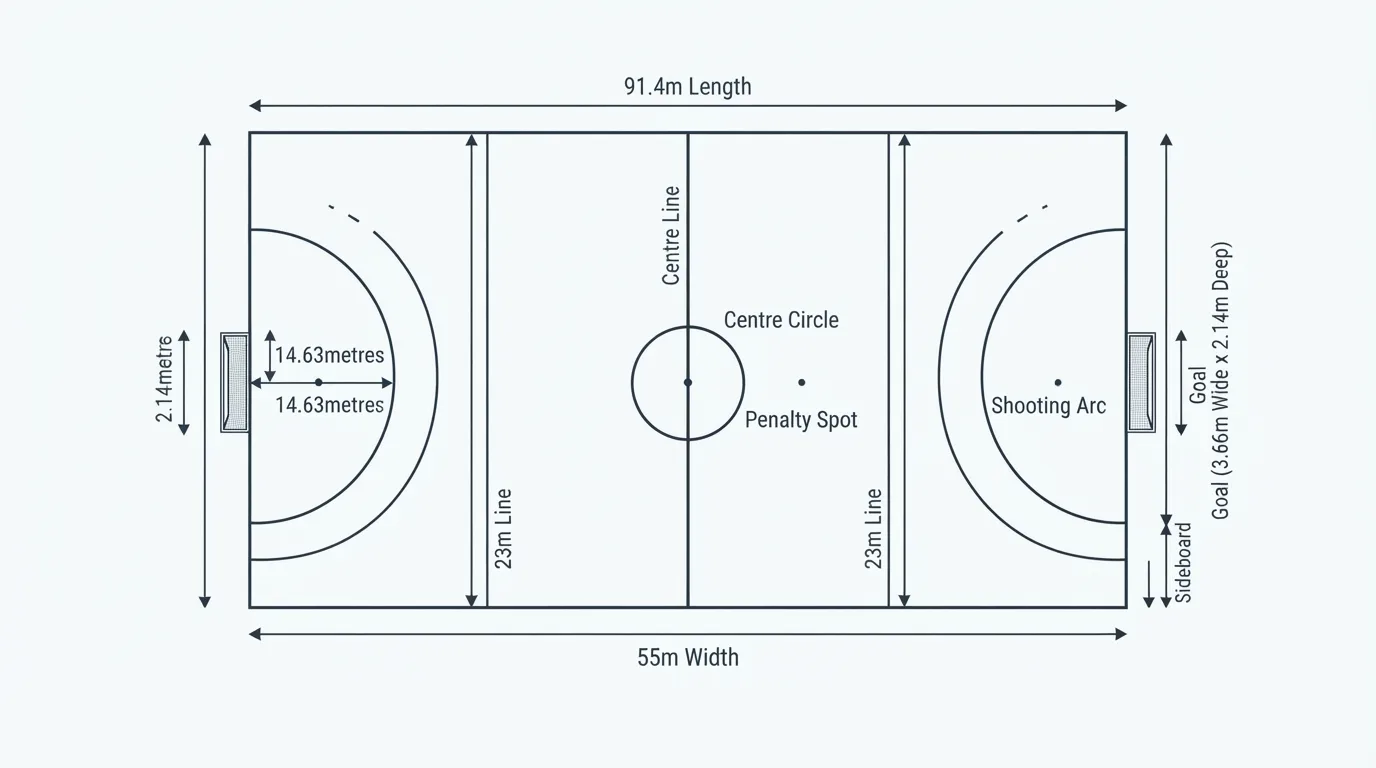
Field hockey is played by ten outfield players and a goalkeeper on each side, eleven in total, on a pitch measuring 91.4 m × 55 m, with goals 2.14 m high and 3.66 m wide. Matches since 2017 have been split into four fifteen-minute quarters with a two-minute break between quarters and a fifteen-minute half-time, sixty minutes of action in total. The team with more goals after sixty minutes wins. A tied classification match since March 2013 goes straight to a penalty shoot-out rather than extra time, under FIH regulations.
International field hockey has been an Olympic sport since 1928. Men’s hockey was dropped in 1924 and reinstated in 1928; women’s hockey was added in 1980. India won every match at the 1928 Olympic tournament without conceding a goal, and took men’s gold in 1932, 1936, 1948, 1952, 1956, 1964 and 1980 — a record unmatched in any team sport at the Games. The modern international calendar is built around the FIH Hockey World Cup, the FIH Pro League (a home-and-away league for the leading nations), the continental championships (the EuroHockey Championships, the Sultan Azlan Shah Cup, the Sultan of Johor Cup), and the Olympic qualifier pathway.
The bookmakers on this page price the events their traders watch: the FIH Pro League and Hockey World Cup at every major operator, EuroHockey at the more specialised firms, and women’s internationals at the firms that carry them. Friendly internationals and lower-tier tournaments appear at fewer operators and at wider margins. A punter looking for the sharpest price on a Tuesday-night friendly will find one operator with a market and ten without; that asymmetry is the bet.
Where each tournament sits in the calendar
- FIH Hockey World Cup — held every four years; the next men’s and women’s editions fall in 2026.
- FIH Pro League — annual home-and-away league running from late autumn to mid-summer, with the Grand Final in June.
- EuroHockey Championships — biennial, with the men’s and women’s events rotating; held in the summer.
- Olympic hockey — at the Summer Games every four years.
- Sultan Azlan Shah Cup — annual invitational held in Ipoh, Malaysia.
- Continental and qualification fixtures — round out the year.
Comparing ten GB-licensed bookmakers on field hockey
Each operator below holds a Gambling Commission remote licence, verified against the Commission’s public register, and is a member of GAMSTOP. The brands are listed in a set order; no single brand is “the only” licensed one, and the comparison is not a ranking. The fourth column reads what the operator’s own terms state on the key subject, not what the firm markets.
| Brand | Licence holder and account | What the operator’s terms state |
|---|---|---|
| Fitzwilliam Sports | SBKI Limited, account 48760 | A Dublin bookmaker with capped membership and a “High Stakes Welcome” subject to compliance criteria; instant deposits, fast withdrawals, timeouts, deposit limits, and links to GambleAware, GamStop and Gamblers Anonymous |
| Smarkets | Smarkets (Malta) Limited, account 39173 | A betting exchange; UK open-bank-transfer deposits instant from £10 up to £10,000, withdrawals processed within six hours from £10 up to £100,000; UK debit-card deposits instant from £10 up to £15,000 |
| Sporting Index | Sporting Index Limited, account 27343 | Spread betting and fixed odds on the same account, with in-play betting, a Bet Builder for football, auto cash-out and Multi-Markets |
| Hollywoodbets | Hollywoodbets International UK Limited, account 53028 | Welcome offer: stake returned as a free bet of up to £30 on a first qualifying losing accumulator (stake £10+, three or more legs, combined odds 4/1 or greater, settled within seven days); one free bet per customer |
| Betboro | Webmedia Development N.V., account 44181 | Welcome offer: a 100% matched free bet of up to £25 on a first qualifying wager, requiring a debit-card deposit of at least £10 and a first bet of £5 to £25 with three or more selections each at 3/5 (1.60) or higher |
| Dabble | Dabble Sports UK Ltd, account 65677 | Welcome offer: “Bet £10, Get £10 in Free Bets” on a first deposit for new customers, with minimum odds on the qualifying bet, a seven-day free-bet expiry and the stake not returned |
| Unibet | Platinum Gaming Limited, account 45322 | In operation since 1999; welcome offer: “Get £40 in Free Bets when you bet £20” — a £20 deposit and bet at minimum odds of 2.0 (1/1), free bets expiring within seven days, new GB customers using a debit card or instant bank transfer |
| Star Sports | Star Racing Limited, account 9177 | Customers can speak to a trader on 08000 521 321 to open an account, place bets or raise queries; support at [email protected] |
| William Hill | WHG (International) Limited, account 39225 | Best Odds Guaranteed on UK and Irish horse racing from 8 AM on the day of the race, on singles and multiples; does not apply to ante-post, tote or pari-mutuel bets |
| Betmaster | BM Solutions GB Ltd, account 65699 | App covers football, cricket, horse racing, NFL and eSports, including League of Legends and Dota 2 |
Field hockey at the comparison bookmakers
Field hockey is a secondary sport at most UK-licensed bookmakers. The mainstream operators — William Hill, Unibet, Betmaster, Betboro — carry the FIH Pro League and the Hockey World Cup when the tournament is live, and price a handful of EuroHockey and Olympic qualifier fixtures in season. The specialist firms — Smarkets as an exchange, Sporting Index on a spread-betting basis, Fitzwilliam Sports at higher stakes — bring a different angle: Sporting Index lets the punter switch between fixed odds and spread bets on the same event, and Smarkets lets the punter back or lay selections at the market price rather than take a bookmaker’s line. Hollywoodbets and Dabble price the major tournaments with the same offer-led framing as their football coverage; Star Sports, with its phone-trading desk, handles bespoke stakes and price requests on the bigger internationals.
Midnite is not on the comparison list, but the operator’s site cites Gambling Commission licence 101839 and shows in-play events, an acca builder, popular accas and price boosts with maximum-stake limits. Bet365, the official global betting partner of the UEFA Champions League and the most downloaded sports betting app in the UK, runs Bet Builder+, Super Boosts, Winnings Boosts on Bet Builders and selected singles, and daily Bet Boosts. Midnite and bet365 both price major international hockey fixtures when in season.
A punter who wants the widest field hockey coverage at a mainstream bookmaker should check the firm’s tournament pages rather than the homepage: many operators carry the World Cup and Pro League but bury them behind a sport-by-sport menu. A punter who wants to lay a result — bet against an outcome — needs an exchange, and Smarkets is the licensed GB option in this comparison set.
The legal frame for field hockey betting in Great Britain
Field hockey betting in Great Britain is licensed by the Gambling Commission under the Gambling Act 2005. The Act covers England, Scotland and Wales; Northern Ireland is outside it and runs on its own older law. Since the Gambling (Licensing and Advertising) Act 2014 an operator whose remote facilities are used in Great Britain needs a Commission licence wherever it is based. A Curaçao, Maltese or Gibraltar licence is not a substitute. The Commission’s public register, searchable by business name, trading name, domain or account number, is the test of who holds a licence.
There is no statutory list of permitted bets or markets. The Commission licenses categories — remote general betting standard (real events), remote general betting standard (virtual events), remote general betting limited, remote pool betting and remote betting intermediary (the licence for exchanges). An operator prices field hockey under its own licence conditions and the Commission’s Licence Conditions and Codes of Practice. In-play betting is offered under the operator’s licence conditions and customer-protection duties; the legal frame is permissive rather than restrictive, and never write that in-play is “unrestricted” as a legal conclusion. Esports are treated like any other event; virtual events sit under a separate licence category. No statutory cap on stakes in sports betting exists; operators set their own maximums and may restrict customers.
The minimum age is 18. Identity is verified before the first deposit or bet, including with a free bet or bonus. Credit cards have been banned for gambling in Great Britain since 14 April 2020, including credit-card-funded payments through an e-wallet; debit cards and bank-based payments are not covered by that ban. The credit-card ban is at the payment stage and sits alongside the Commission’s wider player-protection rules.
What a GB licence changes
A GB-licensed bookmaker verifies identity before the first deposit, runs GAMSTOP membership as a condition of licence, caps bonus wagering at 10x under rules in force since 19 January 2026, runs financial vulnerability checks once net deposits cross £150 in a rolling 30 days, links to GamCare and the National Gambling Helpline, and submits to the Commission’s complaints and enforcement routes. The punter who bets with an unlicensed brand loses all of those protections — no GAMSTOP coverage, no Commission complaints route, no approved dispute-resolution body, no British consumer redress if funds are withheld, no 10x bonus cap, no £150 vulnerability check.
Providing gambling facilities in Great Britain without the licence the Act requires is an offence under section 33 of the Gambling Act 2005, aimed at the operator. No offence is aimed at the customer who merely bets with an unlicensed site: licensed means checks, limits, GAMSTOP, the bonus cap and a complaint route, and unlicensed means none of those and a possible loss of funds. Neither is “the safe choice” by default.
Tax
The punter pays no tax on betting winnings in Great Britain — that is general information, not tax advice, and a professional gambler should ask HMRC or an adviser. General Betting Duty is the operator’s tax on gross profits, currently 15%. From 1 April 2027 a new remote betting rate of 25% applies within General Betting Duty, while remote bets on UK horse racing, self-service betting terminal stakes in licensed premises, pool betting and in-person betting stay at 15%. Until 1 April 2027 the remote rate stays at 15%. Whether operators pass duty on through odds is not established. Spread betting has its own rates — 3% financial, 10% other — under the same regime.
Advertising
Advertising is not licensed by the Commission. The Committee of Advertising Practice Code (non-broadcast) and the Broadcast Committee of Advertising Practice Code (broadcast), enforced by the Advertising Standards Authority, sit alongside the Commission’s marketing conditions. Section 16 of the CAP Code requires marketing to be socially responsible, not of strong appeal to under-18s, and to feature no one who is or seems to be under 25 gambling or playing a significant role, with an exception for marketing placed where a bet can be made directly. The rule concerns who may appear in the advertisement, not who may bet. Since 1 August 2019 betting advertisements have not been shown on television from five minutes before a live sporting event to five minutes after it, before the 9pm watershed — the “whistle-to-whistle” code, an industry rule rather than statute. Premier League clubs have agreed to withdraw gambling sponsorship from the front of matchday shirts from 2026/27; sleeves and hoardings remain. That withdrawal is voluntary, not law. The Commission’s bonus cap, the GAMSTOP condition, and the £150 vulnerability check are the only operational rules the writer should think of as licence conditions; everything else is industry code.
Frequently asked questions
How can it be checked that a bookmaker holds a Gambling Commission licence?
Open the Gambling Commission’s public register at its official site and search by business name, trading name, domain or account number. The register shows the licence categories and the operating company. A domain proves nothing: licensed operators use both .co.uk and .com. The account number is the Commission’s reference, not a customer-facing code.
How is the return on a bet worked out from the stake and the odds?
Multiply the stake by the decimal odds. A £10 stake at 2.50 returns £25; profit is £15. For an accumulator the odds of each leg multiply into one price, then the stake multiplies that combined price.
What is the bookmaker’s margin and how can it be seen in the odds?
Take the implied probability of each selection — 1 divided by the decimal odds — and add them up. The surplus over 1.000 is the overround. A match priced at home 1.90, draw 3.40, away 4.00 sums to 1.070, an overround of 7.0% (a margin of 6.6%). The margin is what the bookmaker keeps of every unit staked across the market.
How do fractional odds such as 5/1 convert to decimal odds such as 6.00?
Divide the numerator by the denominator and add 1. Five divided by one is 5, plus 1 is 6.00. Eleven divided by four is 2.75, plus 1 is 3.75. Evens (1/1) is 2.00. The fractional form states the profit per unit stake; the decimal form states the total return per unit stake, including the stake.
Which tools for controlling play does a licensed bookmaker have to offer?
At least deposit limits, timeouts, reality checks, session timers, product blocks, access to activity statements, and a route into GAMSTOP for longer self-exclusion. GamCare, GambleAware, the NHS gambling clinics and Gamblers Anonymous sit outside the operators and are linked from each licensed site.
US & other team sports – Best betting exchange
Content created by the «Best betting exchange» team
