
Online NASCAR betting in Great Britain — who is on the register, what they sell, what it costs
 Available in US
A punter looking for NASCAR betting in Great Britain this season does not face a shortage of sites. The shortage is the opposite one: ten licensed brands are reviewed below and there are many more on the Gambling Commission’s public register. The work is sorting what each one charges for the privilege of placing a wager on a Cup Series race, which markets matter in stock-car racing and which rules quietly shrink a winning ticket.
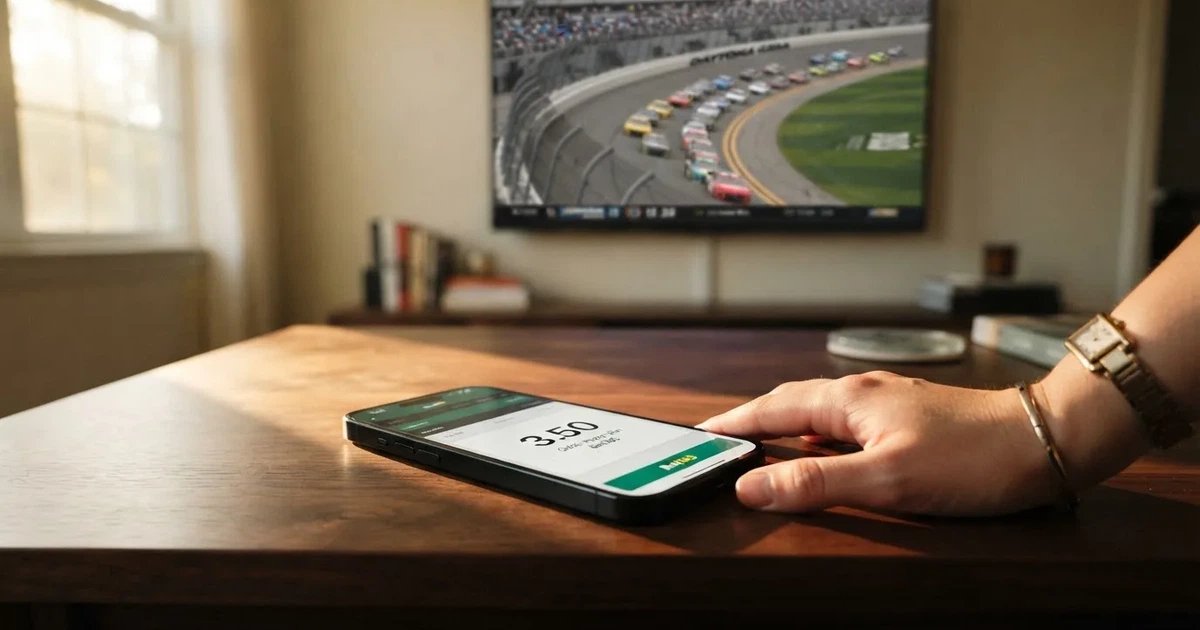
The following sections explore the betting landscape for NASCAR in Great Britain — covering mobile apps, live betting, bonuses, payment methods and responsible gambling. Every figure is from the operator’s own pages or the Commission’s public register; the work is in the comparison.
Currency stamp: prices and licence checks current as of 27 October 2026, against the Gambling Commission’s public register of remote operating licences for Great Britain.
Staying in control when NASCAR takes 36 weekends a year
Stock-car racing is a long season. The 2026 Cup Series has 36 points-paying races, plus the Cook Out Clash, the Duel at Daytona and the All-Star Race as non-championship events — almost forty weekends of betting opportunity between February and November. Anyone who has watched a punter drift through a full season knows that the volume is the danger, not any single race.

The British framework is built for that reality. GAMSTOP is the national multi-operator self-exclusion service and every GB-licensed online bookmaker participates in it. Periods run six months, one year, five years, or five years with auto-renewal; once the minimum term is up, the exclusion stays in place for a further seven years unless the customer asks GAMSTOP to remove it. Joining one brand closes online play across every GB-licensed site and app.
Deposit limits sit with the customer by default. The Commission’s Remote Technical Standards require operators to offer a gross deposit limit on a fixed time frame; it is the punter’s choice, not a state ceiling. A separate financial vulnerability check applies when a customer’s deposits minus withdrawals cross £150 in a rolling 30 days — that is a public-record check, not a credit check, but it does trigger more questions about source of funds. The “affordability checks” reported in the press are a separate, staged financial risk assessment, announced in July 2026 with no start date; whether they are operating today is not established.
Help is straightforward to find. GamCare runs the National Gambling Helpline; GambleAware funds treatment and research; the NHS runs gambling clinics across the regions; Gamblers Anonymous runs peer-support meetings. None of these is a brand. None of them sells anything to a punter.
That rail of safeguards runs through every brand reviewed below. The same rail does not run through a Curaçao, Maltese or Gibraltar site. Operators serving customers in Great Britain need a Commission licence since 2014, and unlicensed brands operating here commit an offence under section 33 of the Gambling Act 2005. The offence is aimed at the operator, not the customer, but the customer loses the GAMSTOP cover, the Commission complaints route, the approved alternative dispute resolution and any British consumer redress if funds are withheld. None of that makes an unlicensed brand “the safe choice”; it makes it a different proposition with different risks.
Crypto rails, identity checks and the gap between them
Stock-car betting sits in a peculiar spot when it comes to cryptocurrency. The Commission’s framework does not list permitted payment methods, but it does require identity verification before the first deposit — name, address and date of birth have to be checked before a punter can stake or even claim a free bet. That condition alone rules out genuinely anonymous play at any GB-licensed brand. A first deposit at BetVictor, bet365 or any of the others goes through an account that has already been matched to a real person.

No operator licensed by the Gambling Commission for remote betting in Great Britain accepts Bitcoin, Ethereum, Litecoin or other cryptocurrencies for sports betting. While many punters search for ways to bet on NASCAR using crypto, licensed brands in Britain do not support these deposits. All brands reviewed here operate using debit cards and bank transfers; credit cards have been banned for gambling in Britain since April 2020, and that ban includes e-wallet top-ups funded by credit cards.
For a punter who wants to bet on NASCAR from a crypto balance, the working options sit offshore — operators licensed in Curaçao or in jurisdictions that do not name a customer before a deposit. Those sites are outside the Commission’s checks, outside GAMSTOP, outside the 10x bonus cap and outside the £150 financial vulnerability trigger. Whether they are “legal to use” is not the right question; the right question is what protections the punter is giving up by being on them, and that question has to be answered before a deposit is made, not after a withdrawal stalls.
The licensed side has been moving in the opposite direction. The 14 April 2020 credit-card ban, the verification-before-deposit rule from 7 May 2019, the financial-vulnerability check and the staged financial risk assessment are all building an identity-led model of online betting. A licensed NASCAR bet is a named bet on a named account at a named operator. The opposite is not a small thing to give up.
What a bonus is really worth on a 36-race season
The promotion rules in force since 19 January 2026 cap wagering requirements on bonuses at 10x. A £10 bonus that would have needed £500 of bets under a 50x requirement now needs no more than £100, and the change matters because the old multiple was standard. The rules also ban mixed-product promotions — an offer that ties sports betting to casino play, lottery or bingo in one package is not lawful. Whether the cap reaches free bets with no wagering condition and whether there is a cap on the money value of a bonus remain open questions.
A few of the offers reviewed below carry real numbers worth reading. Coral’s sports welcome returns £40 in free bets after a £20 qualifying bet at minimum odds of 2.0 (1/1), with the free bets issued within seven days and expiring seven days later. Hollywoodbets’ sports welcome stakes back a first losing accumulator as a free bet of up to £30 — qualifying stake £10 or more, three legs or more, combined odds of 4/1 or greater, settled within seven days, one free bet per customer. Both are described as each operator’s own terms state them; the print below spells out what each one costs the punter through the season.
The bigger number hiding in most promotions is turnover. The arithmetic a punter runs before claiming an offer is short and worth running: required turnover = bonus base × wagering factor; the number of bets needed is that turnover divided by a qualifying stake; only bets at or above the minimum price count. Coral’s qualifier carries its own minimum-odds condition, so bets below 2.0 (1/1) drop out of the eligibility count. The free-bet credit itself is usually not returned with a win — the punter keeps the profit, the operator keeps the stake — and that detail turns a “free bet” into something with a real expected value that the punter can work out.
The promotion clampdown is not the end of the matter. Several brands still run best-odds-guaranteed concessions on horse racing; QuinnBet pays it from 10:00 daily on UK and Irish racing, with a £150 maximum benefit per customer per race. William Hill pays BOG from 8 AM on the day of the race on singles and multiples but not ante-post, tote or pari-mutuel pools. BetVictor pays BOG on UK and Irish racing. None of those concessions sits on NASCAR — racing in this context is horse and greyhound — but they are part of the cost picture because they tell the punter what kind of bookmaker this operator is. BOG is a price concession that runs to the punter only when the starting price beats the price taken; the bookmaker is paying for it on those races where SP drifts out, and the operator showing that pattern is signalling something about margin and generosity elsewhere on the card.
William Hill’s Football Acca Boost sits across accumulators of two or more legs at minimum individual odds of 1/5, scaling from 3% on a double to 200% on twenty legs or more, with a £10,000 ceiling per online bet, and runs until 30 May 2027. That is a NASCAR-free offer too, but it sets the template: an operator with a long-running acca bonus carries a different relationship with accumulators in general, including stock-car multiples.
Apps and what they actually deliver on a race day
bet365’s app is the most-downloaded sports betting app in the UK, according to the brand’s own App Store listing. Spreadex’s app merges fixed-odds and spread betting in one place with one-click, auto and partial cash out and a Bet Builder that covers fixed odds and spreads. LiveScore Bet’s Bet Builder runs to ten selections and covers match result, BTTS, corners, total goals, player scoring and card markets — built for football-shaped sports more than for NASCAR, and the punter checking the app before race day will see that immediately. 888sport offers pre-match and in-play, Cash Out, Bet Builder, racing streams, BetFinder form tools, a live bet feed and daily boosted odds. Midnite shows in-play events, an acca builder, popular accas and price boosts, with maximum-stake limits flagged on its home page.
A mobile app for stock-car racing is judged on three things in practice: how fast a price updates in the corners of a stage, whether the cash-out button is available on a driver-finish market during a caution period, and whether in-play betting covers the race cleanly. The brands below vary on those three points and the punter who bets NASCAR seriously finds out which one fits within a race weekend, not from a feature list.
Spreadex and Lottoland UK’s apps bundle the betting with other products — Spreadex with spread betting, Lottoland with casino, lottery betting and scratchcards. A punter who wants a betting-only app finds the bundled products a nuisance; a punter who wants everything in one wallet finds them a feature. Neither reading is wrong, but it is worth knowing which app is downloaded before any wager is sized.
Live betting on stock-car races and what can go wrong with cash out
In-play betting on NASCAR is unusual among British sports. A Cup Series race runs close to three hours with stage breaks, cautions and pit windows, and the punter can trade positions through all of that on the books that offer in-play on the sport — but the practice is far thinner than on football or tennis. Many punters search for live NASCAR betting odds, but the supply is uneven compared to sports like football or tennis.
Cash out sits in the same sentence. Spreadex runs one-click, auto and partial cash out; 888sport runs Cash Out outright; bet365 runs in-play with live streaming of events worldwide, plus its Match Live and Bet Track tools for following bets in play. The mechanic is the same across operators in principle: a cash-out value is offered based on the current state of the bet, and the punter who accepts locks in a return that is smaller than the full win but bigger than the losing stake. In practice, the price during a NASCAR caution flags is often thin and the offered cash-out value moves with the on-track situation rather than the in-running market. A punter who wants to use cash out on stock-car bets should size the wager with the assumption that the offered value will not appear at every flag.
Live streaming as a feature is broader than NASCAR. bet365 streams events worldwide; Spreadex streams UK and Irish horse racing, greyhounds, tennis, NFL and selected football; William Hill runs WHTV, which shows Betting TV content with selected UK and US horse racing and UK greyhounds free, with WHTV requiring a funded account or a bet in the last 24 hours and live racing needing a £1 bet on a qualifying race. None of those flows NASCAR footage directly; a punter watching a race while betting on it relies on a separate stream from the broadcaster.
Picks, predictions and what to do with someone else’s tip sheet
There is no shortage of NASCAR betting tips and predictions in the search results. There is no method that turns them into a winning position at a price, because the bookmaker’s margin inside every quoted price means the punter has to overcome a built-in deficit on every wager before any selection skill takes over. The arithmetic is in the next section and it holds whether the tip comes from a friend, a YouTube channel or a paid service.
Bankroll management is the closest the strategy cluster comes to a working advice. A punter who sizes wagers at a fixed percentage of bankroll, sticks to the percentage regardless of recent results and stops at a fixed floor cushions the variance of NASCAR — 36 races a season, plenty of time for a hot streak to be undone by a Talladega pile-up. A punter who doubles down on a losing streak after a favourite blows an engine does not.
The honest framing: NASCAR is a high-variance sport to bet on. Stage finishes split races into thirds and offer markets on those thirds; the punter who bets the whole-race winner on a 1.5-mile track is taking a heavier swing than the punter who bets the stage winner at the same track, because stage results are smaller samples and the favourites are priced tighter. Matchup betting (driver A versus driver B, finishing position) is offered by some books and is a smaller-stakes way to test a read.
Markets, prices and the margin sitting underneath
A British punter betting on NASCAR this season sees five market shapes on most books: race winner (the most liability, the longest odds, the smallest payout share); podium finish (top three, three places paid); top-six or top-ten finish (depending on the field and the book); head-to-head (driver A versus driver B, finishing position higher); stage winner (per stage, three stages per race on most tracks). Each market carries a different number of outcomes and a different margin, and the difference is what determines whether the punter’s selection skill has a chance to show.
The price the punter sees on a screen is decimal by default on British books and reflects the bookmaker’s margin inside every outcome. The margin of a market is what the book keeps of every unit bet on that market, and it is built into the prices such that the sum of implied probabilities is greater than 100%. The illustrative case at decimal odds 1.90 / 1.90 — a two-way market with even chances — is the easiest margin to show:
| Outcome | Decimal odds | Implied probability |
|---|---|---|
| Selection A | 1.90 | 52.63% |
| Selection B | 1.90 | 52.63% |
| Sum | 105.26% |
Payout share = 1 ÷ (1/1.90 + 1/1.90) = 1 ÷ 1.053 = 95.00%. Margin = 100% − 95.00% = 5.00%. That 5% is what the bookmaker keeps, on average, of every pound wagered on this market. The punter sees a price of 1.90 and does the math; the book keeps 5p of every £1 wagered across enough bets that the law of large numbers flattens the variance.
On a NASCAR race winner market with, say, 36 cars in the field, the implied-probability sum rises sharply — most books price a 36-driver race winner market with an implied-probability sum in the 130-140% range, meaning a margin closer to 25-30%. The punter’s edge has to overcome that larger take before any selection skill shows. Stage-winner markets are smaller (typically 8 to 12 named drivers), so the margin falls back toward the 5-10% band. Head-to-head markets are two-driver, and the margin sits in the 5-10% band as well, with the added feature that both sides of the bet are priced up.
The concession bands narrow further on stage and head-to-head markets. The “best odds” tag a bookmaker slaps on its prices is really a margin claim, and the punter comparing brands is in practice comparing margins on the markets they actually bet. Best Odds Guaranteed on horse racing is a price concession that pays the starting price when it beats the taken price; the same concession rarely runs on NASCAR, because horse racing has a starting price benchmark and stock-car betting does not. The punter reading the small print finds out which book offers best price the hard way, by losing out at SP — and the punter reading the NASCAR markets finds out which book offers tight margin the same way, by losing out on every wager where a closer price was available elsewhere.
The 2026 season — what is actually running
The 2026 NASCAR Cup Series has 36 points-paying races plus the three non-championship events named above. The Daytona 500, the season opener, was held on 15 February 2026 and was the 68th running of the race; Tyler Reddick won it. The season finale is the Straight Talk Wireless 400 at Homestead–Miami Speedway on 8 November 2026, and the playoff structure takes the top 16 drivers in points after 26 races. The win-and-you’re-in rule is gone this season, replaced by a staggered starting-points system keyed to regular-season standings.
A punter mapping the calendar sees what the calendar’s edges hold. The Daytona 500 and Talladega superspeedways are restrictor-plate races with pack racing at 200 mph and a markedly higher big-pileup frequency — a bet on the race winner at those tracks has more variance than a bet on the winner at a 1.5-mile intermediate. The short tracks (Bristol, Martinsville, North Wilkesboro) and the road courses (Sonoma, Watkins Glen, the Charlotte Roval) reward different skills and different qualifying positions, and the books price them differently on race day. The stage breaks on a road course produce tighter stage-winner markets than the stage breaks at a superspeedway, because fewer cars are in contention at a road-course stage break.
The 36-race calendar also means the punter has 36 opportunities to size in and 36 opportunities to get beat by a wreck. A bankroll plan that suits football — eight months, ten weekends of consequence — does not transfer cleanly; the sheer number of weekends pushes volume, and volume is what erodes bankroll under a margin no matter how good the picks look in isolation.
The licensed field in Great Britain this season
Ten brands carry a remote operating licence from the Gambling Commission for general betting on real events and form the comparison below. The full register carries many more; the ten below were selected for their NASCAR coverage and the markets that matter on a race weekend. Names are alphabetical in the second column of the table; columns are licence, licence holder and what the operator’s own terms say about a stock-car betting package in 2026.
| Brand | Gambling Commission licence | What the operator’s own terms state |
|---|---|---|
| 888sport | 039028 (888 UK Limited) | Pre-match and in-play, Cash Out, Bet Builder, racing streams, BetFinder form tools, live bet feed, daily boosted odds |
| BetVictor | 039576 (BV Gaming Limited) | Best Odds Guaranteed on UK and Irish horse racing, enhanced live race streaming, BetFinder, Smart Stats |
| bet365 | 055148 (Hillside (UK Sports) ENC) | In-play betting and live streaming worldwide, Bet Builder+ across pre-match and in-play, daily Bet Boosts, Match Live, Bet Track, Live Golf Tracker; UEFA Champions League official global betting partner |
| Coral | 054743 (LC International Limited) | Welcome offer £40 in free bets after a £20 qualifying bet at 2.0 (1/1), free bets issued within 7 days and expiring 7 days after issue |
| Hollywoodbets | 053028 (Hollywoodbets International UK Limited) | Welcome offer: stake returned as a free bet of up to £30 on first losing accumulator (3+ legs, combined odds ≥ 4/1, settled within 7 days) |
| Kalooki Sportsbook | 057730 (Kalooki Sportsbook Limited) | Operating company Kalooki Sports Book Ltd (company number 12938274), GAMSTOP member |
| LiveScore Bet | 056859 (LiveScore Betting and Gaming (Gibraltar) Limited) | Bet Builder up to 10 selections covering match result, BTTS, corners, total goals, player scoring and card markets |
| NetBet | 039170 (Netbet Enterprises Limited) | Daily Boosts, Profit Boosts, free bet offers, Bet Builder with dynamic odds, sports stats for major leagues |
| QuinnBet | 061011 (QuinnBet (Gibraltar) Limited) | Best Odds Guaranteed on UK and Irish horse racing from 10:00 daily, singles/multiples/systems, £150 maximum benefit per race |
| Spreadex | 008835 (Spreadex Limited) | Fixed-odds and spread betting in one app, one-click/auto/partial cash out, Bet Builder across fixed odds or spreads, live streaming of UK and Irish horse racing, greyhounds, tennis, NFL and selected football; FCA-regulated for spread betting |
Every brand in the table is on the Commission’s public register under a remote general betting standard (real events) category, apart from Coral, which additionally holds a remote betting intermediary licence for exchange activity. Every GB-licensed online operator takes part in GAMSTOP. Several brands run under one licensee — LC International Limited carries Coral alongside other names in the wider group — and the register, not the marketing page, is the test of who is licensed.
The numbers in the licence column are Gambling Commission account numbers and can be looked up directly on the Commission’s public register. The licensee column carries the operating company named on the same page of the register; the trading name (Coral, Hollywoodbets, Spreadex and so on) is the brand the punter sees in the app store. Both belong on the page so the punter can match what they read here against what they see on the Commission’s database.
A punter who wants to check a brand before depositing follows three steps. First, find the brand’s full legal entity name on the operator’s own terms page (it is usually at the bottom of the home page or in the licence information section). Second, search the Commission’s public register by that entity name or by the brand’s domain; the entry on the register lists the licence number, the licence categories and the trading names. Third, check that the licence category is remote general betting standard (real events) for ordinary sports betting, or remote betting intermediary for an exchange. A licence check takes a minute and is the only way to separate a GB-licensed brand from an offshore one.
Betting with and through each of the ten brands
BetVictor pays Best Odds Guaranteed on UK and Irish horse racing and runs enhanced live race streaming with a BetFinder feature and Smart Stats. The punter betting NASCAR at BetVictor is using a bookmaker whose identity in the market is racing-shaped; the racing concession exists and runs, the NASCAR coverage is real but not the centrepiece. The BetFinder and Smart Stats tools transfer to a NASCAR card as form-reading infrastructure — qualifying history, previous finishes at the same track, stage wins in the season so far. The relevant punter is one who has a view and wants a quiet, racing-shaped book to put it through.
Hollywoodbets’ stock-car suite reads as a typical international bookmaker with a NASCAR-friendly accumulator structure. The welcome offer stakes back a first losing multi as a free bet of up to £30 — qualifying stake £10 or more, three legs or more, combined odds 4/1 or greater — and that is a NASCAR-shaped offer because accumulators are how stock-car punters build a race-weekend card from a single favourite plus a longshot stage winner. The 7-day settlement window is ordinary; the £30 cap is the kind of ceiling that suits a punter who does not want a marketing-driven churn in their first month.
LiveScore Bet runs a Bet Builder to ten selections across match result, BTTS, corners, total goals, player scoring and cards. The structure is football-shaped — most stock-car books do not offer a same-race multi across finish position, stage wins and head-to-head — and the punter betting NASCAR finds the betting menu thinner here than at a racing-shaped operator. The relevant punter is one whose main betting is football and who wants a NASCAR bet in the same app without changing brand.
Spreadex is the only brand in the table that bundles fixed-odds with spread betting, and that combination determines who it suits. Spreadex is regulated by the FCA for spread betting and by the Commission for fixed-odds, and the brand itself flags that spread-betting losses can exceed the deposit. A spread bet on a NASCAR stage winner is a different product to a fixed-odds bet on the same selection: the punter is right or wrong by a margin, not at a binary outcome, and the liability runs higher. The cash-out suite (one-click, auto and partial) and the streaming list (UK and Irish horse racing, greyhounds, tennis, NFL, selected football) attach cleanly to NASCAR for in-play trading on race day. The punter suited to Spreadex already understands spread products; the punter who does not will find the cost of a single bad spread position larger than the cost of a bad fixed-odds wager.
bet365 is the most-downloaded sports betting app in the UK by the brand’s own claim and the global betting partner of the UEFA Champions League — neither of those claims is about NASCAR, but both shape what the punter meets on the app. The app bundles Bet Builder+ (markets from one event combined into a single bet, available pre-match and in-play), Super Boosts, daily Bet Boosts and Winnings Boosts on Bet Builders and selected singles, with live streaming of events worldwide plus Match Live and Bet Track for following bets in play. For a NASCAR punter the meaningful test is whether Bet Builder+ runs on stock-car markets (the marker is that Bet Builder+ is positioned as a multi-event feature and stock-car betting typically does not combine into a same-race market), and the in-play coverage of NASCAR — which the brand offers across many sports but markets thinly where the volume is low.
NetBet runs Daily Boosts, Profit Boosts and free-bet offers with a Bet Builder that shows dynamic odds instantly and a sports-stats panel for major leagues. The punter betting NASCAR at NetBet gets the boost catalogue — the marketing-led free-bet and price-promotion suite that is the typical busy bookmaker’s stock in trade — and the Bet Builder for sports where it applies. The relevant punter is one who likes a lot of promotional traffic and a dynamic betting menu.
QuinnBet’s Best Odds Guaranteed applies from 10:00am daily to UK and Irish horse racing across singles, multiples and systems, with a £150 maximum benefit per customer per race. NASCAR is not a horse race and the BOG does not run, so the concession the brand is best known for does not transfer to the stock-car card. The relevant assessment for a NASCAR punter is the ordinary margin on the race-winner market and the in-play book.
Kalooki Sportsbook is operated by Kalooki Sports Book Ltd (company number 12938274) and licensed by the Commission under account 57730 as a GAMSTOP member. What is publicly known about Kalooki beyond its licence and GAMSTOP membership is limited. The punter choosing Kalooki is choosing a smaller, racing-shaped operation; the relevant test is how deep the NASCAR market runs in this book relative to a tall-ship brand like bet365.
Coral’s welcome offer — £40 in free bets after a £20 qualifying wager at minimum odds of 2.0 (1/1), with the free bets issued within seven days and expiring seven days later — is the kind of offer a NASCAR punter can run: a £20 single on a race winner at minimum price 1/1, with the understanding that bets below the threshold do not qualify. The £40 of free-bet credit is the price the punter is being paid for a first deposit of £20, and the expiry window is short enough that the offer has to be planned through. Coral is licensed under LC International Limited, the same licensee that carries other names in the wider group.
888sport offers pre-match and in-play betting, Cash Out, Bet Builder, racing streams, BetFinder form tools, a live bet feed and daily boosted odds. The Bet Builder framework runs on sports whose markets split cleanly (football, basketball), and the NASCAR-card version of the menu is narrower than the football one. The relevant punter is one who wants a full-feature bookmaker with an everyday NASCAR offering and will use the racing streams to follow other sports as well.
Lottoland UK runs casino, lottery betting, sports betting and scratchcards from one app and states it is licensed by the Commission for customers in Great Britain. It is not in the comparison table but is mentioned here as a recognisable name in the GB-licensed space with a betting suite that includes sports. The punter meeting Lottoland for the first time should treat it as a multi-product house and check the betting menu before sizing a NASCAR wager.
How an odds price pays out
A winning bet pays stake × decimal odds. A £10 bet at decimal odds 6.00 returns £60 — that is the stake plus £50 of profit, because the punter’s net profit is stake × (odds − 1). The same punter’s net profit is £50; the operator pays £60 and keeps nothing of the original stake. A punter betting on a NASCAR race winner at 6.00 is being offered one chance in roughly 6.25 of the price the bookmaker considers fair; the difference is the margin.
A combination bet multiplies the decimal odds of each leg into one price. A two-leg accumulator with legs at 3.00 and 4.00 returns stake × 12.00 — a £5 wager pays £60 if both legs win, of which £5 is stake returned and £55 is net profit. The price climbs because the punter needs both legs to win, not just one; the bookmaker’s margin on each leg is multiplied into the combined price, which is why long-shot accumulators at small margins still lose on average to a patient, well-priced singles bettor.
The cash-out feature cuts the chain. A two-leg acca with one leg settled and one leg running is offered a cash-out value based on the current state of the remaining leg; the punter who accepts takes a smaller guaranteed return than the full win, in exchange for the bet being closed before the final leg is decided. Cash out is not free — the offered value carries the operator’s margin inside it — and it is the option the punter turns to when conviction on the remaining leg has shifted, not the option to take “just in case”.
The margin spelled out, with the numbers doing the work
The margin is what the book keeps, on average, of every unit wagered on a market. The arithmetic for a two-way market at decimal odds 1.90 / 1.90 was already walked through above: payout share 95.00%, margin 5.00%, kept by the book on every £1 staked across enough bets to flatten the variance. The 1.90 / 1.90 illustrative example is a useful benchmark because the punter can see the calculation: even-money chances are the simplest case and the resulting margin is a clean 5% — the band a healthy, well-priced market sits in.
Real markets run hotter. A NASCAR race winner market with a 36-driver field, priced at typical bookmaker levels, sums implied probabilities into the 130-140% band and carries a margin closer to 25-30%. A 25% margin means the book keeps 25p of every £1 staked, on average, across the race; the punter has to clear that 25p before skill, form reading or luck takes over. Stage-winner markets on a 1.5-mile track with eight plausible contenders typically run a 7-10% margin. Head-to-head markets with two drivers carry a 5-10% margin. The ranking from lowest to highest margin within a NASCAR card is: head-to-head → stage winner → top-six / top-ten → podium → race winner. The punter whose skill is in spotting the race winner pays the biggest margin for that skill; the punter whose skill is in head-to-head pricing pays the smallest.
The expected cost of clearing an offer is turnover × margin. A punter running turnover of £500 across a season-long sequence of £10 qualifying bets at an average market margin of 7% is paying the book £35 of expected cost — that is £500 of qualifying betting producing £35 of bookmaker edge. The offer’s headline number is rarely the punter’s expected outcome.
The conclusion sits inside that gloss: a margin answers what the book keeps and what the offer costs on average, never whether a specific bet wins.
Picking the right book for a NASCAR weekend
The honest read of the table is that no brand is the cheapest across every NASCAR market. A punter whose weekend is race-winner singles pays a higher margin than a punter whose card is stage-winner and head-to-head bets; the operator that runs a tighter margin on race winners may not run a tighter margin on stage markets, and the operator that runs the tightest margin on heads may pay a different concession on the same race-day card. Comparing brands means comparing margins on the markets the punter actually bets, on the size of stake the punter actually places, over the number of races the punter actually plays through. That comparison is the punter’s work, and it has to be done with the bookmaker’s current prices, not the prices that were on screen during Daytona week.
The punter who wants the deepest in-play trading on race day finds Spreadex and bet365 the liveliest books, with the caveat that Spreadex bundles fixed-odds and spread and the punter needs to know which product the price is for. The punter who wants the racing-shaped concessions — BOG on the horse card, BetFinder form, Smart Stats — finds BetVictor, with NASCAR coverage running through the same book. The punter who wants a busy promotional book with a NASCAR welcome offer is reading Hollywoodbets, with the £30 free-bet cap and the 7-day window as the boundary. The punter who wants an exchange-running book on the same platform finds Coral, with its remote betting intermediary licence covering exchange activity. Each of these is a working fit for a particular punter and none of them is “the safe choice” in general terms.
The work of choosing is sharper than the search results suggest, and the rest of the page is the FAQ the same comparison raises.
The legality of betting on NASCAR in Great Britain
Great Britain does not run a state monopoly on sports betting and does not publish a list of permitted sports or markets. The framework is the Gambling Act 2005, which covers England, Scotland and Wales; Northern Ireland is outside the Act and runs on its own older legislation. Under the Act, every operator whose remote facilities are used in Great Britain needs a Gambling Commission licence — the requirement has stood since the Gambling (Licensing and Advertising) Act 2014 — and the licence, whoever issued it, must be a Commission licence to be lawful in GB. A Curaçao, Maltese or Gibraltar licence is not a substitute for the point of consumption.
The Commission’s public register is the whole test of who holds a licence. It is searched by business name, trading name, domain or account number and lists the licence categories attached to each entry. The categories relevant to this page are remote general betting standard (real events) for ordinary sports betting and remote betting intermediary for an exchange. A licence number, on its own, does not guarantee a brand carries a real-events licence; the category is what matters.
The minimum age is 18. Since 7 May 2019, name, address and date of birth are verified before the first deposit, including before a free bet or bonus can be claimed. That rule kills anonymous play at any licensed brand. Credit cards have been banned for gambling since 14 April 2020, with the ban reaching credit-card-funded e-wallet top-ups.
Betting duty is the operator’s tax, not the punter’s. General Betting Duty sits at 15% of gross profits and from 1 April 2027 a new remote betting rate of 25% will apply, while bets on UK horse racing, bets on self-service betting terminals and pool betting stay at 15%. A punter in Great Britain does not pay tax on betting winnings — but a professional gambler should ask HMRC or an adviser, because the general rule is not the whole story. Until 1 April 2027 the remote rate stays at 15% and whether operators pass that on through tighter prices is not established; never write that the punter is being charged duty by the bookmaker.
The advertising rules sit outside the Commission’s remit. The CAP Code (non-broadcast) and the BCAP Code (broadcast) are enforced by the ASA, alongside the Commission’s LCCP marketing conditions. CAP Code section 16 keeps gambling marketing socially responsible, away from under-18 audiences and away from anyone who appears to be under 25 in the marketing creative (with an exception for marketing placed where a bet can be made directly). The January 2026 promotion rules cap wagering requirements on bonuses at 10x and ban mixed-product offers. None of this changes who may bet at 18+; it changes how the offer is shaped.
The offshore side of the comparison was already walked through in the crypto-rails section. The key read: a GB licence is compulsory at the point of consumption. Operators serving GB customers without one commit an offence under section 33 of the Gambling Act 2005 — the offence is aimed at the operator, not the customer. The customer on an unlicensed site loses the GAMSTOP cover, the Commission complaints route, the approved alternative dispute resolution, the £150 vulnerability check, the 10x bonus cap and any British consumer redress if funds are withheld. The Commission has been given, or is about to receive, court-order DNS blocking powers; ISP-level blocking is not yet in operation, and the framing should not state it as such. Off-site, the same punter has access to markets a licensed book would not take — but pays for that access in lost protections.
The bookmaker’s margin, in plain terms
The bookmaker’s margin is what the book keeps, on average, of every pound wagered on a market. It is built into the prices such that the sum of the implied probabilities is greater than 100%. The bigger the gap above 100%, the more the bookmaker takes. The punter’s job is to find the book that takes the least on the markets the punter actually plays.
The simple read is at the 1.90 / 1.90 example: even-money chances at a clean 5% margin is the case a punter should look for first. Markets priced above 100% by more than 5 points are markets where the punter pays more than they should for the same skill. Markets priced above 100% by less than 5 points are markets where the book is generous — the “best odds” claim that marketing departments love to make. The honest markets sit closer to 102-105% implied.
The reason the comparison matters is that the margin is not just a number. It is what the punter pays on every wager, every weekend, for 36 weekends. A punter who bets £20 on a race winner at 110% implied probability and the same £20 on a stage winner at 105% implied probability is paying the book £1.83 on the first bet and £0.95 on the second. Over 36 races the difference becomes the difference between running at a loss and running close to break-even on the betting alone, before any selection skill is added.
That is the cost the page is built around. The rest of the licence landscape — the responsible-gambling rails, the payment rails, the offshore risks — is what frames the choice, but the cost is in the margin, every weekend, for 36 races.
How a punter checks a brand is licensed
Three steps, in this order.
First, find the legal entity behind the brand. The full company name is usually on the operator’s own terms page, often near the bottom of the home page or in a “About” or “Licence” section. The domain is not enough on its own; a .com is lawful at a GB-licensed brand and a .co.uk is also possible. The legal entity is the brand’s real name.
Second, search the Commission’s public register by that entity name or by the brand’s trading name. The register lists the licence number, the licence categories and the trading names covered. The categories relevant to NASCAR betting are remote general betting standard (real events) and remote betting intermediary (for exchanges). A brand whose entry lists a different category — pool betting only, for example — is not authorised for ordinary sports betting.
Third, check the licence is current. The register carries an action status on each entry; a “Licence lapsed”, “Licence surrendered” or “Licence revoked” status means the entry is not a live licence. The punter checking the date on the entry against the search date is the only check that needs a calendar — the entry does not change unless the operator’s status changes.
A licence check takes a minute. The punter who skips it is betting at an unknown operator.
What the wagering cap on bonuses means in practice
A bonus with wagering requirements that exceed 10x is unlawful at a GB-licensed book under the rules in force since 19 January 2026. The cap matters because before the cap, 50x wagering was standard on welcome offers, and a £10 bonus needed £500 of bets to clear. Under the cap, a £10 bonus needs no more than £100 of bets.
The cap is not the whole story. Most welcome offers at licensed brands are free bets, not cash bonuses, and the wagering cap does not always reach free bets with no wagering condition — research did not establish whether a free bet with no rollover sits inside or outside the cap. What is established is that wagering requirements on bonuses can no longer exceed 10x, and mixed-product offers that tie sports betting to casino, lottery or bingo have been banned since the same date.
The promotion rules do not cap the headline value of a free bet or a price boost. Coral’s £40 free bet on a £20 qualifying wager is lawful because the qualifying bet is not a bonus that needs to be cleared — it is a wager, not a bonus — and the free-bet credit expires if unused. A £100 free bet with a 10x wagering condition would be unlawful: the £1,000 turnover is within the cap, but a £100 bonus at 10x is the absolute ceiling, and a £100 bonus at 50x would breach.
The conclusion the page reaches: a bonus cap of 10x puts an upper bound on the punter’s expected cost in clearing an offer and shuts down the worst offers that used to push 50x; it does not turn a free bet into a piece of free money, and the punter holding a free bet still has the cap on the punter’s side of the bettor’s deal.
Frequently asked questions
How do I bet on NASCAR from Great Britain?
Pick a brand licensed by the Gambling Commission for remote general betting standard (real events), open an account with verified name, address and date of birth, deposit by debit card or bank-based payment (credit cards and crypto-funded cards are not allowed at GB-licensed books), and place a wager on the race-winner, podium, top-six, head-to-head or stage-winner market for the race you want. Use the brand’s own markets page on race day for the deepest menu.
Where can I bet on NASCAR online?
Ten brands reviewed on this page hold a Commission licence and offer a NASCAR card as part of their real-events betting suite: 888sport, BetVictor, bet365, Coral, Hollywoodbets, Kalooki Sportsbook, LiveScore Bet, NetBet, QuinnBet and Spreadex. The Commission’s public register carries additional brands not listed here. The punter checking a brand against the register before depositing is the right first step on any unfamiliar name.
How do I bet on a NASCAR race step by step?
Choose a race on the calendar (36 points-paying events in the 2026 Cup Series, plus the Cook Out Clash, the Duel at Daytona and the All-Star Race). Pick a market — race winner, podium, top-six, head-to-head, stage winner — and read the price as decimal odds. Enter the stake, confirm the bet, and the wager is locked. Track the race through the brand’s in-play tab and use cash out if the offered value beats waiting for the flag.
How can I check a bookmaker holds a Gambling Commission licence?
Find the legal entity behind the trading name on the operator’s own terms page (typically a Companies-Act-limited company or a Gibraltar-registered operator named as licensee). Search the Commission’s public register by entity name, brand name or domain. Confirm the licence category is remote general betting standard (real events) for ordinary sports betting, or remote betting intermediary for an exchange, and that the action status is live (not lapsed, surrendered or revoked). The register’s entry page lists everything relevant; the punter checking the date on the entry against today’s date confirms the status.
What is the return on a winning bet?
Return = stake × decimal odds. A £10 bet at decimal odds 4.00 returns £40 in total — £10 stake plus £30 profit. A combination bet multiplies the decimal odds of each leg into one price, so a £5 accumulator with legs at 3.00 and 4.00 returns £60 if both legs win. The decimal odds are the price the punter sees on the screen; the profit is return minus stake, and the operator pays the full return on settlement.
What is the bookmaker’s margin and how do I see it in the odds?
The margin is what the book keeps, on average, of every unit bet on a market. It is built into the prices such that the sum of the implied probabilities (1 ÷ decimal odds, summed across the outcomes) is greater than 100%. Two-way markets at decimal odds 1.90 / 1.90 sum to 105.26%, giving the book a 5.00% margin. The larger the field and the longer the prices, the larger the margin — typical NASCAR race-winner markets at 36 drivers run 25-30% margin, while stage-winner and head-to-head markets at 5-10% margin are closer to break-even for a sharp punter. The punter comparing brands is comparing margins on the markets they actually bet, on the current week’s prices, on the size of stake they actually place.
Combat & motorsport – Best betting exchange
Content created by the «Best betting exchange» team
