
What online Gaelic football betting actually costs a British bettor in 2026
 Available in US
A £10 stake on Gaelic football does not become £20 because the price reads 2.00. It becomes whatever the bookmaker’s margin leaves after the odds are multiplied by the stake, and the margin sits inside every price the bettor sees, on every market, on every licensed site. This page is built around that fact. It works through what a Gaelic football bet costs a punter in Great Britain — the spread of prices across the ten bookmakers and exchanges that actually hold a Gambling Commission remote licence, what a “free bet” turns into once the stake is not returned, what a “boosted odds” line takes back in lost margin, and what the Commission itself charges the operator, because the operator’s tax does not vanish into thin air either.

Gaelic football itself is not the focus here. It is the sport the bettor is betting on, and the rules of the sport shape what can be wagered: a 15-a-side game with up to 15 substitutes of whom six may be used, two 35-minute halves at senior inter-county level, a goal worth three points and a point worth one. Those rules, plus the rule change that from 2025 makes a shot from outside the new 40-metre arc worth two points, decide the menu of markets any licensed bookmaker can sensibly offer. The rest — the margin, the licence, the bonus terms, the live-betting experience — is what the price on the screen is really made of, and the rest of this page is about it.
Current as of 27 October 2026 against the Gambling Commission’s public register and the operator terms each brand publishes on its own site.
Safer gambling on Gaelic football sites: what the licence actually gives the punter
A Gambling Commission remote licence is not a marketing badge. It is the only thing in Great Britain that pulls a bookmaker inside the player-protection regime: identity checks before the first deposit, GAMSTOP self-exclusion, a 10x cap on bonus wagering since 19 January 2026, a financial vulnerability check that triggers once deposits net of withdrawals clear £150 across a rolling 30 days, and a duty on the operator to flag harmful play. None of those protections is opt-in. They are licence conditions, and the Commission’s enforcement record — fines, licence reviews, operating-condition suspensions — is the reason they get taken seriously.
For a punter, the practical shape of the regime is this. A licensed site will ask for name, address and date of birth before the first deposit, and that question cannot be dodged by paying in a free-bet or bonus route; the verification sits in front of the deposit, not behind it. If gambling stops being fun, GAMSTOP self-exclusion can be set for six months, one year, five years, or five years with auto-renewal; once expired the stay keeps the punter out for a further seven years unless GAMSTOP is asked to lift it. Help lines are advertised in the responsible-gambling section of every licensed site, and GamCare’s National Gambling Helpline is the one operator with a UK-wide number any punter can ring at any hour.
The £150 vulnerability check is not a credit check. It is a public-record look — county court judgments, bankruptcy, that kind of thing — and it is the Commission’s earliest financial tripwire, not its last. The next stage, the financial risk assessment that the press calls an “affordability check”, was announced on 7 July 2026 in a staged plan with no start date. It is not in force. Until it is, the £150 tripwire is the only mandatory spending-level control, and what sits above it is the operator’s own risk-based monitoring, which varies brand by brand. A punter who wants to bet large on Gaelic football at a licensed site should expect to be asked where the money is coming from at some point; that question is the anti-money-laundering regime talking, not the bookmaker being difficult.
The single biggest cost a licence imposes on a bettor is also the most invisible: identity verification means no anonymous play. The bettor who wants to walk in, bet, walk out, never speaks to a licensed site at all. Whether that is a price worth paying depends on what the alternative is, and that comparison sits in the section on offshore sites further down. The short version: a licensed site takes the punter’s details, in exchange for the protections named above and the right to complain to an independent adjudicator when funds are withheld. An unlicensed site takes the deposit and is under no British duty to give either back.
Crypto and anonymity at Gaelic football bookmakers
Bitcoin, Ethereum and a dozen other tokens can buy a great many things. A licensed Gaelic football bet in Great Britain is not one of them at most of the brands this page covers. The credit-card ban in Great Britain is the cleanest example of why: since 14 April 2020 no credit card, including a credit-card-funded payment through an e-wallet, may be used for gambling. A crypto on-ramp in 2026 almost always touches a credit product at some point — a debit card on a fiat off-ramp, a card-issued stablecoin, a margin trade to acquire the token — and the Commission’s view, set out in its guidance, is that the spirit of the ban reaches that route too.

Identity verification sits in front of the deposit at every brand in this ranking, which means even the operators that accept a token deposit still know who is paying. That is the second reason the “anonymous” pitch does not land at a licensed site. The bookmaker has to verify the punter’s name, address and date of birth before the first deposit can be made, including where the first product the punter touches is a free bet or bonus. A crypto wallet attached to a verified person is not an anonymous wallet. It is a wallet the bookmaker has tied to an identity it can hand to the Commission on request.
The honest answer, then, is that crypto at a British-licensed Gaelic football bookmaker is a payment rail, not an anonymity product. The punt pays in tokens, the bookmaker credits the account in pounds, the bet is placed in pounds, and the winnings come back in pounds. Where the bookmaker even offers crypto at all, the offer is narrow — usually a single token, sometimes two — and the brand list is short. Most of the brands in this ranking either do not mention crypto on their cashier pages or accept a token only through a partner that converts at the point of deposit. The punt should expect to be charged a conversion spread, and should expect no special treatment from the bookmaker because the deposit came in tokens rather than pounds.
For a punter who wants crypto-native gambling, the only routes are offshore brands and betting exchanges that sit outside the British regime. Those brands carry every protection gap named in the section on offshore sites, and they are not on this ranking. The section on offshore sites further down is the place to weigh what is given up in exchange for the token.
Bonuses, free bets and the price hidden inside the headline
“Get £40 in free bets when you bet £20” is the headline. The arithmetic behind it is what costs the punter money, and it is rarely the arithmetic the headline emphasises. A free bet is a stake the bookmaker gives, not a stake the bookmaker replaces: when a £10 free bet wins at 3.00 the bookmaker pays £20 in winnings, not £30, because the £10 stake is not returned. That is the single biggest difference between a free bet and a cash bonus, and it is the difference the headline does not mention.
The 10x wagering cap, in force since 19 January 2026, is the Commission’s second line. Before the cap, a £10 bonus could carry a 50x rollover, which meant £500 of qualifying bets before any winnings could be withdrawn; under the cap no more than £100 of qualifying bets is needed. That is a real change, and it is the change that makes the welcome offers at the licensed brands on this ranking more legible than they were a year ago. It is also the change that made mixed-product promotions — the kind that asks the punter to bet on football to get free spins on a slot — disappear, because the Commission banned them in the same rule package.
The arithmetic of a free bet, on the punter’s side, is the multiplication of stake × (odds − 1) ÷ odds × payout share of the market. The free bet’s expected value is what it is worth on average, not what it wins on a single bet, and a free bet at short odds is worth less than the headline figure suggests. A £10 free bet at 1.5 is worth roughly £3.30 on average; the same free bet at 5.0 is worth roughly £6.40. The headline does not move with the odds; the expected value does.
“Risk-free” is the word to be most careful of. A “risk-free” bet at a licensed site is usually a free bet issued as a refund if the first bet loses. The punter does not get cash back; the punter gets another free bet whose stake will not be returned with a win. The marketing language calls this “risk-free” because the punter cannot lose the first stake, which is true. The marketing language does not call it a refund in money, because it is not one. The “risk” being removed is the loss of the first stake, and the cost of removing it is the loss of the stake on the refund. A punter who understands that trade is the punter who reads the term; a punter who reads only the headline is the punter the term is written for.
“Best odds guaranteed” is a different word, and it is a real one. William Hill pays Best Odds Guaranteed on UK and Irish horse racing from 8 AM on the day of the race, on both single and multiple bets, and the rule does not apply to ante-post, tote or pari-mutuel bets. The bookmaker pays the bigger of the price taken and the starting price; on a horse race, where the morning price often drifts as money comes in, that is a real saving. On Gaelic football, BOG is not a thing, because there is no starting price on a match and no morning drift to compare against.
The bonus cap and the marketing rules make the licensed market more honest than it was; they do not make the offers free. A £40-in-free-bets welcome is worth what the free bets are worth in expected terms, not the £40 in headline terms, and a punter who works the expected value before opting in is the punter who walks away with money in their account rather than money they thought they had.
Live betting, cash out and the price of changing your mind
In-play betting on Gaelic football at a licensed site is a thin product. The All-Ireland Championship is the one fixture list that justifies an in-play book at most brands, and the provincial championships and club championships run underneath it at lower volume. The number of markets in play is smaller than on a Premier League football match — typically match result, next goal, total points bands — and the margin on those in-play markets is wider than on the pre-match equivalent, because the book is less efficient and the bookmaker has more uncertainty to price in. A punter who has shopped the pre-match price and walked into the in-play window at the same event is often paying two or three percentage points of extra margin to bet on the same thing.
Cash out is the operator’s offer to settle a bet before the event has finished, at a price the operator sets. The price reflects the operator’s view of the bet’s live value, and it is rarely the same as the live market price, because the operator is taking the other side of the trade. A punter who cashes out a winning bet before the final whistle has taken the operator’s price, not the market’s price, and the operator’s price always includes a haircut. The size of the haircut depends on the brand, the market and the live state of the bet; the existence of the haircut does not.
Bet Builder and same-game multi are the newer trade names for what used to be a request bet. The product combines markets from one event into a single bet — a Gaelic football match result plus first goalscorer plus total points over a line, all on one ticket — at a price the bookmaker builds. The price is built by multiplying the prices of the legs and then applying the bookmaker’s margin to the combined ticket, and the margin on a Bet Builder ticket is usually higher than the margin on any of the legs in isolation. That is the cost of the convenience of one ticket, and it is a cost the punter pays even when every leg wins. Bet Builder+ at bet365 is the same product under a different name, and it carries the same trade.
The live-betting experience that is worth paying for at a licensed site is the live stream. A licensed brand that holds the rights to stream a Gaelic football match — and the rights are limited, because GAA holds the main broadcast rights in Ireland — is offering the punter a service most brands cannot. Matchbook streams horse racing and greyhounds through its exchange; Betfair streams UK and Irish horse racing and football inside its app. Neither streams Gaelic football at the time of writing, and the punter who wants to watch the match they are betting on is watching it through a separate broadcast.
Tips, predictions and what the punter can know before kick-off
There is no model that can name the winner of a Gaelic football match in advance. The All-Ireland Senior Football Championship has been running since 1887, and the championship record still says that form turns more often than the formbook expects; Kerry’s 39 titles are a long way ahead of every other county, and Dublin’s run through the 2010s is recent enough to be in working memory. Mayo won the 2026 final on 26 July 2026 at Croke Park, beating Kerry 1–20 to 1–17 for a fourth title. The history of the championship is the single biggest predictor of any single match, and even it is unreliable at the level the punter cares about.
The honest framing is this. Every prediction a tipster sells is a tipster’s opinion, dressed up in a win-rate number that almost never reconciles with the prices the tipster actually took. A tipster who picks 60 % of winners at average odds of 1.80 is a tipster who loses money on turnover, because the margin at 1.80 is 10 % and a 60 % strike rate at 1.80 yields a 8 % loss per unit staked. The math is the math, and the math does not care how confident the tipster sounded. A punter who pays for tips is paying for someone else’s opinion at a price that has to come out of the opinion’s edge before any of it reaches the punter.
Bankroll management is the only piece of advice that travels. Staking a fixed unit — say, 1 % of bankroll — on every bet, never chasing losses, never raising the stake after a win, is the discipline that separates the punter who is still betting in five years from the punter who is not. The shape of the bankroll curve under flat staking is well known and the maths are simple; the discipline is the hard part, and no tipster sells it. A licensed site will let the punter set a deposit limit, and that limit is the cleanest expression of bankroll discipline the punter can lock in before the session starts.
The punter who wants a real edge on Gaelic football bets will find it in the market, not in the tipster. The All-Ireland Championship final is the most-priced match on the British calendar; provincial finals and qualifiers are priced by fewer brands and the prices diverge more widely. A punter who holds accounts at three or four licensed brands and is willing to bet the price they like, not the price in front of them, will find edges that do not exist on Premier League football, where every price has been priced by every bookmaker to within a fraction of a point. The edge is small — a percentage point here and there — but on a market the punter knows well, it is real, and it is the edge the tipster cannot sell.
Bet types, odds formats and how the price on the screen is built
Fractional odds are the British form; decimal odds are the European form. A 5/1 shot is a six-times return on the stake — five units of profit plus the unit stake — and reads 6.00 in decimal. Evens is 1/1 and reads 2.00. The conversion is a ÷ b + 1: the numerator divided by the denominator, plus one. The reverse conversion is odds − 1, expressed as a fraction rounded to the nearest traditional price (5/1, 11/4, evens), and the punter who flips between the two forms sees the same price both ways. The punter who cannot flip between them is the punter the marketing copy is written for.
The return on a winning bet is stake × odds in decimal. A £10 stake at 3.75 returns £37.50, of which £27.50 is profit and £10 is the stake returned. The net profit is stake × (odds − 1). A combination bet multiplies the odds of the legs into one price, and the price of a four-fold at legs of 2.00, 3.00, 4.00 and 5.00 is 120.00 — a £1 stake returns £120. The combination price looks spectacular and the bookmaker’s margin is multiplied along with the legs, which is why combination bets at licensed brands carry higher margins than singles.
The margin is what the bookmaker keeps of every unit bet on a market. The arithmetic is a one-line calculation. The payout share of a market is the sum of the reciprocals of the prices inverted — 1 ÷ (1/odds₁ + 1/odds₂ + … + 1/oddsₙ) — and the margin is 1 minus the payout share. On a two-way market priced at 1.90 / 1.90, the reciprocal sum is 2 × (1 ÷ 1.90), which is 1.0526, and the payout share is 1 ÷ 1.0526, which is 0.9500. The margin is 5.00 %. Every pound bet on that market returns 95p in the long run, and the bookmaker keeps 5p. Move one leg to 1.80 and the margin widens; move one leg to 2.00 and the margin tightens. The band on a competitive football match result sits between 2 % and 8 %, and the band on a Gaelic football match result sits a touch wider because the market is less efficient. On a Bet Builder ticket the margin is higher still, and on an accumulator the margin compounds with every leg.
The punter who reads the margin sees the price for what it is. A 1.90 / 1.90 market is a 5 % market; a 1.80 / 1.80 market is an 11.11 % market; a 1.95 / 1.95 market is a 2.56 % market. None of those markets is “the best odds” in any absolute sense — the best odds is the price that compares well to the true probability of the outcome — but the punter who can see the margin knows which market is cheapest to bet into, and that is the knowledge the page is here to share.
Each-way betting is the British institution that turns a win bet into two equal bets — one on the win, one on the place — at the same stake. The stake doubles, the place terms depend on the field size of the event, and the place price is a fraction of the win price (typically a quarter or a fifth at one-quarter or one-fifth of the win odds, on horse racing; on Gaelic football, each-way is rarely offered because the markets are head-to-head). The punter who backs a horse each-way at 5/1 with one-quarter the odds for places 1–4 has paid two £5 stakes; if the horse wins the punter is paid at 5/1 plus the £5 stake on the win leg and at 1.25/1 plus the £5 stake on the place leg. If the horse places the punter is paid at 1.25/1 on the place leg only. The two bets are independent, the place leg pays out at a fraction of the win price, and the punter who treats each-way as one bet has misread it.
The bet types the punter will meet on Gaelic football at a licensed site are: match result, total points over/under a line, handicap lines (a goal start, a points start), both teams to score (less common in Gaelic football because the scoring is unusual), next goal/next point, half-time result, and the more exotic markets Bet Builder offers. The punter who sticks to match result and totals is the punter who pays the lowest margin on average, because those are the markets the bookmaker has priced most efficiently.
Gaelic football: the sport, the season and what the bookmaker is pricing
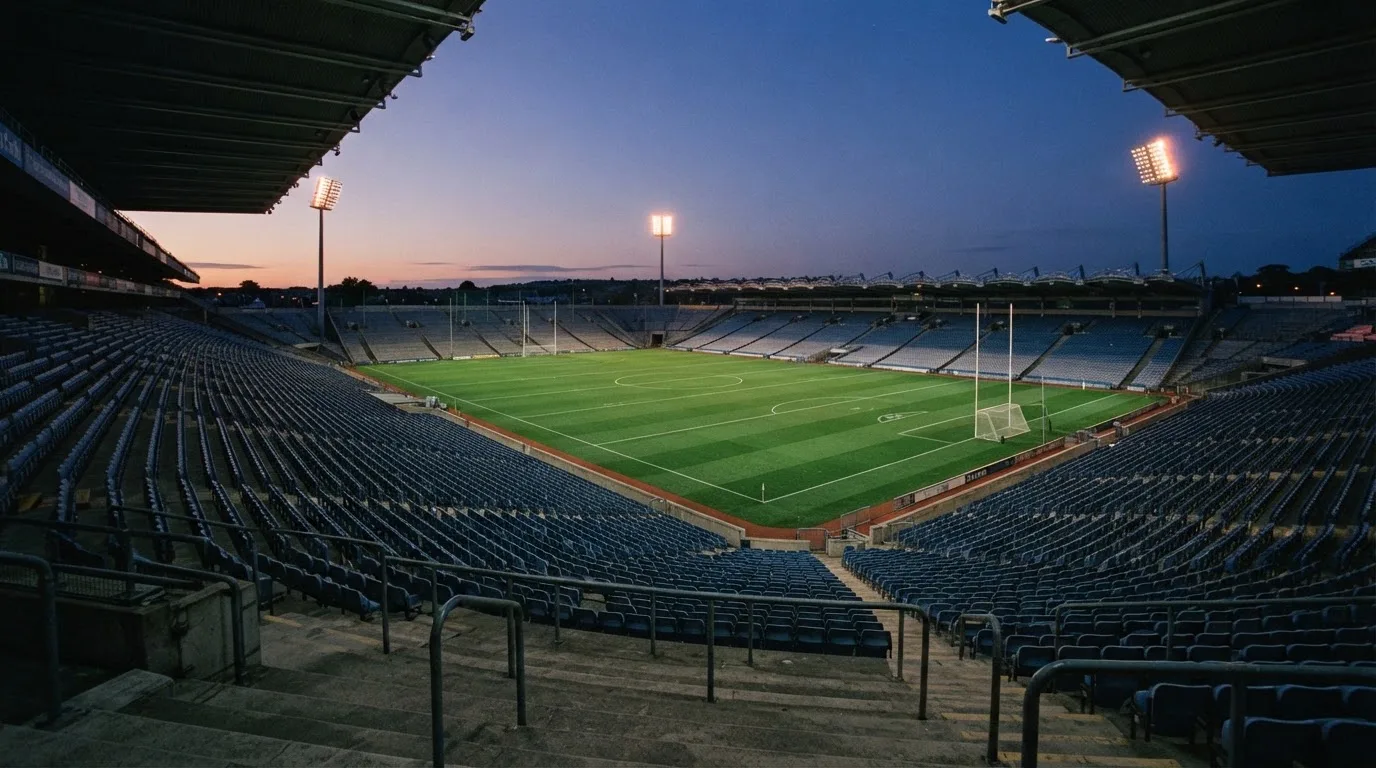
Gaelic football is the larger of the two Gaelic games, the other being hurling, and both are governed by the Gaelic Athletic Association. The All-Ireland Senior Football Championship final is held each year at Croke Park in Dublin, in front of the largest crowd of the GAA’s calendar. The senior inter-county game is fifteen-a-side, with up to fifteen substitutes of whom six may be used, and the match lasts seventy minutes — two halves of thirty-five. Most other adult matches run to sixty minutes, two halves of thirty. The pitch is a rectangle 130 to 145 metres long and 80 to 90 metres wide, and the goal is an H-shaped affair with a crossbar three metres up and a net below.
The scoring is the part the punter has to learn. A goal, scored by kicking or hand-passing the ball under the crossbar into the net, is worth three points. A point, scored by kicking or hand-passing the ball over the crossbar between the posts, is worth one. Since the 2025 rule changes, a shot from outside the new 40-metre arc — the two-point arc — is worth two points, which is the first time the GAA has tinkered with the goal/point ratio in living memory. The scoreboard reads goals-points, with the goals on the left, so a 1-20 to 1-17 final, like the 2026 final, reads as thirty-eight points to thirty-five.
The championship runs from January to July, with provincial championships in Munster, Leinster, Connacht and Ulster feeding into the All-Ireland series. The Super 8s were replaced by a round-robin All-Ireland group stage in 2020, and the knockout rounds run from quarter-finals through to the final on the last Sunday in July. The club championship runs underneath the inter-county calendar, with county championships feeding into All-Ireland club finals in March. The bookmaker’s year opens onto the same calendar, with markets priced from January through to the St Patrick’s weekend club finals and the summer inter-county run.
The punter who bets Gaelic football at a licensed British site is betting a sport whose main championship sits outside the British summer sporting calendar: Premier League football ends in May, the Championships and Wimbledon run in July, and the All-Ireland final takes its place in the bookmaker’s July marketing. The market is small relative to Premier League football — a typical All-Ireland final at a mainstream British bookmaker carries thirty to forty pre-match markets, against two hundred or more on a Premier League match — and the margin on Gaelic football is wider than on Premier League football for the reason above. The punter who treats Gaelic football as a small specialist market and prices it as such is the punter who reads the margin correctly.
Kerry hold the record for most All-Ireland Senior Football Championship titles, with 39. Dublin’s run through the 2010s saw them win six of the decade’s ten finals; Mayo’s 2026 title was their fourth, and ended a long wait for Sam Maguire. The formbook turns over more often than the league tables suggest, which is the single reason the All-Ireland final is one of the harder matches on the British calendar to call. The punter who looks at form and looks at the price, and bets the price that compares well to the form, is the punter who finds the edges the less attentive market leaves.
The ten licensed Gaelic football bookmakers in Great Britain
The ten brands below hold a Gambling Commission remote licence as of the register check behind the contents of this page. The list is the comparison the punter asked for; it is not a ranking, and a place in the list is not a recommendation. Each brand is licensed under the Commission’s remote general betting standard (real events) category unless the card says otherwise, and every brand on the list takes part in GAMSTOP. Brands run by the same licensee are named together because they are not independent operators.
| Brand | Licence Number | Licence Holder | Terms Focus |
|---|---|---|---|
| Matchbook | 39504 | Triplebet Limited | Exchange pricing and commission |
| 888sport | 39028 | 888 UK Limited | Boosted odds and BetFinder tools |
| Betfair | 39439 | PPB Counterparty Services | Sportsbook/Exchange dual product |
| Sporting Index | 27343 | Sporting Index Limited | Sports spread betting |
| NetBet | 39170 | Netbet Enterprises Limited | Daily boosts and dynamic odds |
| Coral | 54743 | LC International Limited | Market depth and welcome offer |
| Betmaster | 65699 | BM Solutions GB Ltd | eSports and traditional sports |
| Tote | 54779 | TDCO Limited | Pool betting on horse racing |
| Kalooki Sportsbook | 57730 | Kalooki Sportsbook Limited | Dedicated sportsbook platform |
| BetMGM | 39198 | LeoVegas Gaming PLC | Multiple free bets offer |
The licence numbers below are the Commission’s own account numbers, the form a punter enters into the register’s business-name or domain search to confirm a licence. The punter who wants to bet at any of these brands should check the licence number on the Commission’s public register before depositing; the register is the only test of a licence, and a brand that asks a punter to skip the check is a brand the punter should think twice about.
1. Matchbook
Matchbook is a betting exchange, which means the punter bets against other users, not against the bookmaker. The exchange’s prices are set by the users backing and laying, and the margin on a well-matched market is tighter than on a bookmaker’s equivalent because there is no built-in overround. The Commission licence covers remote betting intermediary, which is the licence category for exchanges, alongside the standard remote general betting licence. Matchbook offers Bet Builder, multiples, in-play betting and live streaming of horse racing and greyhounds inside the app. The licence holder is Triplebet Limited under Commission account 39504.
Matchbook is the choice for an exchange experience, providing deeper prices and the option to lay an outcome. It is a departure for anyone accustomed to fixed-odds books, as the back/lay mechanics and the commission structure on winning net returns differ from the standard hidden-margin model.
2. 888sport
888sport offers pre-match and in-play betting, Cash Out, Bet Builder, racing streams, BetFinder form tools, a live bet feed and daily boosted odds. The licence holder is 888 UK Limited under Commission account 39028. The brand sits inside 888’s broader gaming group, which is one of the larger names on the Commission’s register.
For a full-service experience featuring daily boosted-odds and form-finding tools, 888sport is a primary destination. Fixed-odds bettors will find the pricing architecture built around standard bookmaker margins rather than the tighter spreads found on betting exchanges.
3. Betfair
Betfair runs both a Sportsbook and an Exchange under the same brand. The Sportsbook is a fixed-odds bookmaker; the Exchange is the original peer-to-peer betting exchange, with prices set by users and a commission charged on net winnings. Betfair offers in-play betting, Bet Builder, free live streaming of events such as UK and Irish horse racing and football inside the app, and a 90 Minute Payout market on football that pays out if the backed team goes ahead by two goals. The licence holder is PPB Counterparty Services Limited under Commission account 39439.
Betfair provides the flexibility to choose between Sportsbook odds and Exchange prices on the same event. This dual-product interface requires a nuanced understanding, as settlements, pricing and cash-out features diverge significantly between the two sides of the platform.
4. Sporting Index
Sporting Index lets customers switch between fixed odds and spread betting on the same event. Spread betting is a financial product in some forms and a betting product in others; financial spread betting on price indices is regulated by the Financial Conduct Authority, while Sporting Index’s sports spread betting sits inside the Commission’s general betting regime. Sporting Index offers in-play betting, Bet Builder for football, auto cash-out and Multi-Markets. The licence holder is Sporting Index Limited under Commission account 27343.
Those familiar with the mechanics of spread betting, where the outcome’s variance directly affects the stake-multiplied return, will find Sporting Index appropriate. It is distinct from fixed-odds betting, with a higher volatility profile that demands caution regarding potential losses.
5. NetBet
NetBet offers Daily Boosts, Profit Boosts and free bet offers, a Bet Builder with instant dynamic odds, and sports stats for major leagues. The licence holder is Netbet Enterprises Limited under Commission account 39170. The brand is one of the smaller names on the Commission’s register by visibility, but it holds the same remote general betting standard licence as the larger brands.
NetBet caters to users seeking daily promotional boosts and Bet Builder functionality with real-time odds adjustments.
6. Coral
Coral’s sports welcome offer is “Get £40 in Free Bets when you bet £20”: a deposit and a sports bet of £20 or more at minimum odds of 2.0 (1/1), with £40 in free bets issued within seven days and expiring seven days after issue, for new GB customers who opt in. Coral offers in-play betting, Bet Builder, and a wide range of pre-match markets across football, horse racing and other sports. The licence holder is LC International Limited under Commission account 54743; Coral runs alongside Ladbrokes under the same licensee.
Coral is a strong option for those prioritising headline welcome offers and extensive market depth. Fixed-odds bettors should note that pricing follows standard bookmaker margin structures.
7. Betmaster
The Betmaster app is published by BM Solutions GB Ltd and covers football, cricket, horse racing, NFL and eSports betting, with League of Legends and Dota 2 listed as the eSports markets. The licence holder is BM Solutions GB Ltd under Commission account 65699. The brand is one of the newer names on the Commission’s register.
Betmaster integrates an eSports-heavy offering alongside a traditional sports book, suitable for a balanced betting approach.
8. Tote
Tote is the pool-betting brand, originally the UK Tote established by Parliament and now a private operator. Tote runs pool betting on horse racing, where the payout is a share of the pool rather than a fixed-odds return, and offers fixed-odds sports betting alongside it. The licence holder is TDCO Limited under Commission account 54779. The Commission’s licence covers remote general betting standard (real events); pool betting on horse racing sits under a separate licence category.
Tote remains the standard for pool-betting on racing, relying on dividend-based payouts. Its fixed-odds product is essentially a secondary offering to the core pool business.
9. Kalooki Sportsbook
Kalooki Sportsbook is operated by Kalooki Sports Book Ltd, licensed by the Gambling Commission under account number 57730, and is a GAMSTOP member. It provides a straightforward sportsbook platform for traditional betting.
Kalooki Sportsbook serves bettors looking for a dedicated and compliant fixed-odds environment.
10. BetMGM
BetMGM’s sports welcome offer for new UK customers who deposit £10 or more and place a sports bet within seven days is four £10 free bets (two football accumulators of four-plus selections and two sports multiples of two-plus), valid for seven days with minimum odds and opt-in required. BetMGM offers in-play betting, Bet Builder and a sports book alongside its casino product. The licence holder is LeoVegas Gaming PLC under Commission account 39198.
BetMGM offers an appealing multi-bet welcome package. Users should carefully review the terms, particularly the non-returnable stake condition common to free-bet offers, to avoid misinterpreting the actual value.
How a Gaelic football bet pays back: the arithmetic of the price
A Gaelic football bet at decimal odds of 1.90 on the team that wins returns £19 on a £10 stake: the £10 stake plus £9 of profit. The calculation is stake × odds in decimal, with the net profit being stake × (odds − 1). A £10 stake at 3.00 returns £30, of which £20 is profit; a £10 stake at 6.00 returns £60, of which £50 is profit. The arithmetic is the same on every licensed site because decimal odds are the same number in every cashier.
A combination bet multiplies the odds of the legs into one price. A treble at legs of 2.00, 3.00 and 5.00 is priced at 30.00 in decimal; a £1 stake returns £30, of which £29 is profit. The longer the combination, the bigger the headline price and the wider the compounded margin. A four-fold at legs of 2.00, 2.00, 2.00 and 2.00 is priced at 16.00, but the margin on each 2.00 leg is around 5 %, so the compounded margin on the four-fold is closer to 19 % — the bookmaker keeps nearly a fifth of every pound bet on the ticket.
The margin of a market is the share of every pound bet that the bookmaker keeps in the long run. On a two-way match result at decimal prices of 1.90 / 1.90, the arithmetic is: the sum of the reciprocals is 2 × (1 ÷ 1.90), which is 1.0526; the payout share is 1 ÷ 1.0526, which is 0.9500; the margin is 1 minus 0.9500, which is 5.00 %. Every pound bet on that market returns 95p in the long run, and the bookmaker keeps 5p. That 5 % margin is the price the punter pays for the bet, hidden inside the prices rather than charged as a fee.
Move the prices to 1.80 / 1.80 and the margin widens. The reciprocal sum becomes 2 × (1 ÷ 1.80), which is 1.1111; the payout share is 0.9000; the margin is 10.00 %. Move the prices to 1.95 / 1.95 and the margin tightens. The reciprocal sum is 2 × (1 ÷ 1.95), which is 1.0256; the payout share is 0.9750; the margin is 2.50 %. The competitive band on a Gaelic football match result at a mainstream British bookmaker runs between 2 % and 8 %, and the band on a Gaelic football match result on a Bet Builder ticket runs wider because the combined market is priced with a larger overround.
The expected cost of clearing a bonus is turnover × margin. A £10 bonus with a 10x rollover at a market carrying a 5 % margin costs the punter 10 × £10 × 5 %, which is £5 in expected loss, before any consideration of variance. That is the price the punter pays to clear the bonus; the headline value of the bonus is the gross amount, not the net amount, and the difference between the two is the margin on the qualifying bets.
The legal frame: the Gambling Commission and what it actually requires
The Gambling Commission is a non-departmental public body sponsored by the Department for Culture, Media and Sport, and it regulates the whole commercial gambling market in Great Britain under the Gambling Act 2005. The Act covers England, Scotland and Wales; Northern Ireland is outside the Act and runs on its own older law. Since the Gambling (Licensing and Advertising) Act 2014 an operator whose remote facilities are used in Great Britain needs a Commission licence wherever it is based, and a Curaçao, Maltese or Gibraltar licence is not a substitute. Sections 33 and 36 of the 2005 Act, as amended, are the relevant provisions; providing gambling facilities in Great Britain without the licence the Act requires is an offence under section 33, and on summary conviction the penalty is up to 51 weeks’ imprisonment, a fine up to level 5, or both — six months in Scotland.
The licence categories that cover the brands on this list are remote general betting standard (real events), remote general betting standard (virtual events), remote general betting limited, remote pool betting and remote betting intermediary. The Commission’s public register can be searched by business name, trading name, domain or account number, and the register is the whole test of whether a brand holds a licence. There is no state monopoly on betting licences and no statutory cap on the number of licences issued. There is also no statutory list of permitted sports or markets: a bookmaker licensed for remote general betting standard (real events) decides which markets to offer under its own rules and the Licence Conditions and Codes of Practice (LCCP).
In-play betting on Gaelic football is offered by GB bookmakers under the same controls as any other in-play market. The controls are the operator’s licence conditions and customer-protection duties; the law does not single out in-play as more or less restricted than pre-match. Esports are treated like any other event under remote general betting standard (real events); virtual events are a separate licence category. Bets on politics, TV shows and novelty markets are offered by GB bookmakers and no statutory prohibition was found. Betting exchanges run under a betting intermediary licence; rates and rules specific to exchanges are stated only from each exchange’s own terms.
Financial spread betting is regulated by the Financial Conduct Authority, not the Commission, where it is a financial product. Sports spread betting sits inside the Commission’s general betting regime, and Spreadex, which holds both an FCA licence for spread betting on financial products and a Commission licence for fixed-odds betting, is the clearest example of the dual regime. The punter who bets a financial spread bets inside the FCA regime; the punter who bets a sports spread bets inside the Commission regime, and the customer-protection rules differ between the two.
The minimum age is 18. Identity verification — name, address and date of birth — has been a precondition of the first deposit since 7 May 2019, including where the first product the punter touches is a free bet or a bonus. The verification sits in front of the deposit, not behind it, and the punter who cannot or will not verify cannot deposit or gamble at a licensed site. There is no anonymous play at a British-licensed Gaelic football bookmaker, and there is no way to route around the verification through a free-bet claim.
Credit cards have been banned for gambling in Great Britain since 14 April 2020, including credit-card-funded payments through an e-wallet. Debit cards and bank-based payments are not covered by that ban. The Commission’s view, set out in its guidance, is that the spirit of the ban reaches any route that ultimately draws on a credit product — a debit card on a fiat off-ramp, a card-issued stablecoin, a margin trade to acquire the token — and most British gambling operators apply that view in their cashier pages.
The tax position for the punter is that betting winnings are not taxed in Great Britain. General Betting Duty is the operator’s tax on gross profits, currently 15 %; from 1 April 2027 a new remote betting rate of 25 % applies within it, while remote bets on UK horse racing, bets on self-service betting terminals in licensed premises, pool betting and in-person betting stay at 15 %. Until 1 April 2027 the remote rate stays at 15 %; whether operators pass duty on through odds is not established, and a punter should never assume the bookmaker is charging duty. Spread betting has its own rates: 3 % on financial, 10 % on other. A professional gambler should ask HMRC or an adviser; the tax treatment of a professional’s betting income is a different question from the tax treatment of a recreational punter’s winnings.
The Commission’s own levy is a separate charge on operators and is not a tax on the punter. The Commission’s enforcement powers include fines, licence reviews, operating-condition suspensions and, more recently, court-order DNS blocking powers. Enforcement against unlicensed operators is disruption rather than blocking: cease-and-desist notices, search-engine referrals, work with registrars, hosts and payment providers. The punter who sees a brand advertising in Great Britain is the punter who should check the Commission’s register, and the punter who finds no licence is the punter who has found the most important fact about that brand.
Offshore Gaelic football bookmakers and what the punter gives up
An unlicensed Gaelic football bookmaker is not illegal for the punter to use. No offence aimed at a customer who merely bets on an unlicensed site was found in the Gambling Act 2005 or its related provisions; the offences are aimed at the operator, and the operator’s penalty is the section 33 sanction above. The punter who bets at an unlicensed site does not commit an offence in Great Britain, and the punter who reads “illegal” on a comparison page is reading a comparison page that has not read the statute.
What the punter gives up at an unlicensed site is the protection regime. There is no GAMSTOP coverage, no Commission complaints route, no approved dispute-resolution body, no British consumer redress if funds are withheld, and no obligation on the operator to honour the 10x bonus cap, the £150 vulnerability check or the verification regime. The operator is under no British duty to pay out winnings at all, and the punter who disputes a withdrawal is disputing it with an operator in a different jurisdiction under that operator’s house rules. The punter who is comfortable with that trade is the punter the offshore brand is priced for.
The offshore brand is also free of the LCCP marketing conditions, the CAP Code restrictions, the whistle-to-whistle rule on TV advertising and the Premier League shirt-sponsorship withdrawal that runs from 2026/27. The marketing an unlicensed brand can run is the marketing the licensed brand cannot, and the punter who is being marketed at by an unlicensed brand is being marketed at with the full force of an unregulated promotional economy. The punter who sees a “200 % bonus” headline at an unlicensed site is the punter who should read the rollover before depositing, because the rollover is the price of the headline.
The honest framing is this. A licensed site takes the punter’s details, in exchange for the protections named in the section on the legal frame. An unlicensed site takes the deposit and is under no British duty to give either back. Neither is “the safe choice” by default, and the punter who wants the protection of a British licence chooses the licensed site; the punter who wants the offer or the payment rail an unlicensed brand provides chooses the unlicensed brand and accepts the cost. The comparison on this page is between licensed brands, because the licensed brands are the brands a British punter can verify, complain about and recover from.
The licence check and the Commission’s public register
The Commission’s public register is the whole test of who holds a licence. A brand is licensed if the Commission’s register finds it, and the brand is unlicensed if the register does not find it. The punter who wants to check a brand before depositing searches the register by business name, trading name, domain or account number, and the search returns the licence details, the licence holder and the categories on the register. The account number is the most reliable search field, because it is the licence’s primary key on the register; the domain is the least reliable, because licensed operators use both .com and .co.uk and the domain proves nothing on its own.
The brands on this ranking hold the following Commission account numbers: Matchbook 39504, 888sport 39028, Betfair 39439, Sporting Index 27343, NetBet 39170, Coral 54743, Betmaster 65699, Tote 54779, Kalooki Sportsbook 57730, BetMGM 39198. A punter who wants to verify any of them enters the number into the register’s account-number search and confirms the licence holder and the categories match the brand’s marketing. The punter who finds a mismatch — a brand claiming a licence under one name and registered under another, or a domain on the register that does not match the domain in the cashier — is the punter who should think twice before depositing.
The Commission’s register is updated when licences change, when operators notify changes of corporate structure and when the Commission takes regulatory action. A licence that is suspended or under review is marked on the register; a licence that has been revoked is removed. The punter who checks the register on the day of deposit is the punter who has the most accurate view, and the punter who checks again on the day of withdrawal is the punter who has the view the Commission would want them to have. Both checks take less than a minute, and the second check is the one that matters when something has gone wrong.
What Gaelic football betting actually looks like in Great Britain
Gaelic football is a small specialist market on the British betting calendar, and the punter who bets it should expect to pay a wider margin than on Premier League football. The market is priced by fewer brands, the prices diverge more widely, and the punter who holds accounts at three or four licensed brands and shops the price is the punter who finds the edges. The match result market, the total points market and the handicap market are the markets the bookmaker has priced most efficiently; the Bet Builder market, the in-play market and the combination market carry higher margins and the punter who bets them pays for the convenience.
The bookmakers on this ranking cover the All-Ireland Senior Football Championship, the provincial championships and the club championships underneath, and the prices tighten into the All-Ireland final as the event approaches. The form book says Mayo won the 2026 final on 26 July 2026 at Croke Park, beating Kerry 1–20 to 1–17 for a fourth title; the form book also says Kerry hold the championship record with 39 titles, and that the formbook turns over more often than the league tables suggest. The punter who bets the All-Ireland final bets the hardest match on the British calendar to call, and the price that looks generous is rarely as generous as it looks once the margin is taken out.
The cost of a Gaelic football bet, in pounds, is the stake. The cost of a Gaelic football bet, in expectation, is stake × margin. The punter who knows the second number is the punter who sees the price for what it is, and the punter who bets the market knowing the second number is the punter who walks away with money in their account at the end of the year. The arithmetic is on the page above; the rest is the discipline to use it.
Frequently asked questions on Gaelic football betting in Great Britain
How do you bet on Gaelic football?
Pick a licensed British bookmaker from the comparison above, open an account, verify your name, address and date of birth, deposit by debit card or bank transfer, and find the Gaelic football section in the sportsbook. The All-Ireland Senior Football Championship is the main fixture list, with provincial and club championships underneath. Match result, total points over/under and handicap lines are the most-priced markets; Bet Builder and in-play markets are also available at most brands. Place the bet, confirm the price, and the bet settles at the end of the match.
How do you check that a bookmaker holds a Gambling Commission licence?
Go to the Gambling Commission’s public register, search by business name, trading name, domain or account number, and confirm the brand appears with a current remote general betting standard (real events) or remote betting intermediary licence. The account number on the register should match the account number on the brand’s own terms page. A brand that does not appear on the register, or that appears under a different name or with a different domain, is not a brand to deposit with.
How is the return on a bet worked out from the stake and the odds?
The return is stake × odds in decimal. A £10 stake at 3.75 returns £37.50, of which £10 is the stake returned and £27.50 is profit. The net profit is stake × (odds − 1). A combination bet multiplies the odds of the legs into one price: a treble at legs of 2.00, 3.00 and 5.00 is priced at 30.00, and a £1 stake returns £30, of which £29 is profit.
What is the bookmaker’s margin and how is it visible in the odds?
The margin is what the bookmaker keeps of every pound bet on a market in the long run. It is calculated as 1 minus the payout share, where the payout share is 1 divided by the sum of the reciprocals of all prices on the market. On a two-way market at 1.90 / 1.90, the payout share is 95.00 % and the margin is 5.00 %. The wider the margin, the more the bookmaker keeps, and the more the punter pays to bet into that market.
How do fractional odds such as 5/1 convert to decimal odds such as 6.00?
The conversion is a ÷ b + 1. A 5/1 shot becomes 5 ÷ 1 + 1, which is 6.00 in decimal. A 11/4 shot becomes 11 ÷ 4 + 1, which is 3.75. Evens at 1/1 becomes 1 ÷ 1 + 1, which is 2.00. The reverse conversion from decimal is odds − 1, expressed as a fraction in the British form (5/1, 11/4, evens).
Which tools for controlling play does a licensed bookmaker have to offer?
A licensed British bookmaker has to offer GAMSTOP self-exclusion for periods of six months, one year, five years or five years with auto-renewal; deposit limits on a fixed time frame (the rules have been phased in since 31 October 2025, with a second phase postponed to 30 September 2026); a financial vulnerability check that triggers once deposits net of withdrawals exceed £150 across a rolling 30 days; timeouts and reality checks; and links to GamCare’s National Gambling Helpline, GambleAware and the NHS gambling clinics. Identity verification sits in front of the first deposit, so the punter cannot play anonymously at a licensed site.
Rugby, cricket & Gaelic – Best betting exchange
Content created by the «Best betting exchange» team
