
Formula 1 betting odds in 2026: how prices are set and what licensed UK bookmakers actually offer
 Available in US
The honest starting point is dull: a Formula 1 betting market is a list of numbers, every number carries the bookmaker’s margin inside it, and no odds board tells the bettor where the margin sits. A price of evens (2.00 decimal) on two drivers in a fair market would mean the bookmaker expects each to win half the time; the bookmaker is not being generous, he is taking a cut, and the cut is the difference between the “true” probability and the price. The page below is a guide to what that means in practice — the season that’s running, the rules the sport and the regulator set, the licensed bookmakers in Great Britain, and the arithmetic a punter needs to read a price before staking on it.

Last verified: 27 October 2026 · checked against the Gambling Commission’s public register.
Staying in control while betting on Formula 1
The fastest way to lose a season-long interest in Formula 1 is to let the betting account run it. A 23-race calendar with sprints and six Saturday races in select weeks can absorb a small budget quickly, and motor racing markets settle fast — a Safety Car at lap one can void half an in-running ticket in the time it takes the bookmaker to settle the bet. The protection the law gives a British bettor in 2026 is more than it was a few years back, and it begins with the operator.

A bookmaker serving customers in Great Britain needs a Gambling Commission licence. The licence brings an obligation to offer tools for controlling play, and the tools are standardised: deposit limits, reality checks, time-outs, product blocks and self-exclusion through GAMSTOP, the national multi-operator online self-exclusion scheme. GAMSTOP is mandatory for online operators and covers exclusion periods of six months, one year, five years, or five years with auto-renewal, and after the minimum period the exclusion remains in force for a further seven years unless the customer asks GAMSTOP to remove it. The scheme covers online sites and apps; the betting shop has a separate service.
Beneath those headline tools sit quieter rules worth knowing about. A financial vulnerability check has applied to licensed remote betting since 30 August 2024, and from 28 February 2025 it triggers once a customer’s deposits minus withdrawals exceed £150 in a rolling 30 days. It is a public-record check (bankruptcy, county court judgments and the like) and is not an income check. A second, more demanding tier — financial risk assessments, the press’s “affordability checks” — has been announced in a staged plan with no start date. Deposit limits under the Remote Technical Standards (RTS 12) have applied in a first phase since 31 October 2025; a second phase was postponed to 30 September 2026, and whether it is live is not established. There is no state-set deposit or loss ceiling: the limit is the customer’s choice.
The help lines are the same across every licensed operator. GamCare runs the National Gambling Helpline, GambleAware funds treatment and education, the NHS runs gambling clinics, and Gamblers Anonymous runs peer support. The licensed bookmakers named later in this article all link to one or more of them from the safer-gambling page; an operator that does not is missing a basic feature of the licence.
What an unlicensed bookmaker cannot offer is the protection of the licence. A bet on an unlicensed site is not illegal for the customer, but the bookmaker is breaking section 33 of the Gambling Act 2005 at the point of consumption, and the bettor loses the practical protections: no GAMSTOP coverage, no Commission complaints route, no approved dispute-resolution body, no British consumer redress if funds are withheld, no 10x bonus cap and no financial vulnerability check. Honest framing: licensed means checks, limits, GAMSTOP and the bonus cap, but also identity verification before the first deposit; unlicensed means none of those. Neither is “the safe choice” by default.
Practical controls for a motor-racing punter
Three habits cut most of the harm before any rule kicks in. First, set a deposit limit before the first bet, not after a bad Saturday — most operators will let the limit be lowered immediately and raised only after a cooling-off period. Second, treat each Grand Prix as a single session with a fixed stake, not a venue for chasing outstanding bets when a Safety Car scrambles an in-running ticket. Third, use the product blocks: most operators will let a customer block casino, slots or bingo while leaving sports betting open, and for a punter who finds himself drifting from racing into novelty markets, blocking the unfamiliar categories is the cheapest discipline there is.
Betting on Formula 1 from a phone in 2026
A motor-racing calendar does not wait for a desktop. Practice sessions run during British working hours on Fridays; sprint qualifying and the sprint itself crowd into Saturdays; the race starts late on Sunday for European rounds and in the small hours for races in Singapore, Japan and Las Vegas. The bookmaker a punter uses needs to be open on a phone, fast on a phone, and unsurprising on a phone — three things the comparison below takes seriously.
The mobile experience for Formula 1 in 2026 divides into three layers. The first is the native app: most major bookmakers ship an iOS app and an Android app from their own site, and the App Store age rating sits at 17+ for several of them, reflecting the gambling content. The second is the mobile site: every licensed operator in this comparison renders cleanly on a phone browser, with a collapsible menu, a sticky bet slip and one-tap access to in-play. The third is the in-app experience itself, where the gaps open: live streaming needs rights under access to the feed, in-play markets need a fast price engine, and Bet Builder needs a deep enough Formula 1 market to make a same-race multi more than three legs.
What a good Formula 1 mobile bookmaker does well
Four features separate a usable racing app from an ordinary sportsbook. Live streaming matters because motor racing is a visual sport: a live tracker that places cars on a circuit map adds information a static odds screen cannot, and the best in-app trackers carry tyre compounds, gaps to the car ahead and pit-window countdowns. In-play betting needs granular markets at sensible intervals — not only “winner” but “fastest lap”, “podium finish”, “head-to-head”, “Safety Car in the next 5 laps” and the team-specific markets the bookmaker builds around its own prices. Cash out lets a punter close a position mid-race; full cash out closes the whole bet, partial cash out books a part of the share and leaves the rest running. Push notifications are a fourth, more divisive feature: alerts for every race start, every Safety Car and every odds move can be useful for a punter who bets in-running, and a nuisance for one who does not — most apps will let the customer choose the categories.
The choice between an app and a browser is largely a matter of habit. An app is better for live streaming, push alerts, biometric login and a one-tap bet slip; a browser is better when a punter wants to compare prices across two bookmakers side by side without installing either. Some operators restrict features to the app — Bet Builder on a Formula 1 race is more complete on the app than on the browser at several bookmakers — and the section on each operator below notes where that gap matters.
Reading predictions and strategy for Formula 1
The honest framing of any “prediction” page on motor racing is short: a Formula 1 race is decided by a machinery of more than 700 pieces on each of 20 cars, run by 11 teams spending more than £200 million apiece, on circuits that change grip from session to session. No model, no tipster and no bookmaker knows who will win a race before it starts, and any page that names a “sure” winner is selling something other than analysis. What a punter can do is read the markets that the sport’s structure makes easier to price than the winner market — qualifying markets, fastest-lap markets, head-to-heads between team-mates, and the team-specific markets that turn on form rather than outright pace.
The starting point is qualifying. A Formula 1 race is decided by track position more than any other variable the bookmaker can price, and qualifying position is more predictable than race position because the session is short, the conditions are stable and a single lap carries less variance than 60. Prices on pole position and the top three in qualifying carry a smaller margin than the race-winner market at most bookmakers, because the qualifying market draws more money in sharper markets. For the same reason, the head-to-head market between two team-mates — the “match bet” between the two McLarens, for example — is more efficient than the outright: it removes the car-versus-car variance and leaves the driver-versus-driver variance, which is smaller and easier to price.
The other anchor is the form cycle. Formula 1 in 2026 runs under new technical regulations — the MGU-H has been removed, the MGU-K output has risen from 160 bhp to 470 bhp, DRS has been replaced by active aerodynamics, and the team cost cap has risen from $135M to $215M — and the field reorders at the start of a regulation change in a way no pre-season test fully reveals. The first three or four races of a regulation cycle are the most volatile of the season for prices; the last third of the season, with development stabilised and the constructors’ championship often settled, is the most predictable. A punter who watches the regulation cycle closely can read the early races with a margin the season-end prices do not always offer.
The category-by-category guide below is what a punter can use without a model.
Markets the structure of Formula 1 makes cheaper to bet on
The cheapest markets on a Formula 1 race for the punter are not the ones the headline odds board leads with. Qualifying markets draw money from sharper markets and carry a smaller margin. Head-to-head markets between team-mates, where the car is the same and the driver is the only variable, are more efficient than the outright because the variance is smaller. Fastest-lap markets have settled into a small set of patterns at most circuits and carry lower margins than the race winner. The team-specific markets — “McLaren to finish 1-2”, “Ferrari on the podium”, “a Mercedes win from the front row of the grid” — turn on the team-versus-team comparison rather than the car-versus-car variance of the winner market, and a punter who reads team form carefully can find value there.
The most expensive markets are the longshots. A safety-car-every-lap novelty market, a “both cars to retire in the first lap” market, and the exotic match bets on an under-performing team carry the highest margin on most bookmakers because the volume is low and the price can be set wide without drawing sharp money. A punt on a longshot is paying for the bookmaker’s margin before it pays for the bet, and a punter who plays longshots should be aware that the margin is the first thing they are buying.
Bankroll discipline on a 23-race calendar
The arithmetic of a season is simple and unforgiving. With 23 Grands Prix and six sprint events, the season runs from the Australian Grand Prix at Albert Park on 8 March 2026 to the Abu Dhabi Grand Prix at Yas Marina on 6 December 2026 — 39 sessions of competitive running if sprints are counted, and a small stake on each session adds up to a season that costs more than the punter remembers. A flat unit — a fixed stake on every selection regardless of price — is the discipline that keeps a season-long interest alive. A punter who varies the stake with confidence is, in most cases, varying the stake with recency, and recency on a regulation-change season is the worst guide there is.
The cycle is also where the discipline breaks. After a regulation change the early races are volatile; mid-season, when the field stabilises, the prices tighten; late in the season, when the constructors’ championship is settled, the value shifts to the drivers’ championship. A punter who plays flat through the early races and tilts the stake only when the cycle gives them an edge is doing what a model would do; a punter who varies the stake by confidence is doing what memory does, and memory is the worst price engine in motor racing.
The licensed UK bookmakers reviewed
Ten operators are reviewed below. Each one holds a Gambling Commission remote licence for general betting standard (real events); each one is listed on the Commission’s public register against a named licence holder; each one takes part in GAMSTOP. The set is not a ranking and not a recommendation — the Commission’s register lists many more brands than any article features, and no single brand is “the only” licensed one. The reviews are written from the operators’ own published terms, and each closes with the page’s own judgement of what the operator is worth, and to whom.
The comparison table at the end of this section sets the same facts side by side: the Commission account number, the licence holder, and what the operator’s own terms state on a key feature for Formula 1 betting.
Midnite
Midnite holds Gambling Commission account 101839, with Midnite Limited named as licence holder. The site offers in-play events, an acca builder, popular accas and price boosts with maximum-stake limits stated on the boosted lines. The sports welcome offer, as Midnite’s App Store listing states it, gives new customers £25 in free bets and 50 free spins for a £5 or more pre-match bet at evens (2.0) or greater, placed within 14 days of sign-up; the free bets and spins are valid for 7 days. The site carries the safer-gambling basics and lists Midnite Limited as the licence holder named on the Commission’s public register.
The price boosts are the feature most worth weighing. A boosted price on a Formula 1 market is a higher margin dressed as a favour — the bookmaker is paying above his own line on a specific outcome — and the question for the punter is whether the boost covers the wider margin Midnite carries on its un-boosted racing markets. For a punter who bets selectively on boosted lines and skips the rest of the card, the offer is workable. For a punter who bets the whole card, the un-boosted margin is what pays the boosted headline.
Betboro
Betboro holds Gambling Commission account 44181, with Webmedia Development N.V. named as licence holder. The site offers in-play markets and cash-out on football, racing and tennis, boosted odds on selected singles from £10 stakes, and a safer-gambling page covering deposit limits, reality checks and self-exclusion. The site does not advertise Best Odds Guaranteed on horse racing in the same form as the racing-focused bookmakers below; the racing offer is the boosted-odds line.
For a punter whose interest in Formula 1 is a Saturday-and-Sunday affair with the occasional midweek sprint, Betboro is one of the cheaper places to start: the boosted-odds feature on a singles market from £10 is a low entry point, and the cash-out covers the in-running discipline most racing punters need. The thinner side is depth — a longshot market on a back-of-grid team is less complete than at the racing-focused brands.
Fafabet
Fafabet holds Gambling Commission account 57385, with Taichi Tech Limited named as licence holder. The site pays Best Odds Guaranteed on UK and Irish horse racing win and each-way bets from 9am on race days: if the starting price is bigger than the original price, the bigger odds are paid. The racing offer sits alongside a sportsbook with the standard menu of in-play and pre-match markets. Formula 1 falls under the sportsbook, not the horse-racing offer, and the BOG feature is what carries the racing reputation; the Formula 1 offer is the standard bookmaker offer of race winner, podium, head-to-head and fastest lap.
For a punter whose primary interest is British and Irish racing with a side interest in Formula 1, Fafabet is a clean fit: BOG on racing from 9am is a real feature, the racing margin is competitive, and the Formula 1 card carries the markets a Saturday punter needs. For a punter whose primary interest is Formula 1, the racing feature is irrelevant and the un-boosted sportsbook is the comparison point.
Octobet
Octobet holds Gambling Commission account 62545, with Octopus Game Limited named as licence holder. The site pays Best Odds Guaranteed on UK and Irish horse racing, up to £150 per customer per race. The sportsbook carries the standard menu for motor racing — race winner, podium, head-to-head, fastest lap, qualifying pole — with in-play on the race itself.
The £150 cap on BOG is the key figure: a punter who backs a longshot horse at a big price will have the BOG honoured up to £150 per race and no further, which is a real ceiling on the offer for a high-stake racing punter. For a Formula 1 punter, the racing cap is irrelevant and the sportsbook is the comparison point. Octobet is one of the newer brands on the register; the depth of the in-play Formula 1 card is narrower than at the longest-established brands below.
BetTom
BetTom holds Gambling Commission account 64959, with Bet Tom Limited named as licence holder. The sports welcome offer, as BetTom’s App Store listing states it, is 50% back as a free bet of up to £50, with a matching 50% back up to £50 as free slot funds for casino play. The site carries the standard sportsbook and casino menu. The “50% back” framing is the kind of headline that needs reading carefully: a free bet, unlike a cash bonus, does not return the stake with a win, and the value of a £50 free bet at evens (2.00) is the expected value of £50 × (1.00) × the market payout share, which is closer to £45 than £50 once the market margin is netted.
For a punter who reads the small print, BetTom is a workable offer: the qualifying wagering terms are clearer than at several competitors, the free bet is usable on Formula 1 markets, and the casino half of the welcome offer is opt-in rather than mandatory. For a punter who reads only the headline, the offer is the half-page the marketing wants it to be.
bet365
bet365 holds Gambling Commission account 55148, with Hillside (UK Sports) ENC named as licence holder. The site offers in-play betting and live streaming of events worldwide, plus Bet Track, Match Live and a Live Golf Tracker for following bets in play. The in-play Formula 1 product carries the widest market depth of any bookmaker in this comparison: race winner, podium, top six, head-to-head, fastest lap, qualifying pole, constructor markets, and a deep selection of team-specific bets that turn on form rather than outright pace. Live streaming of Formula 1 practice, qualifying and the race itself sits behind the in-play product for funded accounts, and the Bet Track feature places cars on a circuit map with tyre compounds and gaps to the car ahead.
For a Formula 1 punter, bet365 is the operator that defines the comparison: the in-play depth is unmatched in the British market, the live streaming carries the sport the punter watches, and the margin on the major markets is at the tighter end of the British bookmakers. The thin side is the welcome offer — bet365’s headline offer changes regularly and is rarely the highest headline on the page — but the long-term value of a Formula 1 account sits in the in-play product, not in the welcome bonus. For a punter who bets Formula 1 across a season, bet365 is the brand the comparison starts from.
William Hill
William Hill holds Gambling Commission account 39225, with WHG (International) Limited named as licence holder. The site pays Best Odds Guaranteed on UK and Irish horse racing from 8am on the day of the race, on both single and multiple bets; it does not apply to ante-post, tote or pari-mutuel bets. The sportsbook carries the standard Formula 1 menu, and the in-play product carries the full range of race-day markets with cash out.
The BOG feature from 8am is the headline: a punter who backs a horse early in the day and sees the starting price drift up is paid the bigger odds, on singles and multiples alike. For a Formula 1 punter, the racing feature is irrelevant and the sportsbook is the comparison point. William Hill is the longest-established brand in the comparison, and the depth of the in-play menu on a Formula 1 race — winner, podium, top six, head-to-head, fastest lap, qualifying pole, each team’s two-car finishing position — is closer to bet365’s than to the newer brands’.
Spreadex
Spreadex holds Gambling Commission account 8835, with Spreadex Limited named as licence holder. The company is regulated by the Financial Conduct Authority for spread betting and by the Gambling Commission for fixed-odds betting, and the site states that spread betting losses can exceed the deposit. The new customer offer, as Spreadex’s own terms state it, is £60 in free bets for a £10 fixed-odds bet, with the free bets usable across fixed odds and spread betting; the qualifying bet must be placed within 28 days of opening the account.
The spread-betting product is what sets Spreadex apart from the rest of this comparison. A spread bet on a Formula 1 race is a bet on a make-up number — points scored, finishing position, gap to the next car — and the leverage is higher than a fixed-odds bet, with the corresponding increase in risk: a wrong-way move on a small-stake spread bet can lose more than the deposit. The fixed-odds sportsbook is the conventional offer, and the £60-in-free-bets welcome is competitive for a punter who plans to use the free bets across both products.
For a punter who wants the conventional fixed-odds experience with the option of a spread bet on a race, Spreadex is a clean fit. For a punter who wants only fixed odds, the spread-betting capability is irrelevant and the fixed-odds sportsbook is the comparison point — and on the fixed-odds product alone, the welcome offer is the main reason to open the account.
LiveScore Bet
LiveScore Bet holds Gambling Commission account 56859, with LiveScore Betting and Gaming (Gibraltar) Limited named as licence holder. The site accepts debit cards (Visa and Mastercard), Apple Pay, PayPal, Pay by Bank (Open Banking) and Revolut Pay, and the payment menu is the broadest in this comparison. The sportsbook carries the standard Formula 1 menu with in-play on race day.
The payment menu is the headline for a punter who values flexibility. A bettor who wants to fund the account from a bank account via Open Banking, from a debit card, from PayPal or from Revolut Pay has all four options at LiveScore Bet, and the Open Banking route in particular is what makes identity-verification-before-first-deposit frictionless — the same source-of-funds check the Commission requires is satisfied in a single step. The thinner side is welcome-offer depth: LiveScore Bet’s headline offer on Formula 1 is modest against the longer-established brands.
VBet
VBet holds Gambling Commission account 44662, with SCGO Limited named as licence holder. The app offers Bet Builder, pre-match and in-play betting, live streaming and a live calendar with results and stats. The Bet Builder on Formula 1 covers the legs a same-race multi punter wants — race winner, podium, head-to-head, fastest lap, qualifying pole — and the live calendar carries the session times a multi-session punter plans around.
The Bet Builder is the feature that sets VBet apart in this comparison. A punter who wants to build a same-race multi on a Formula 1 race — pole sitter to win, fastest lap to the pole sitter, both McLarens in the top six — has a complete builder at VBet where several competitors limit the builder to three legs or block it on race day. The thinner side is brand familiarity: VBet is less known to British punters than bet365 or William Hill, and the in-play depth on race day is narrower than at the longest-established brands.
The comparison at a glance
The table below sets the ten operators side by side on three matters: the Gambling Commission account number and licence holder, and what the operator’s own terms state on a key feature. The key feature chosen for each operator is the headline of the offer the operator itself leads with — the feature the marketing wants the punter to see first.
| Brand | Gambling Commission remote licence number and licence holder | What the operator’s own terms state on the key feature |
|---|---|---|
| Midnite | Account 101839, Midnite Limited | £25 in free bets and 50 free spins for a £5+ pre-match bet at 2.0 or greater within 14 days of sign-up; free bets valid 7 days |
| Betboro | Account 44181, Webmedia Development N.V. | In-play markets and cash-out on football, racing and tennis; boosted odds on selected singles from £10 |
| Fafabet | Account 57385, Taichi Tech Limited | Best Odds Guaranteed on UK and Irish racing win and each-way bets from 9am on race days |
| Octobet | Account 62545, Octopus Game Limited | Best Odds Guaranteed on UK and Irish racing, up to £150 per customer per race |
| BetTom | Account 64959, Bet Tom Limited | 50% back as a free bet up to £50, plus 50% back as free slot funds up to £50 |
| bet365 | Account 55148, Hillside (UK Sports) ENC | In-play betting and live streaming worldwide, with Bet Track and Match Live for following bets in play |
| William Hill | Account 39225, WHG (International) Limited | Best Odds Guaranteed on UK and Irish racing from 8am on race day, on singles and multiples |
| Spreadex | Account 8835, Spreadex Limited | £60 in free bets for a £10 fixed-odds qualifying bet within 28 days; usable across fixed odds and spread betting |
| LiveScore Bet | Account 56859, LiveScore Betting and Gaming (Gibraltar) Limited | Debit cards, Apple Pay, PayPal, Pay by Bank (Open Banking) and Revolut Pay supported |
| VBet | Account 44662, SCGO Limited | Bet Builder, pre-match and in-play, live streaming and a live calendar with results and stats |
The spread across the ten is what the comparison turns on. Three of the ten (Midnite, Spreadex, BetTom) lead on a welcome offer. Two (Fafabet, William Hill) lead on Best Odds Guaranteed for racing. One (Octobet) leads on Best Odds Guaranteed with a per-race cap. Two (bet365, VBet) lead on the in-play product. One (Betboro) leads on a boosted-odds feature with a low entry stake. One (LiveScore Bet) leads on payment flexibility. The choice for a punter is which of those headings the punter’s own betting pattern cares most about.
Formula 1 in 2026: the season and the technical picture
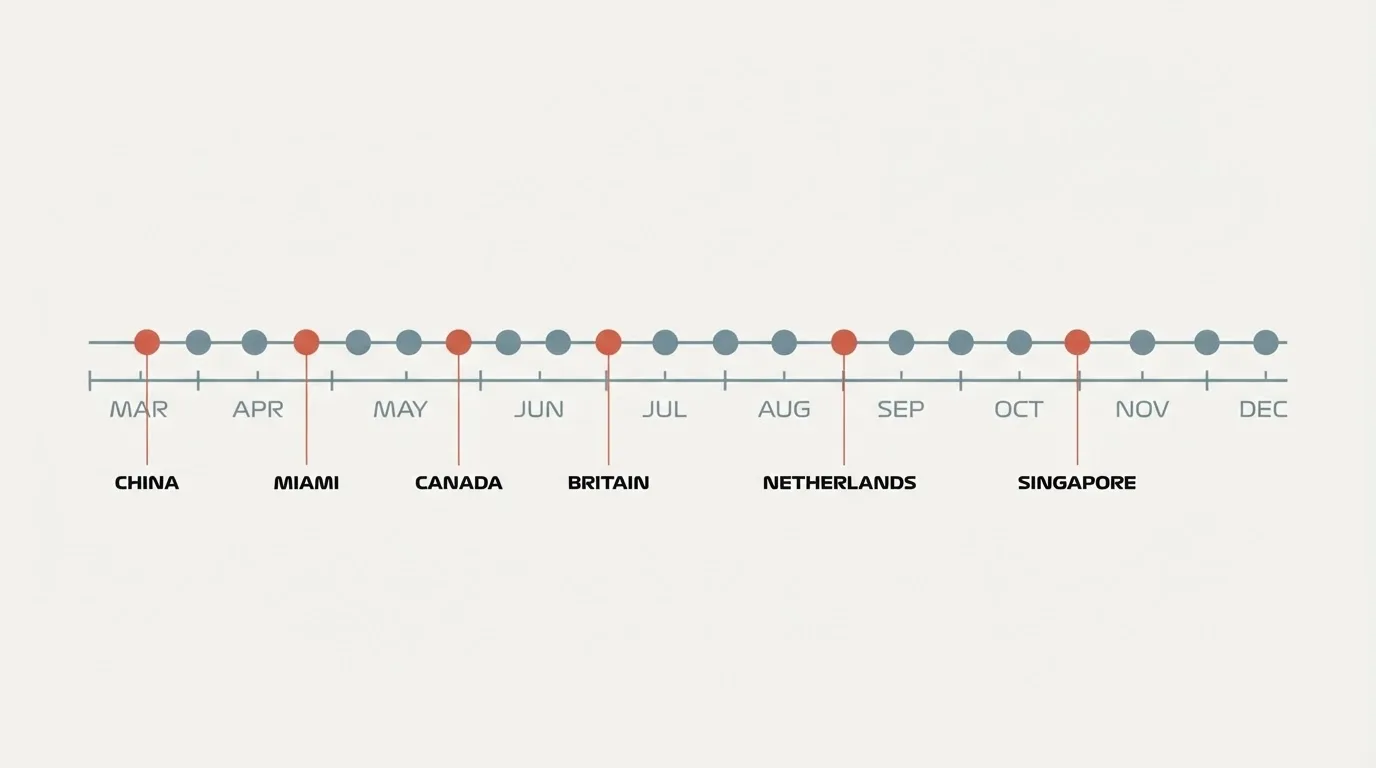
The 2026 FIA Formula One World Championship is the 77th running of the World Championship. The calendar was originally set at 24 Grands Prix with 11 teams; the Saudi Arabian Grand Prix was cancelled, leaving 23 races. The season opened with the Australian Grand Prix at Albert Park, Melbourne on 8 March 2026 and is scheduled to end with the Abu Dhabi Grand Prix at Yas Marina Circuit on 6 December 2026. The calendar includes six sprint events: China, Miami, Canada, Britain, the Netherlands and Singapore. Lando Norris is the reigning Drivers’ Champion into the season.
The technical regulations are new in 2026, and the changes reshape the price of every race. The MGU-H has been removed; the MGU-K output has risen from 160 bhp to 470 bhp (350 kW), more than doubling the electrical component of the power unit; DRS has been replaced by active aerodynamics; and the team cost cap has risen from $135M to $215M. Each change reorders the field in a way the pre-season testing only partly reveals, and the early races of a regulation cycle are the most volatile of the season for prices.
The sprint structure is the other headline of the calendar. Six Grands Prix in 2026 carry a sprint — a shorter Saturday race worth a smaller points allocation — and a sprint weekend turns a normal Saturday-Sunday schedule into a three-session weekend with practice on Friday, sprint qualifying and the sprint on Saturday, and the main race on Sunday. For a punter, the sprint weekend increases the number of betting sessions per weekend from two to three and tightens the time between sessions, which is where in-running discipline matters most.
What a punter should know about the new regulations
The MGU-K increase is the single biggest change in the technical picture. With electrical output more than doubling, the power unit is delivering more of the lap time electrically, and the energy-management story of each race is new. A punter who reads the race as a power-unit story rather than a chassis story is closer to the new reality, and the constructor markets — team-versus-team finishing position — carry the most information in this transition.
The active aerodynamics replacement for DRS is the second change. DRS was a manually opened flap on the rear wing, available when a car was within a second of the car ahead at a detection point; active aerodynamics is a more flexible system that the driver and the car manage together, with different modes for attacking, defending and following. The overtaking mechanic has changed, and the price of any “fastest lap” or “overtake on the next lap” market is set against the new system rather than the old one.
The cost cap increase is the third. With team budgets rising from $135M to $215M, the development war at the front of the grid has more money behind it, and the development cycle through the season is more aggressive. The implication for the punter is that prices set early in the season carry more uncertainty than in a stable-regulation year, and a market that opens before the third or fourth race is pricing more variance than it knows.
The rules that apply to a Formula 1 bet in Great Britain
The rules a British punter bets under are set by the Gambling Act 2005, the Gambling (Licensing and Advertising) Act 2014, the Licence Conditions and Codes of Practice (LCCP) the Gambling Commission issues, and the Remote Technical Standards (RTS) the Commission has enforced since 2019. The framework is wide and the parts that touch a Formula 1 bet directly are narrow; this section is the narrow part.
A bookmaker serving customers in Great Britain needs a Gambling Commission licence, and since the 2014 Act the licence is required at the point of consumption — wherever the operator is based, if his remote facilities are used in Great Britain he needs the licence. The Commission’s public register can be searched by business name, trading name, domain or account number, and is the whole test of who holds a licence. The set of operators above is taken from that register.
The minimum age is 18. The licence holder verifies the customer’s name, address and date of birth before the customer can deposit or gamble, including with a free bet or a bonus. There is no anonymous play at a licensed site, and source-of-funds questions at higher spend are normal under the money-laundering rules. A financial vulnerability check has applied to licensed remote betting since 30 August 2024, and from 28 February 2025 it triggers once a customer’s deposits minus withdrawals exceed £150 in a rolling 30 days. It is a public-record check, not an income check.
Bonuses are capped. Wagering requirements on bonuses are capped at 10x — a £10 bonus at 50x needs £500 of bets, and under the cap no more than £100 of bonus is allowed. Mixed-product promotions — an offer that requires gambling on two or more product types such as betting, casino, bingo and lottery, for example “bet on football to get free spins” — are banned in their current form. Whether the cap applies to free bets with no wagering condition, and any cap on the money value of a bonus, are not established.
Credit cards are banned for gambling in Great Britain since 14 April 2020, including credit-card-funded payments through an e-wallet; debit cards and bank-based payments are not covered. The player pays no tax on betting winnings in Great Britain. General Betting Duty is the operator’s tax on gross profits, currently 15%; from 1 April 2027 a new remote betting rate of 25% applies within it, while remote bets on UK horse racing, bets on self-service betting terminals in licensed premises, pool betting and in-person betting stay at 15%. The remote rate stays at 15% until 1 April 2027; whether operators pass duty on through odds is not established, and the player is never charged duty directly.
Advertising is not licensed by the Commission. It runs through the CAP Code (non-broadcast) and BCAP Code (broadcast), enforced by the ASA, alongside the LCCP marketing conditions. Marketing must be socially responsible, must not be of strong appeal to under-18s, and no one who is or seems to be under 25 may be featured gambling or play a significant role. The “whistle-to-whistle” rule is an industry code, not law: betting advertisements are not shown on TV from five minutes before a live sporting event to five minutes after it, before the 9pm watershed; horse and greyhound racing are excluded. The Premier League clubs’ withdrawal of gambling sponsorship from the front of matchday shirts from 2026/27 is voluntary, not law.
Northern Ireland is outside the Gambling Act 2005 and has its own older law; a “Great Britain licence” or “GB-licensed” framing is the correct one, and a GB licence does not regulate Northern Ireland.
Where the regulator stops and the operator begins
The Commission’s role is to licence the operator, set the licence conditions, and enforce them. The operator’s role is to set the markets, the prices, the stake limits and the customer terms within those conditions. The line between them matters: the Commission does not set the margin on a Formula 1 race winner market, the operator does; the Commission does not set the depth of the in-play menu, the operator does; the Commission does not cap the stake, the operator does. The Commission’s intervention is at the level of the licence: a £150 vulnerability check, a 10x bonus cap, a ban on mixed-product promotions, a ban on credit cards, mandatory GAMSTOP. The operator’s choices are everything else.
That line is also where the comparison in the table above sits. The Commission account numbers and licence holders are the regulator’s data; the “what the operator’s own terms state” column is the operator’s. The two columns together tell the punter where the licence ends and the marketing begins.
Frequently asked questions
How do I bet on Formula 1 in Great Britain?
Pick a bookmaker that holds a Gambling Commission licence, verify your identity (name, address, date of birth), set a deposit limit, and choose a market on the race — race winner, podium, head-to-head, fastest lap, qualifying pole. Place the bet from a debit card or bank-based payment; credit cards are not allowed. The minimum age is 18, and the operator checks identity before the first deposit.
How can I check that a bookmaker holds a Gambling Commission licence?
Use the Commission’s public register, searchable by business name, trading name, domain or account number. A licensed operator is listed there against a named licence holder. The register is the whole test of who holds a licence, and the licence is required at the point of consumption, wherever the operator is based.
How is the return on a bet worked out from the stake and the odds?
The return on a winning bet is stake × odds. At decimal odds of 2.00, a £10 stake returns £20; at odds of 6.00, a £10 stake returns £60. The profit is stake × (odds − 1), so a £10 stake at 6.00 returns £60 with a profit of £50. The formula assumes a single settled bet; for a combination bet the odds of the legs multiply into one price.
What is the bookmaker’s margin and how can it be seen in the odds?
The margin is the cut the bookmaker takes on every market, expressed as a percentage of turnover. On a two-way market at decimal odds of 1.90 / 1.90, the payout share (1 ÷ (1/1.90 + 1/1.90)) is about 95%, and the margin is 1 − 0.95 = 5%. At a margin of 5% the bookmaker keeps about 5p on every £1 staked across the market in the long run, and the punter’s payout share is 95p on the pound.
How do fractional odds such as 5/1 convert to decimal odds such as 6.00?
A fractional odds of a/b converts to decimal as a ÷ b + 1. Fractional 5/1 is 5 ÷ 1 + 1 = 6.00; fractional 9/10 is 9 ÷ 10 + 1 = 1.90; fractional evens (1/1) is 1.00 + 1 = 2.00. The decimal form is the only one this page uses; a British bookmaker will display fractional by default, but the decimal form is what the calculation above uses.
Which tools for controlling play does a licensed bookmaker have to offer?
A licensed remote bookmaker must offer deposit limits, reality checks, time-outs, product blocks and self-exclusion through GAMSTOP, the national multi-operator online self-exclusion scheme. GAMSTOP is mandatory for online operators and covers six months, one year, five years, or five years with auto-renewal, with a further seven years after the minimum period unless the customer asks GAMSTOP to remove it. Help is available from GamCare (the National Gambling Helpline), GambleAware, the NHS gambling clinics and Gamblers Anonymous.
Combat & motorsport – Best betting exchange
Content created by the «Best betting exchange» team
