
What horse racing betting really costs UK punters in 2026
 Available in US
*Data current as of 27 October 2026; licence status checked against the Gambling Commission’s public register.*
Why the cost of horse racing betting is the only thing worth measuring
Horse racing is one of the few British betting markets where the marketing stretches further than the mechanics, and the mechanics are what empty a wallet. A £10 win bet at 5/1 returns £60 if it lands — the rest of the sport is about what the same £10 does not return on the other ninety-nine races, and what the operator quietly clips off every price in between. That clip is the margin, and on horse racing it is wider than on the headline sports: more runners per race, more markets, more “places” to price, more opportunity for the bookmaker to keep a slice the punter never notices.
This page is built around that cost. It walks through what each-way really means (it is two bets of equal stake, not one), why bookmakers quote in fractions rather than decimals and what the conversion actually does, what “best odds guaranteed” is worth in real money and on which bet types it does not apply, and which welcome offers present as cash while paying out in free bets whose stake is not returned. Ten licensed operators are reviewed at the close — every one holds a Gambling Commission remote licence for Great Britain, every one sits on the Commission’s public register, and every one is presented here as what the operator’s own terms and its published licence entry say it is, not as a recommendation.
Two framing notes before the substance. First, none of the ten operators is “the only” licensed bookmaker in Great Britain — the Commission register lists many more, and a place in any ranking is not itself a licence. Second, every operator that takes a remote bet in Britain has joined GAMSTOP; a customer who has self-excluded lands on the same block at every one of them, and a customer who wants to bet on horse racing without that friction is, by definition, looking outside the licensed market — which is its own conversation and is covered below in the legal frame.
A punt is a price and a stake — and the price is never what it looks like
A horse racing bet has three moving parts: the selection (one horse or several, in one race or several), the stake (the amount risked), and the odds. The odds govern what a win pays back. A £10 single at 5/1 returns £60 — £50 of profit plus the £10 stake — and that is the entire payout arc on this market. Everything else, from each-way to Lucky 15s, is variations on the same multiplication: stake times odds decides the return when the bet wins; stake alone decides the loss when it does not.
Fractional odds are the traditional British form, and decimal odds are the form most online bookmakers also quote. The two carry the same information. Five-to-one (5/1) means £5 of profit for every £1 staked, and in decimals that becomes 6.00 — divide the profit by the stake and add one. Eleven-to-four (11/4, a common short price for a strong favourite) becomes 3.75. “Evens” (1/1) is 2.00 in decimal and means a winning bet doubles the stake. A punter who can read one form can read the other; switching between them is mechanical, never a different bet.
The shape of a horse race — anything from five to thirty runners — is why the prices are what they are. A 30-runner handicap with one favourite has thirty-one possible outcomes priced on it (the thirtieth horse plus the field of non-finishers); an eight-runner Group 1 has nine. The more outcomes the bookmaker quotes, the wider the margin tends to be, because each leg of the overround carries its own slice. Flat racing itself runs from roughly 440 yards to more than four miles, with five to twelve furlongs the most common distances on the British programme; jump racing (National Hunt, in the British and Irish naming) adds hurdles and steeplechases. The two codes are priced separately, and the weights each horse carries depend on the race type. In handicaps each horse carries a different weight calibrated to past ability; in conditions races weights are equalised with allowances for younger horses and fillies.
Each-way bets, place terms and why your “fiver” actually costs a tenner
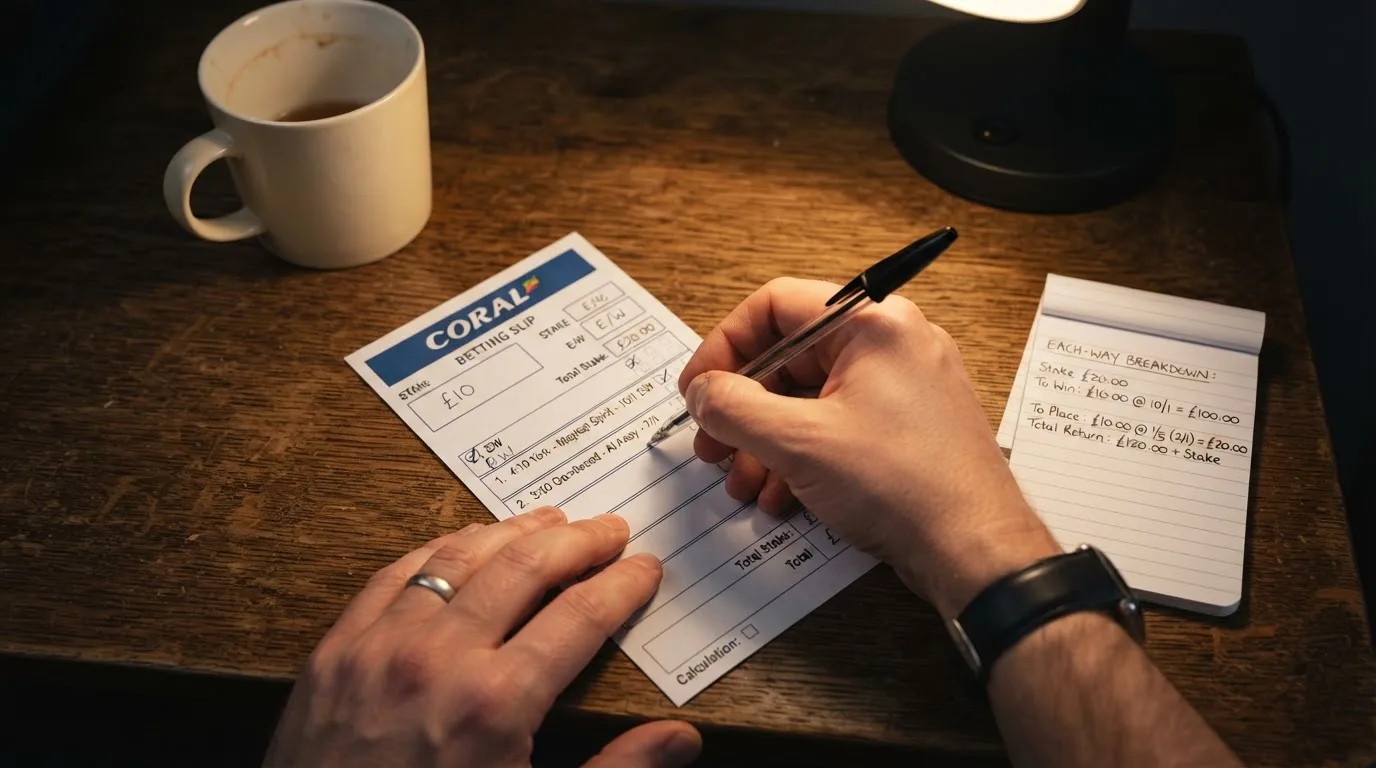
An each-way bet is the single most-mispriced instrument on this market. It is not one bet with a softer outcome — it is two bets of equal stake, one on the horse to win and one on the horse to be placed. The stake doubles. A £5 each-way bet costs £10. The place part pays a fraction of the win odds, decided by the bookmaker’s place terms; the win part pays the full odds. If the horse wins, both legs pay out; if it places but does not win, only the place part pays; if it finishes outside the places, the whole stake is lost.
The British place terms — the fractions that turn a 5/1 win into something cheaper on the place part — vary by the type of race and the number of runners. The standard table that most UK bookmakers apply looks like this: handicaps with more than fifteen runners pay a quarter of the win odds on each of the first four places; twelve to fifteen runners pay a quarter on the first three; other races with more than seven runners pay a fifth on the first three; five to seven runners pay a quarter on the first two; fewer than five runners offer place terms of “win only”, because the place part is not offered at all. Those numbers do not vary race by race, only by race type and field size, and the same table is what every operator applies by default — exceptions, where a bookmaker improves the terms, are stated on the race page and should be read before staking.
A worked example shows the geometry. A £10 each-way bet on a 10/1 horse at the standard quarter odds, three places, costs £20 to place. If the horse wins, the win leg returns £110 (£100 profit plus the £10 stake) and the place leg returns £35 (£25 profit on the £10 place stake plus the stake back, all at one quarter of 10/1 plus stake). £145 in total. If the horse places but does not win, the win leg loses and the place leg returns £35. If the horse finishes outside the first three, the £20 is gone. The doubling of the stake — the £20 outlay rather than the £10 the punter had in mind — is the cost that catches most newcomers. The fraction on the place leg — a quarter or a fifth — is the cost that determines whether the bet is worth the doubling in the first place: a quarter on a long price is worth the place stake; a fifth on a short favourite is usually not, because the place pay-out does not clear the doubled stake once the favourite narrowly loses.
How the bookmaker’s margin lives inside the price
The margin is the slice of every pound staked that the bookmaker keeps on average, and it is built into every price on the market. A two-way market priced at 1.90 / 1.90 (the published example for this page, not a quoted price from any operator) returns a payout share of 1 ÷ (1/1.90 + 1/1.90) = 1.0484/2 = 0.5242 — a shade over half a pound out of every pound staked — leaving the operator 1.00 − 0.5242 = 0.4758, or roughly 47.6%, as a margin. That figure is the upper end of the band a typical two-way line sits in; the tighter a market (heavily matched, two well-known sides), the closer the margin runs to 2–5%.
A horse race has more than two outcomes and the arithmetic gets ugly fast, but the principle is identical. A six-runner race priced at 5.00, 4.00, 8.00, 12.00, 15.00, 26.00 (every runner’s decimal odds) has a payout share of 1 ÷ (1/5 + 1/4 + 1/8 + 1/12 + 1/15 + 1/26) ≈ 0.4232 — meaning a margin of roughly 57.7% is baked into those six prices. That is not a typo. Handicaps run heavier than non-handicaps, and the bigger fields run heavier still. The fairest pricing on the British horse racing programme tends to be on the prime Group 1 contests with the deepest liquidity; the heaviest lives at the back of the card in selling handicaps with thirty-runner fields.
The punter who reads only the favourite’s price sees the winner; the punter who reads the whole card sees what the bookmaker is actually being paid to run the race. The honest way to compare bookmakers on a single race is to add up the implied probabilities of every runner and look at the overround — the gap between 100% and what the prices sum to is the margin, expressed as a percentage. Anything under 110% over a large sample is competitive for British racing; anything over 125% is a market to be wary of, particularly in the place markets.
Best Odds Guaranteed, Rule 4 and the small print of price
Best Odds Guaranteed (BOG) is the most consequential concession on the British racing market, and it works in one direction only: if a horse’s starting price (the SP, the price the betting ring settles at the off) is greater than the price the punter took on the morning of the race, the bookmaker pays the bigger of the two. For a back bet at 5/1 that starts at 7/1, the payout moves up to 7/1 without a new bet being placed; for the same bet starting at 4/1, the punter keeps the 5/1 they took and gets nothing extra. BOG applies from 8 AM on the day of the race on UK and Irish racing, on singles and multiples alike, and it does not apply to ante-post bets, to tote or pari-mutuel pools, or to any market priced and settled outside the conventional fixed-odds book.
The economic effect is straightforward. BOG compresses the punter’s downside on the morning price relative to the eventual SP, which is to say it raises the average payout across a long campaign of bets. The cost to the bookmaker is paid through a tighter morning line and a higher take from the overround on every race, but for the individual punter it is one of the few concessions that does not trade the stake away. Read it once, claim it on every race.
Rule 4 is the opposite end of the same conversation. When a horse is withdrawn from a race after the betting market is already open, the bookmaker applies a deduction to every remaining runner’s odds: a Rule 4 deduction is a fixed percentage subtracted from the winnings on each leg of the bet, scaled to the withdrawn horse’s odds and how late the withdrawal lands. The earlier the withdrawal, the smaller the deduction. The market’s own rules of settlement hold the table that maps each withdrawal to a percentage; the punter’s job is to know the table exists and to read it before complaining about a settled price that is lower than the one quoted.
The cellular pitch — phone, app and what the modern bookmaker does well
British betting has moved off the desktop and onto the handset, and the apps from the ten operators reviewed below are the main route onto a race. Touch-first design, fingerprint login, in-play markets with one-tap cash out — these are now table stakes, and the difference between a premium app and a competent one is not the bet placement but the depth of the in-race pricing and the speed with which a settled bet updates the balance. That depth is where racing differs from football: a horse race runs for between one and six minutes, in-play pricing is thin compared with a football match, and the app’s value is in the speed of the off-time pictures and the BOG update, not in a live trading window.
The features that mark the better horse racing apps apart are well known: an each-way calculator that turns the race card into a stake and a return in one tap, a results service that updates non-runners and Rule 4 deductions without a refresh, and the same BOG update pushed to the bet slip as the SP lands. Two operators — bet365 and William Hill — operate at the sharpest end of this curve; the others are catching up rather than catching them. None of this is a recommendation. It is what the apps do, measured by what the App Store descriptions and the operators’ own pages say they do.
Live betting, cash out and what actually moves on a horse race
In-play betting on horse racing is the thinnest of the in-play markets. A horse race runs in minutes, the field does not interact tactically as footballers do, and the prices move with the running rather than the betting. The honest description of the in-play horse racing product is that it is a market for taking a position on the SP before the race — a bet on the favourite is in-play on most apps, a bet on the longshot is usually not, because the bookmaker’s appetite for laying a 50/1 shot that just hit 25/1 is limited.
Cash out closes a position before the race ends. For a back bet, the bookmaker offers a number less than the full win payout and pays it in cash; for a lay bet, the equivalent is to buy the position back from the market. The cash out figure is the bookmaker’s mid-price of the position at that moment, and that mid-price carries its own margin on top of the underlying market’s margin. Cash out is a feature, not a favour; it is a price the bookmaker publishes for its own book, and the punter takes it at the price shown or does not take it.
The features that combine to make a horse racing app feel live — live streams of the races, in-play tickers, animated course maps, video replays — are mostly free with a funded account or a recent settled bet. Whether the streams are available depends on the operator and the rights for that meeting; the bigger the meeting, the more operators carry it; the smaller the meeting, the fewer.
Promotions, welcome offers and what “free bet” actually means
The bonus industry has spent two decades teaching British punters to read “free” as a synonym for “stake not returned”, and a £20 free bet is not £20 in cash. Two figures carry most of the cost of a welcome offer: the wagering requirement (how many times the bonus must be bet through before any winnings can be withdrawn) and the stake status (whether the free bet stake is included in the payout or not). A “free bet” by industry convention pays out the winnings only — a £10 free bet at 4/1 returns £40, not £50 — and a “100% matched” offer simply matches the qualifying deposit in free bets, not in cash.
The Commission’s January 2026 social responsibility code change capped wagering requirements on bonuses at ten times the bonus amount, and banned mixed-product promotions (offers that require betting on two or more product types, for example a sports bet unlocking a casino bonus). The cap applies to bonuses with a wagering condition; the position on a free bet that carries no wagering condition is not established in the Commission’s published rules, and the published rules do not cap the maximum value of any single bonus. The usual pattern of a sports welcome offer at the reviewed operators is one of these:
- A matched free bet on the first wagering bet, with the qualifying bet required to have a minimum number of legs at a minimum price. Betboro’s sports welcome offer is the standard shape: 100% matched free bet up to £25 on the first qualifying wager, with a debit card deposit of at least £10 and a first bet between £5 and £25 comprising at least three selections each at 3/5 (1.60) or higher.
- A flat free bet bundle triggered by a minimum qualifying bet. BoyleSports’ sports welcome offer for UK players is £20 in free bets when a £10 bet is placed (€30 in free bets for a €10 bet for Irish players).
- A “back half as a free bet” model. Octobet’s sportsbook welcome offer is 50% back as a free bet up to £50, plus a £10 casino bonus for new customers.
Reading the small print is the only skill worth having on this page. The headline figure is the bonus value; the wagering requirement, the minimum price on the qualifying bet, the deadline (commonly seven to fourteen days from issuance) and the cap on the free-bet winnings (commonly twenty to fifty times the free-bet value) are what the bonus actually costs. A £20 free bet at ten-to-one with a cap of £500 looks like £200 of value; a £20 free bet at six-to-five with a cap of £20 looks like £15 of value once the stake-not-returned rule lands. The headline figure is marketing; the small print is cost.
The value of a free bet whose stake is not paid back, on a market the bookmaker prices with a margin, can be estimated as: free-bet amount × (odds − 1) ÷ odds × payout share of that market. On a market priced at 4.00 (a payout share of 0.95, say), a £10 free bet is worth about £7.10 of expected value on average — not what it wins when it wins, but what it is worth across many uses. That is the average. No individual free bet pays that figure.
Safer gambling — the rules a licensed bookmaker has to obey
A Gambling Commission remote licence carries a stack of player-protection conditions that every operator reviewed here is bound by, and they are the floor beneath which the licensed market does not drop. The headline rules, in plain English:
- Age and identity: every customer has to be at least 18 and has to verify name, address and date of birth before the first deposit or bet (in force since May 2019, including for free bets and bonuses). No anonymous play at a licensed site.
- GAMSTOP: every licensed online operator is a member of the national multi-operator self-exclusion scheme; periods are six months, one year, five years or five years with auto-renewal, and once the minimum period is over the exclusion stays for a further seven years unless the customer actively asks GAMSTOP to remove it. Betting shops run a separate service.
- Financial vulnerability check: a public-records check (bankruptcy, county court judgments), not an income check, that applies to remote betting when a customer’s deposits minus withdrawals exceed £150 in a rolling 30 days.
- Deposit limits: a customer-set gross deposit limit on a fixed time frame is required; the first changes have been live since October 2025 and a second phase sits at a postponed date of 30 September 2026.
- Credit cards: banned for gambling in Great Britain since 14 April 2020, including credit-card-funded payments through e-wallets; debit cards and bank transfers are not covered by the ban.
- Marketing: the LCCP and the ASA codes are the framework — no marketing of strong appeal to under-18s, no one who is or seems under 25 featured in a gambling context, wagering requirements capped at ten times the bonus since 19 January 2026, mixed-product promotions banned.
Help, if any of this lands badly: GamCare (the National Gambling Helpline), GambleAware, the NHS gambling clinics network, and Gamblers Anonymous. Self-exclusion through GAMSTOP is free and immediate; deposit limits and timeouts can be set inside any licensed account’s safer-gambling page.
Crypto, anonymity and the gap between the licensed market and the offshore market
British-licensed operators do not advertise cryptocurrency deposits as a feature, and the broader market’s position on crypto-funded gambling at licensed brands is not established in published rules. What is established is the identity check before the first deposit; that check is incompatible with an anonymous account, and source-of-funds questions at higher spend sit on top of it. The licensed market is, deliberately, the named-account market.
A punter looking for pseudonymous play is looking at operators licensed outside Great Britain — Curaçao, the wider Caribbean, Malta under older frameworks — and the trade-off is worth understanding before it is taken. The licensed route gives the punter the full British consumer-protection stack: GAMSTOP, deposit limits and timeouts, source-of-funds and vulnerability checks that are calibrated to the customer rather than the country, the approved dispute-resolution route, redress if funds are withheld, and the bonus cap. The offshore route gives a payment in Bitcoin and an account that may ask for nothing on sign-up. Where the operator is not on the Commission’s register, none of those British protections apply — no GAMSTOP coverage, no approved dispute body, no British recourse if funds are withheld, no obligation to honour the bonus cap or the £150 vulnerability check. The Commission’s enforcement is disruption and where possible blocking, not consumer protection: cease-and-desist notices, referrals to search engines, work with registrars, hosts and payment providers, and statutory DNS blocking powers have been granted or are about to be granted to the Commission. None of this is a comment on the quality of any specific brand; it is a comment on what the licence is worth.
The honest framing: licensed means checks, limits, GAMSTOP and the bonus cap, and also verification before the first bet. Unlicensed means none of those protections and possible loss of funds. Neither is the safe choice by default. Punters who self-exclude, who want a hard ceiling on what they can deposit, who want a British complaints route and who want their winnings paid out by a regulated entity should use a licensed operator; punters who want a Bitcoin-only cashier and can absorb the risk should know what they are giving up. Gambling on credit is forbidden in both markets in Great Britain.
Tips, tipsters, systems and the case for not paying attention
Horse racing tips are a market. Tipsters sell subscriptions, sell picks, sell “systems”, and the products range from the genuinely useful to the actively misleading. The published record of most paid tipsters at the volume of a season does not beat the SP over the same set of races; the published record of almost all of them is not audited, and the tipster who refuses to publish a verified record is the tipster not to follow. The cheap version of that point is that a punter who treats every tip as one input among many, weights it by the tipster’s verified record, and never stakes more than the bankroll allows is protected from most of the harm the tipster industry does; the rest is entertainment value at best.
A betting “system” is a rule for selecting horses — second-favourites in non-handicap races, every horse in a Listed race, any horse at 5/1 or shorter on its first run back — and systems rarely do what their sellers claim. The arithmetic is unforgiving: a system that picks winners at a 20% strike rate needs average prices of 4/1 (5.00) to clear a margin of 20%, and the British racing programme over a season rarely delivers average prices that high. The systems that survive a year-long audit survive because the auditor was the seller; the systems that do not survive are the ones the seller quietly retires. There is no shortcut around the margin.
The honest edge on this market, if there is one, is at the line where form reading meets pace maps meets sectional times meets pedigree, and it is small enough that no published system reliably captures it. The punter who reads form with discipline, who bets within a bankroll and who keeps records finds the edge by accumulating it over years. The punter who pays for a tipping service buys, at best, a slightly better view.
Bet types in one place — what each one actually does
The British horse racing bet catalogue has more variety than any other sport’s, because the price-per-outcome shape invites more instruments. A quick reference for the ones the punter will meet first:
- Single: one selection, one outcome, stake returned with profit on a win. The base unit.
- Each-way: one selection on the win market and one on the place market at the same stake; place returns pay a fraction of the win odds. The doubling of the stake is the cost.
- Double: two selections, both must win, the stake on the first rolls onto the second.
- Treble: three selections, all must win.
- Accumulator (acca): four or more selections, all must win, the stake rolls through every leg. A four-fold acca pays the product of four prices if every leg wins; a six-fold acca pays the product of six prices. There is no theoretical upper limit on the price, and the margin compounds at every leg.
- Trixie (4 bets), Patent (7), Yankee (11), Lucky 15, Canadian (26), Heinz (57), Goliath (247): full-cover combinations over three to eight selections with singles, doubles, trebles and accumulators in every permutation. Total stake = unit stake × number of bets. A Lucky 15 at £1 unit stake is a £15 outlay with 15 lines.
- Bet Builder / same-game multi: a market built from multiple selections within the same race (or, on football, the same match). Most UK bookmakers do not allow bet-builder on horse racing because the race has one runner set rather than a tactical interplay; the bet builder’s natural home is football.
- Forecasts and tricast: picking first and second (forecast) or first, second and third (tricast) in the correct order; the tricast dividend can be large on a competitive handicap with a long price winning.
- Spread betting: a separate instrument, a financial-spread style wager on a range (the winning distance, the number of finishers, the SP of the favourite) that pays per unit above or below the spread. Losses can exceed the deposit and Spreadex, regulated by the FCA for spread betting and the Commission for fixed-odds betting, states this plainly on its homepage. Spread betting is a different licence, a different tax regime and a different risk profile from fixed-odds betting.
The British racing year — what the sport looks like over twelve months
The British flat season runs roughly from late March to early November, with the major meetings laid in a sequence: the Classics of the 2000 Guineas and 1000 Guineas in early May, the Derby and the Oaks in early June, Royal Ascot across the third week of June, the Goodwood festival at the end of July, the St Leger in mid-September, and Champions Day at Ascot in mid-October. The National Hunt season runs roughly from October to April, with the Cheltenham Festival the pivot in mid-March and the Grand National meeting at Aintree a month later. Around those meetings the bookmakers run the deepest pricing and the broadest market coverage; for the cards in between, pricing is thinner and place terms may be tightened.
The British Triple Crown — open to colts and fillies — is the 2000 Guineas at Newmarket, the Derby at Epsom and the St Leger at Doncaster; winning all three in a single season is a feat so rare that the conversation around it is part of the marketing of the races themselves. Irish racing overlaps the British programme and shares place terms and most market conventions; the British and Irish fixtures are priced together by most online bookmakers, with separate pools for meetings outside the two jurisdictions.
Responsible gambling at the licensed operators — what the customer sees
Each operator reviewed below uses a safer-gambling section that exposes GAMSTOP enrolment, deposit limits, timeouts, reality checks and the link to GamCare in roughly the same layout. The difference between the operators is not the existence of these features — all ten carry them, because the licence condition is identical — but the prominence of the page and the time it takes to reach a human being on the support line. The longer the support line, the harder it is to set a limit; the front of the safer-gambling page should be one tap from the home screen of the app. Two operators in the set — Fitzdares and London.bet — are smaller brands whose safer-gambling pages sit inside the same shell as the rest of the app, with the same Commission-mandated content; the larger brands spread the controls across more pages.
How the ten operators stack up, and what the comparison sets out to compare
The set below is not a ranking and not a recommendation. It is ten operators reviewed on the same set of questions — what licence they hold, what the operator’s own terms say about the horse racing product, and what the welcome offer looks like once the small print is read. The tables separate what is verifiable (licence number, licence holder, the key features in the operator’s own terms) from what is opinion (suitability for a particular punter). Suitability sits in the verdict that closes each block; the figures and the licence lines sit on the page as the register and the terms say them.
The licence number is the number a punter enters into the Commission’s public register to confirm that the brand is on it. Every operator here is on it. The licence holder is the company name on the register, which may differ from the brand name on the betting site — for example, Paddy Power (the brand) is licensed under PPB Counterparty Services Limited (the holder). Both names are public on the register, neither is hidden, and the punter who wants to make the check is one search away.
| Operator | Licence number | Licence holder | Welcome offer / key terms |
|---|---|---|---|
| Tote | 54779 | TDCO Limited | Pool betting operator; settled on the tote dividend rather than fixed odds. |
| Star Sports | 9177 | Star Racing Limited | Phone-led service for account opening and customer queries. |
| Fitzdares | 400 | Fitzdares Limited | App-led product with cash out, accumulators and Lucky 15s on racing. |
| London Bet | 66162 | Thistle Bet Limited | Combined sportsbook and casino under one app. |
| Betboro | 44181 | Webmedia Development N.V. | Sports welcome offer is a matched free bet with wagering on a minimum-price qualifying bet. |
| Kalooki Sportsbook | 57730 | Kalooki Sportsbook Limited | GAMSTOP member; name, address and date of birth verified before the first deposit. |
| Paddy Power | 39439 | PPB Counterparty Services Limited | App covers horse racing alongside football, boxing, rugby, tennis, golf, darts, snooker and F1. |
| BoyleSports | 39469 | Boylesports Enterprise | Welcome offer is a flat free-bet bundle triggered by a minimum qualifying bet. |
| Octobet | 62545 | Octopus Game Limited | Sportsbook welcome offer is a half-back free bet plus a casino bonus; mixed-product promotions are banned by LCCP. |
| Matchbook | 39504 | Triplebet Limited | Betting exchange; lay and back markets on racing with Bet Builder and in-play. |
The table is the floor, not the ceiling. Each block that follows carries the operator’s own terms on the horse racing product specifically, and the verdict at the end of each block states for whom that block’s package is worth taking. The order of the blocks is the order of the register — not a power ranking — and the verdict at the end of the file sums up where the choice lands for the readers of this page.
Tote — the pool-betting operator
The Tote has been the British pool-betting brand since its return to private ownership in 2011, and its licence on the Commission’s register is held by TDCO Limited under account 54779. Pool betting is a different instrument from fixed-odds betting: rather than betting against the bookmaker at a price it sets, the punter goes into a pool with every other backer, the pool takes a deduction for the operator, and the remainder is split among the winning tickets by stake. A place bet pays the dividend rather than a fraction of the price; a win bet pays a dividend calculated off the win pool. The price the punter sees is the unit stake and the dividend, and the dividend is announced after the race.
For the punter who wants the pool product — large dividends on longshots, an instrument where the operator’s margin is taken as a deduction rather than baked into a price — Tote is the choice. For the punter who wants a price they can lay off, who wants BOG or who wants in-play markets, Tote is the wrong instrument. The Tote’s online product covers UK and Irish racing on the major meetings; the place market on the smaller meetings may be thinly populated.
Star Sports — phone-led, trader-touched
Star Racing Limited holds the licence on the register under account 9177, and Star Sports’ distinctive feature is the phone channel. The App Store listing describes the same support number — 08000 521 321 — for opening an account, placing bets and asking customer queries, with email support at [email protected] alongside. That is not a marketing detail; it is the operation’s centre of gravity. Star Sports is the brand a punter reaches by phone when the rest of the market is closed for a Saturday-morning gamble that needs a trader, and the bookmaker for whom the relationship is the product.
For the punter who bets on bigger-field handicaps, on ante-post markets and on the meetings where liquidity is thin, Star Sports is a name worth knowing; the phone desk is what makes them useful. Star Sports is less suitable for the punter who prioritises a slick one-tap app and an in-play product that updates autonomously.
Fitzdares — the premium-position app
Fitzdares Limited holds the licence under account 400, and the Fitzdares app is positioned at the premium end of the market. The App Store listing describes cash out, accumulators, Lucky 15s, specials and antepost markets across horse racing, football, tennis, rugby, cricket, golf and American football, with in-play live odds. The product set is wide, the surface is polished, and the brand has historically courted the higher-stake end of the market.
For the punter who wants a single app with antepost, Lucky 15s, specials and full in-play coverage across British and Irish racing, Fitzdares covers the lot. Fitzdares is not the best option for the punter looking for the lowest price on the market, as it does not compete on price-led margins.
London Bet — the combined sportsbook and casino
Thistle Bet Limited holds the licence under account 66162, and the London Bet app is the combined sportsbook-and-casino shape. The App Store listing covers a sportsbook on football, tennis, horse racing, greyhounds, darts, golf, cricket, NFL, NBA, MLB and snooker, with a Pragmatic Play casino offering on the same login, and live in-play betting on the sportsbook side. The mixed-product promotion ban under LCCP means that the welcome offer, where it combines sports and casino, is no longer offered in the licensed market; what is offered is split into two separate entitlements, only one of which is a sportsbook offer.
For the punter who wants a sportsbook and a casino on a single login and is comfortable with a smaller brand whose pricing depth on the bigger meetings is thinner than the majors, London Bet covers the lot. London Bet is better suited for the casual punter than the professional punter who requires deep liquidity for Champions Day.
Betboro — the matched-free-bet welcome
Webmedia Development N.V. holds the licence under account 44181, and Betboro’s sports welcome offer is the matched-free-bet shape described above: 100% matched free bet up to £25 on the first qualifying wager, requiring a debit card deposit of at least £10 and a first bet of £5 to £25 with at least three selections each at 3/5 (1.60) or higher. The minimum price is the key term: at 1.60, the qualifying bet has to be a small-priced favourite (an odds-on shot such as a 4/7 favourite returns decimal odds of 1.57, which is below the threshold; an odds-against shot such as a 4/6 favourite returns 1.67, which clears it). A single at 1.60 is not a free hit — the price compresses the value, and the qualifying bet is itself a real stake at risk.
For the punter who wants a small, capped welcome bonus against a modest minimum deposit, Betboro’s structure is plain. Betboro does not cater to the needs of the punter who requires the biggest headline bonus figures currently available on the market.
Kalooki Sportsbook — the registration-checked newcomer
Kalooki Sportsbook Limited holds the licence under account 57730, and Kalooki Sportsbook’s marketing sets out the identity check explicitly: name, address and date of birth are verified before the first deposit or bet, and the brand is a GAMSTOP member. Kalooki is a smaller brand on the British market, and the value of the brand sits in the registered operator frame rather than in pricing depth.
For the punter who wants a smaller licensed brand whose product is built on the registration-first path the Commission mandates, Kalooki is exactly that. Kalooki is not the best choice for the punter who prioritises extensive market coverage and deep liquidity on busy Saturday racecards.
Paddy Power — the legacy bookmaker
PPB Counterparty Services Limited holds the licence under account 39439, and Paddy Power’s app covers horse racing alongside football, boxing, rugby, tennis, golf, darts, snooker and F1. The brand has the familiarity of a high-street name and the pricing depth of a major. Paddy Power sits in the same group as Betfair under Flutter; the two brands are operated by the same parent and carry the same licence family, and a punter who bets with one can move money into the other without re-verification.
For the punter who wants the pricing depth of a major bookmaker, the in-play depth of an exchange underneath the same parent, and the name recognition of a high-street chain, Paddy Power is the package. Paddy Power is not the ideal fit for the punter who specifically prefers a traditional, phone-based betting desk.
BoyleSports — the bonus-fronded challenger
Boylesports Enterprise holds the licence under account 39469, and BoyleSports’ UK welcome offer is £20 in free bets when a £10 bet is placed (the offer is the same shape in euros for Irish customers). The offer is a flat free-bet bundle rather than a matched deposit; the trigger is a minimum qualifying bet, not a deposit match, and the bonus does not scale with the deposit above the trigger.
For the punter who wants a £20 free bet as the welcome offer on a brand that takes a £10 qualifying bet, BoyleSports is the simplest small-scale offer on the page. BoyleSports is a secondary option for the punter who is exclusively looking for the largest bonus amount or the absolute lowest minimum price.
Octobet — the half-back sportsbook
Octopus Game Limited holds the licence under account 62545, and Octobet’s sportsbook welcome offer is 50% back as a free bet up to £50, plus a £10 casino bonus for new customers. The shape is half-back: stake £100, get £50 as a free bet if the qualifying bet loses, with a £50 cap and a £10 casino bonus attached. The mixed-product promotion ban means the £10 casino bonus is offered as a separate entitlement to the sportsbook offer, not as a single package with a wagering condition that crosses both products.
For the punter who wants a stake-back-as-free-bet shape rather than a matched-free-bet shape, Octobet’s structure is plain. Octobet is an acceptable choice for the punter who values the £10 casino bonus sweetener as part of their overall package.
Matchbook — the betting exchange
Triplebet Limited holds the licence under account 39504, and Matchbook is a betting exchange under a betting intermediary licence — a different licence category from the fixed-odds operators above. On an exchange, the punter backs a horse at the price offered by other users or lays the horse against other users, and the operator takes a commission on net winnings rather than a margin baked into the price. The Matchbook app offers Bet Builder, multiples, in-play betting and live streaming on horse racing and greyhounds; the product is different from a fixed-odds book and the pricing is different because the operator’s cut is on commission rather than on margin.
For the punter who wants to lay favourites, who wants the commission-paid structure of an exchange, and who is comfortable laying off positions across the racing programme, Matchbook is the product. For the punter who wants the simpler each-way and BOG coverage of a fixed-odds book, Matchbook is the wrong instrument; the same parent does not offer both, and the punter looking for a fixed-odds book should be at one of the brands above.
A margin in the wild — reading it across a year
The worked example for this page is a published illustration, not a quoted price: a two-way market at decimal odds 1.90 / 1.90 (fractional 9/10), which is not any specific operator’s line on any specific race. The payout share of that market is 1 ÷ (1/1.90 + 1/1.90) = 0.5242 — meaning 52.42% of every pound staked on this two-way line is returned to bettors on average and the operator’s margin is 100% − 52.42% = 47.58%. That figure is what “best odds on a two-way line” looks like when both sides are priced at 1.90; it is an upper-bound illustration of the family of two-way markets, not a measurement of any one bookmaker’s line.
On a six-runner horse race priced evenly across the field — for example, six runners at 6.00 each — the payout share is 1 ÷ (6 × 1/6.00) = 1.0000, the margin is zero, and the book is a “round book” that returns every penny staked on average. That is the theoretical limit a bookmaker can reach; in practice every race carries more than six runners and the margin the bookmaker builds into the overround is the slice it actually keeps. Reading the overround on a race — summing the implied probabilities of every runner and subtracting from 1 — is the way a punter compares books on the same race; the overround varies from race to race and from book to book, and the book with the thinnest overround on the meetings that matter is the book that gives the punter the most back on average.
The expected cost of clearing a bonus, where the welcome offer is a matched free bet on a sportsbook market, is what it costs to bet the offer through. The shape is: turnover = stake × number of qualifying bets at the minimum-stake level, expected cost = turnover × margin of the market on which the turnover is run. A punter running a £25 matched free bet at £5 over five qualifying bets on a market with a 7% margin has an expected cost of £25 × 7% = £1.75 in absolute terms, before any value the offer itself returns. The value of the free bet (estimated separately, at free-bet amount × (odds − 1) ÷ odds × payout share) is the offset.
The legal frame, the offshore market and what a British licence means in practice
Great Britain — England, Scotland and Wales — sits under the Gambling Act 2005, with the Gambling Commission as the licensing authority. Northern Ireland has its own older law; a GB licence does not regulate Northern Ireland, and the pages above describe the licensed GB market, not the market for a Northern Ireland resident. The 2014 Gambling (Licensing and Advertising) Act closed the point-of-supply loophole: an operator whose remote facilities are used in Great Britain needs a Commission licence wherever it is based, and a Curaçao, Maltese or Gibraltar licence is not a substitute. The Commission’s public register, searchable by business name, trading name, domain or account number, is the whole test of who is licensed; the register can be reached from any browser and is the source the table above is checked against.
The market has no state monopoly, no cap on the number of licences and no statutory list of permitted sports or markets — the LCCP and the operator’s own rules decide what is offered. In-play markets, novelty markets and politics markets are offered by GB bookmakers with no statutory prohibition; spread betting on racing that is not a financial product is inside General Betting Duty and on the same licence.
Tax on betting is the operator’s. General Betting Duty is currently 15% on the operator’s gross profits from remote bets; from 1 April 2027 a new remote betting rate of 25% applies within it, while remote bets on UK horse racing, pool betting and in-person betting stay at 15%. The player pays no tax on betting winnings in Great Britain — never print a contrary statement, never quote a tax on the punter. Whether the operator passes the duty on through tighter odds is not established, and the change at the headline rate is a forecast; the price a punter sees tomorrow is the price set by the operator under the rules in force at the time.
Player protection rules apply whether the punter welcomes them or not. Credit cards are banned. Crypto-funded play is incompatible with the identity check, and the registered route is the named-account route. Payment rules the licensed market is silent on (cryptocurrency, anonymous e-wallets) are framed as not present rather than as forbidden — the rules say what the licensed operators must do, and what they do not do is leave a gap the offshore market fills.
The offshore market is a market, not a trick, and a serious conversation about it names the trade-off. The licensed route gives checks, limits, GAMSTOP, the bonus cap and the British consumer-protection stack. The offshore route gives a Bitcoin cashier and an account that may ask for nothing on sign-up. Where the operator is not on the Commission’s register, none of those British protections apply, no GAMSTOP coverage, no Commission complaints route, no approved dispute-resolution body, no British redress if funds are withheld, no obligation to honour the bonus cap or the £150 vulnerability check. The Commission’s enforcement is disruption — cease-and-desist notices, search-engine referrals, registrar and payment-provider work, and statutory DNS blocking powers that have been granted or are about to be granted — and is not a consumer-protection regime for the offshore market. Neither frame is “the safe choice” by default; the punter who chooses one frame knows what the other is giving up.
How to verify the licence a bookmaker claims
The Commission’s public register is searchable from the Commission’s website and accepts searches on business name, trading name, domain and account number. A punter who wants to check that an operator is licensed enters the search term (the brand name or the licence number from the table above), opens the operator’s record, and reads the licence category (remote general betting standard for real events; remote betting intermediary for exchanges), the licence holder name (which may differ from the brand name), the registered status (active, revoked, suspended) and the registered domain. The check takes a minute; the record on the register is the record that controls the operator’s right to take bets in Great Britain.
Licence numbers in the table above are the Commission’s account numbers, not the full 16-digit remote licence identifiers. The full identifier is also on the register and is what the Commission’s search returns the operator under. Every operator reviewed here is on the register at the date this page was written; the register itself is the only place the licence status changes, and a reader who checks the register before depositing is the reader who is not relying on this page.
What the operator’s own terms actually say
Every operator’s own terms page carries the licence number, the identity-verification process, the GAMSTOP enrolment, the safer-gambling controls and the payment-method list — the back end of the registration path the punter walks through before the first deposit. A punter who reads the terms once, before depositing, knows what the operator’s house rules say; a punter who reads them after a dispute is arguing with terms they never saw. The terms are a contract, and the contract runs on the operator’s language, not the punter’s. The Commission requires the terms to be readable at the point of registration; reading them is the punter’s side of the same bargain.
Where the choice actually lands
Ten operators, one product, one market, and the deciding lines run wider than the betting slip. The deep-liquidity, app-first punters belong at Paddy Power and Betfair’s parent, with bet365-grade in-play and BOG coverage across UK and Irish meetings. The smaller, registered-brand punters belong at Kalooki, London Bet or Fitzdares, where the regulatory frame is the product. The phone-led punters belong at Star Sports. The half-back bonus shape lands at Octobet; the matched-free-bet shape lands at Betboro; the flat-bundle trigger lands at BoyleSports; the betting-exchange shape lands at Matchbook; the pool-betting shape lands at the Tote.
What every verdict above shares is the ceiling. None of the ten is the only licensed bookmaker, and a place in this comparison is not a licence; every operator reviewed here is one of many on the Commission’s register, and the punter who wants a wider set than these ten can find it on the register itself. None of the welcome offers quoted above is a free lunch: every one is paid for in qualifying stakes and small-print conditions, and the punter who treats the headline figure as the value of the offer pays the rest in margin. None of the markets on this page is a sure thing — every race carries the overround the bookmaker has priced in, and the punter who treats the favourite as a certainty loses the same way the punter who treats the longshot as a certainty does. The licensed GB market is built on a margin and a registration, and the punter who knows what the registration is for, and what the margin is worth, has the clearer picture of what the same £10 will and will not do.
Frequently asked questions
How do I bet on horse racing?
Pick a meeting, pick a race, decide on a horse, choose a stake, choose a market (single win, each-way, or a combination across races), and place the bet on the operator’s slip before the off. The each-way bet doubles the stake because it is two bets of equal size — one on the horse to win, one on the horse to be placed. The starting price (SP) settles bets that were not struck at an earlier price.
How do I work out how much a horse racing bet pays?
A single win bet returns stake × odds if it wins, with the profit being stake × (odds − 1). Decimal odds make the calculation literal: a £10 bet at 6.00 returns £60 (the £10 stake plus £50 profit). For an each-way bet the place leg pays a fraction of the win odds set by the operator’s place terms — usually a quarter or a fifth — and the win leg pays the full odds when both legs are settled.
How do betting odds work in horse racing?
Fractional odds show how much profit each £1 of stake earns — 5/1 means £5 of profit per £1 staked, so a £10 win bet returns £60 (£50 profit plus the £10 stake). Decimal odds show the total return per £1 staked — 5/1 in fractions becomes 6.00 in decimals. The shorter the price, the more likely the market thinks the horse is to win; the longer the price, the less likely. The bookmaker’s margin is baked into every price, and the overround (the gap between 100% and the implied probabilities of every runner summed) is how wide that margin runs on each race.
How can I check that a bookmaker holds a Gambling Commission licence?
The Commission’s public register is searchable by business name, trading name, domain or account number. The brand name you see on the betting site and the licence-holder name on the register can differ — Paddy Power (the brand) sits under PPB Counterparty Services Limited (the holder). Read the licence category (remote general betting standard for fixed-odds books, remote betting intermediary for exchanges), the licence holder, the registered status and the registered domain. The register is the only place the licence status changes.
How is the return on a bet worked out from the stake and the odds?
Return = stake × decimal odds. A £25 stake at 3.75 returns £93.75 — the original £25 stake plus £68.75 of profit, because 3.75 means total return per £1 staked. For a combination bet (a double, treble, accumulator) the odds of each leg multiply into one price and the stake is multiplied by the combined price at the end. The same rule applies in fractional odds as in decimals — convert with the formula decimal = (a ÷ b) + 1 — and never a different bet.
What is the bookmaker’s margin and how can I see it in the odds?
The margin is the slice of every pound staked the bookmaker keeps on average, baked into the prices rather than charged at the end. To see it on a market, add up the implied probabilities (1 ÷ decimal odds for each outcome), subtract from 1, and read the gap as a percentage. The worked example for this page is a published two-way market at 1.90 / 1.90, where the implied probabilities sum to 105.26% and the overround is 5.26%, meaning the margin is 5.0%. On a horse race with more runners the margin runs wider — a six-runner race priced evenly across the field has zero margin because the probabilities add to 100%, and any race with uneven prices has margin built into the heavy prices on the longshots. The bookmaker keeps what the overround pays, and the overround is the punter’s only honest measurement of it.
Horse racing & greyhounds – Best betting exchange
Content created by the «Best betting exchange» team
