
Horse Racing Betting Odds in Great Britain
 Available in US
Odds are the only thing a bookmaker sells. Everything else — the form guide, the betting slip, the Best Odds Guaranteed banner, the welcome offer — sits on top of them. This page is about what those numbers actually mean, what they cost the person paying them, and which of the ten UK-licensed bookmakers that take horse racing bets are worth a closer look in 2026. The angle throughout is cost: the stake, the place terms, the margin baked into the price, the rollover behind a free bet, the verification step before the first deposit. A punter who sees those clearly walks into the betting shop with a sharper pencil.
*Current as of 27 October 2026 — operator details and licence numbers verified against the Gambling Commission’s public register.*
Safer Gambling and the Frame Around a Bet
A few lines on safety first, because the rest of the page is a better read with them. Every brand named below holds a remote operating licence from the Gambling Commission, the regulator of commercial gambling in Great Britain, and is therefore signed up to GAMSTOP, the multi-operator online self-exclusion scheme. Excluding yourself through GAMSTOP blocks your accounts across every participating operator for a minimum of six months and up to five years with auto-renewal; once the chosen period ends the exclusion stays in force for another seven years unless the customer asks GAMSTOP to remove it. Betting shops use a separate in-shop scheme. GAMSTOP covers the online sites and apps of every operator named below; it does not cover spread betting, financial products or land-based premises.
Two newer Commission rules apply when play reaches a threshold. A financial vulnerability check is mandatory once a customer’s net deposits cross £150 in any rolling 30 days — it is a public-record check for things such as bankruptcy or county court judgments, not an income or credit-reference search. A set of more demanding financial risk assessments — the “affordability checks” of the press — was announced in a Commission article on 7 July 2026, in a staged plan, with no start date set; at the time of writing they are not yet in force. Where a rule has not started, the page says so; a “soon” claim here is a guess and a guess costs the reader.
A deposit limit is something a customer can set themselves. Operators have been required since 31 October 2025 to offer a gross deposit limit on a fixed time frame, with a second phase postponed to 30 September 2026. There is no state-imposed ceiling on stakes or losses — a customer who wants a £10 cap sets £10, and an operator may impose lower limits on its own customers for its own reasons.
The usual help lines are open: GamCare runs the National Gambling Helpline, GambleAware funds treatment and education, the NHS runs gambling clinics, and Gamblers Anonymous runs support meetings. Several of the brands reviewed below carry these links directly on their home pages; a punt is small, the conversation is free.
Crypto, Anonymity and Where the Two Don’t Meet
Search interest around crypto and horse racing exists for a reason worth naming plainly. Cryptocurrency deposits have been adopted by some online bookmakers outside Great Britain, and the appeal is plain: faster settlement, no card on file, a different relationship between the punter and the operator. That is not the British offer.

Two facts pin this down. First, a customer who wants to deposit at a UK-licensed remote operator has to clear identity verification before that first deposit — name, address and date of birth, in line with the Commission’s anti-money-laundering rules that have applied since 7 May 2019. A free bet or a bonus triggers the same check. There is no anonymous play at a licensed site. Second, the licensed market has not settled on a single rule for or against crypto deposits: that policy choice sits with each operator. The page describes payments only from each operator’s own terms, and where a brand does not publish a crypto rail, the brand does not have one for the reader.
The offshore route is a different deal. A Curaçao or Maltese licence does not require GAMSTOP registration, does not deliver the £150 vulnerability check, does not cap wagering at 10x and does not give a British punter any approved dispute-resolution route if funds are withheld. The Commission has disruption powers — cease-and-desist letters, search-engine referrals, work with registrars, hosts and payment providers — and has been given, or is about to receive, court-order DNS blocking powers. Enforcement is real; it is also not a firewall. The honest framing is the one that costs the reader least: licensed brings checks, limits, GAMSTOP and a complaints process but also a verification step before the first bet; unlicensed brings none of those protections and the real risk of losing the lot.
Free Bets, Welcome Offers and What They Cost
A “free” horse racing bet is two things at once: a credit the operator gives the punter, and a set of rules the punter has to meet before anything turns into withdrawable cash. The rules vary. The common ones — minimum odds on the qualifying bet, a deadline, a cap on winnings, stake not returned, a wagering multiple — are the difference between a real offer and a marketing line.
The headline numbers from the ten reviewed brands tell the story. BetGoodwin‘s sports welcome offer is a £15 free-bet bundle in three £5 chunks — a sports single, a £5 acca and a £5 Sub-Cover bet — for a £10 first stake. VBET‘s sports welcome offer is a £10 free bet if a new, verified customer stakes £10 or more on a first-ever bet that loses. Dabble‘s welcome is a £10 free bet on a first deposit for new customers, with a 7-day expiry, minimum odds on the qualifying bet and the stake not returned with any win. Each of those is described in the brand’s own terms. The shape is consistent across the set: a small initial stake unlocks a free-bet bundle, and the bundle expires within a week.
Promotion rules in force since 19 January 2026 put a ceiling on the wagering that hides behind a bonus. Wagering requirements are capped at 10x the bonus, so a £10 bonus at 50x needed £500 of qualifying bets; under the rule no more than £100 is allowed. Mixed-product promotions are banned — no “bet on football to unlock free spins” bundles across two product types. Whether the 10x cap applies to a free bet that carries no wagering condition, and any cap on the bonus amount itself, are not established in the rule the Commission published; the page does not invent the answer. William Hill‘s Best Odds Guaranteed (BOG) is the cleanest of the price promises on this list: from 8 AM on the day of the race, on UK and Irish horse racing, single or multiple bets, the book pays the bigger of the price taken and the starting price. Ante-post, tote and pari-mutuel bets are excluded, and the rule is a payout-side guarantee, not a bonus.
The arithmetic the marketing never prints is straightforward. A free bet whose stake is not returned is worth, on average, the free-bet amount multiplied by (odds minus 1), divided by the odds, multiplied by the payout share of the market in question. A £10 free bet at 4.00 (3/1) on a market with a 95% payout share is worth about £7.13 in expectation — £10 × (4.00 − 1) ÷ 4.00 × 0.95. A higher-priced free bet is worth more; a low-evens market means the bookmaker keeps more of the free bet than the punter ever sees.
Betting Apps and Mobile Sites
The GB market is mobile-first, and the GB bookmaker app is, for most punters, the betting shop. Three differences separate a strong horse-racing app from a generic sportsbook app: the race card layout, the in-play experience and the speed of the cash-out button. A punter who bets each-way on every race wants a slip that defaults to each-way with a place-terms toggle; a punter who lays out a Yankee wants a multiple-bet helper that handles the seven bets of a Patent or the twenty-six of a Canadian without re-keying. None of the brands below is identical on those details, and the table later in the page names what each app carries in horse racing specifically.
Two brands stand out by dint of scale rather than judgement. bet365 is the official global betting partner of the UEFA Champions League and describes its app as the most downloaded sports betting app in the UK; its Bet Builder+, Super Boosts, Winnings Boosts and daily Bet Boosts are part of a football-led product, and horse racing sits inside that product on its own terms. Betfred is published by Done Brothers (Cash Betting) Ltd and covers 21 sports alongside over 2,000 casino-style games; horse racing is one of the longest-standing elements of its offer and the price promise on racing is the brand’s heritage.
The smaller names are not smaller in horse racing. Tote runs the pool-betting product that returns a dividend after the race rather than a fixed price at the time of betting; the app carries the pool alongside fixed-odds markets. LiveScore Bet‘s Bet Builder allows up to 10 selections across match result, both teams to score, corners, total goals, player scoring and card markets — its racing offer is separate, and the football Bet Builder is the headline feature the brand publishes. Midnite shows in-play events, an acca builder, popular accas and price boosts with maximum-stake limits; the app is racing-aware but the racing offer is one chapter of the wider product. Sporting Index runs both fixed-odds and spread betting on the same app, with in-play betting, a Bet Builder for football, auto cash-out and Multi-Markets; spread betting on racing is a different product from fixed-odds, and the FCA regulates the spread side while the Commission regulates fixed odds.
The way the app behaves under a poor signal matters more than its feature list. A punter who has tried to back a horse at the post with a stuttering connection has lost the bet before the price updated.
Live Betting, In-Play and Cash Out on Racing
In-play horse racing is a distinctive product. The race is short, the odds move with the runners and a punter who has the price-locked picture can place a bet between the start and the finish. Three operators on the reviewed list publish live markets specifically. Geoff Banks offers live in-play prices and ante-post prices on future events from the same app. Sporting Index carries in-play betting on its spread-betting and fixed-odds products. bet365‘s in-play product is the broadest on the list and covers racing alongside the football and tennis it is best known for.
Cash out is the related feature and it is a separate decision. A cash-out offer lets the punter lock in a profit (or cut a loss) before the result is known; the price the operator quotes is its own, with its own margin, and it changes with the in-play price. The auto cash-out at Sporting Index lets the punter set a threshold in advance. bet365‘s cash out runs across the bookmaker’s full in-play product. 10bet publishes cash out as a feature alongside Live Streaming and a Bet Builder.
In-play on horse racing has its own legal frame. The Commission does not restrict in-play on racing as a category; the controls are the operator’s licence conditions and customer-protection duties. A punt at the off is in-play; the in-running price is the operator’s price; the rules on what counts as a “match” or a “race” for in-play purposes are the operator’s. No statutory prohibition exists, and the page does not invent one.
A practical note. In-play on a two-minute race is a different product from in-play on a ninety-minute football match. The window is shorter, the slip is faster and the price can move several ticks before the bet lands. The brands that publish live racing markets do so because their technology can take the volume; the brands that don’t are not necessarily worse on the rest of the offer.
Predictions, Tipsters and the Word “System”
Three words appear in nearly every search for horse racing betting tips: “today”, “odds” and “system”. Each one is doing a different job. Today is a filter on the race card; a punter wants the prices for the 2:10 at Kempton, not a verdict on the form of a horse running at a meeting last week. Odds is the price the bookmaker is offering at the moment the page is read. System is the part to be careful with.
There is no “system” that wins. A staking plan — level stakes, percentage of bank, the Kelly criterion — is a way to manage the size of a bet, not the direction of one. A betting tip — a horse to back at a price the tipster thinks is too big — is a view; the view is right or wrong at the off. A “today’s tips” page is a selection of views. What the punter pays for, when paying, is someone else’s time and judgement; what the punter gets, for free or for a fee, is a list of horses. The list may be sharper than the punter’s own, or it may not; the only way to tell is to record the bets and read the results over a sample of a few hundred bets, not a weekend.
The arithmetic of the spread matters. If the tipster’s price is 4.0 and the bookmaker’s is 3.5, the tipster has found an overlay; if the price is 2.5 and the bookmaker’s is 2.6, the tipster has a small underlay and the difference is the margin. A punter who reads the form guide against the betting forecast, who weighs the going-over-head reading of the race, who knows that handicaps weigh horses to equalise the field while conditions races give the same weight to all with allowances for younger and female horses — that punter is closer to finding value than a punter who pays a subscription for tips.
The numbers worth holding on to: a market with a 5% margin returns 95p to the punter for every pound bet across all outcomes; a market with a 10% margin returns 90p. The difference over a season is the difference between a hobby that pays for itself and a hobby that doesn’t.
Bet Types, Each-Way and How the Odds Are Built
A horse racing betting slip looks simple and carries more than it shows. The single bet is a stake on one horse to win. The each-way bet is two bets of equal stake — one on the win, one on the place — so a £5 each-way bet costs £10. The accumulator is a string of single bets whose odds multiply: four horses at 3.0, 2.5, 4.0 and 2.0 form a 60-line price (3.0 × 2.5 × 4.0 × 2.0 = 60.0). The multiple bet inherits the weakness of its smallest leg — a non-runner at the bottom of an acca can pull the whole thing down.
Each-way place terms are where the cost of a bet is most often misread. The British standard for handicaps with more than fifteen runners is a quarter of the win odds for the first four places. Twelve-to-fifteen runners pay a quarter for three places; other races with more than seven runners pay a fifth for three places; five-to-seven runners pay a quarter for two places; fewer than five runners pay only on the win. The numbers come from the operator’s published place terms, not the rulebook; an each-way bet on a five-runner race at an operator that pays only on the win is one bet, not two.
A worked example. A £10 each-way bet on a 10/1 horse at 1/4 place terms for three places costs £20 — £10 on the win, £10 on the place. If the horse wins, the win part returns £110 (£10 × 10 + £10 stake) and the place part returns £35 (£10 × 10/4 + £10 stake), £145 in all. If the horse finishes second or third, the win part loses and the place part returns £35, minus the £10 lost on the win leg, a net return of £25. If the horse finishes out of the places, both legs lose and the £20 is gone.
Flat racing is run directly between two points, around a straight or oval track; jump racing — steeplechases and hurdle races — is called National Hunt racing in Great Britain and Ireland. Flat races range from 440 yards (400 m) to more than four miles (6.4 km), with five to twelve furlongs (1.0 to 2.4 km) the most common distances. The British Triple Crown is the 2000 Guineas, the Derby and the St Leger — three flat races at three different courses across the season. Handicaps are races in which each horse carries a different weight assigned to equalise the field on the basis of ability; conditions races give the same weight to all with allowances for younger and female horses. The weight carried affects how the race is run, and a punter who reads the weights reads the race.
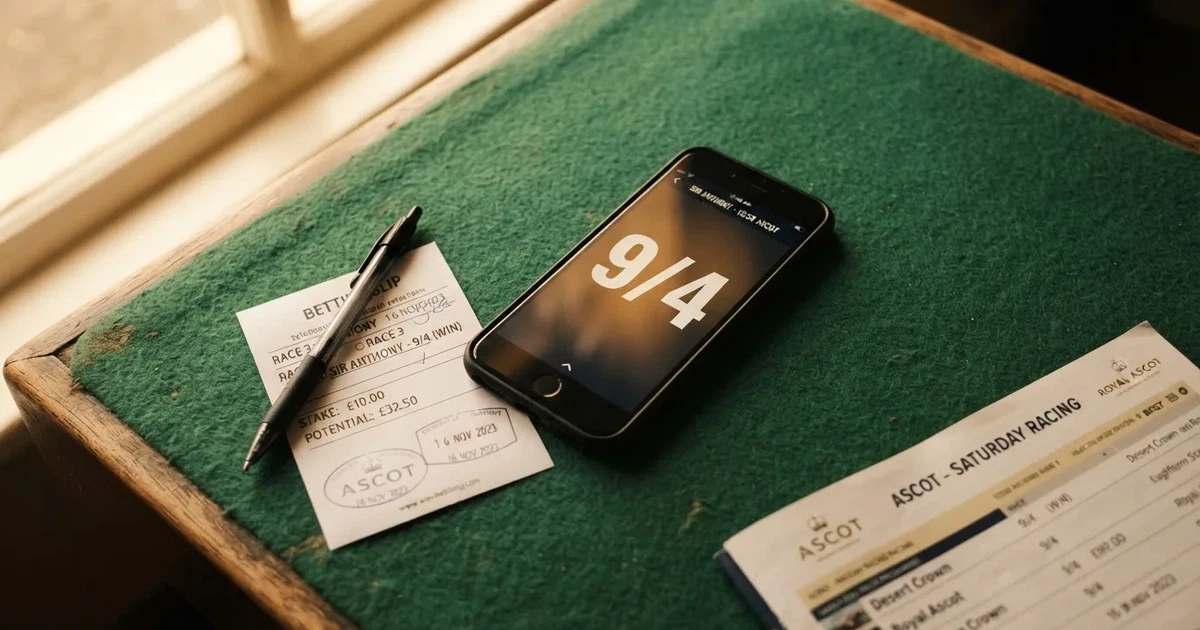
Odds come in two formats. Fractional odds are British: 5/1 (five-to-one) means a £1 stake returns £5 profit plus the £1 stake, £6 in all. Decimal odds are European: 6.00 means a £1 stake returns £6 in all. The conversion is a/b in fractional → (a ÷ b) + 1 in decimal: 5/1 = 6.00, 11/4 = 3.75, evens (1/1) = 2.00. Odds-on is shorter than evens; odds-against is longer. The starting price (SP) is the official industry price taken at the off; a Best Odds Guaranteed book pays the bigger of the price the punter took and the SP.
The bookmaker’s margin is the cut of every pound bet that the book keeps, on average across all outcomes of a market. The arithmetic is plain: for a two-way market, the payout share is 1 divided by the sum of the reciprocal odds of all outcomes, and the margin is 1 minus the payout share. A 1.90 / 1.90 market — a fair-priced even-money line — has a payout share of 1 / (1/1.90 + 1/1.90) = 1 / (0.5263 + 0.5263) = 1 / 1.0526 = 0.9500, a margin of 5.00%. A 1.85 / 1.85 market has a margin of about 8.11%; a 1.80 / 1.80 market has a margin of about 11.11%. Lower decimal odds mean more margin, and the punter who picks the highest decimal odds on the same horse at the same meeting picks the cheapest bet.
A worked illustration. Consider a two-way illustrative market at decimal odds 1.90 / 1.90 — fractional 9/10 on each side, a near even-money line. The reciprocal of 1.90 is about 0.5263, and the sum of reciprocals is 1.0526. Dividing 1 by 1.0526 gives a payout share of about 95.00% — meaning the bookmaker keeps roughly 5.00% of every pound bet on this market in the long run. State this as a band, not a point: a typical two-way market at fractional 9/10 carries a margin in the region of 5%, depending on the operator, the meeting and the time of day. The exact figure for a given bookmaker on a given race is not the same as the figure for the next bookmaker on the next race; margins move with liquidity, time-to-off and the shape of the book.
Horse Racing, the Race Calendar and What to Bet On
Horse racing in Great Britain runs almost every day of the year, with the most televised flat meetings concentrated in the summer and National Hunt meetings taking centre stage through the winter. The British classics — the 2000 Guineas and the 1000 Guineas at Newmarket, the Derby and the Oaks at Epsom, the St Leger at Doncaster — are the spine of the flat season. The Cheltenham Festival in March and the Grand National meeting at Aintree in April are the spine of the National Hunt season. A punter who knows the calendar knows when the bookmakers lift their limits and when the racing pages lead with the form.
The shape of the offer changes with the meeting. A Class 6 all-weather handicap at Kempton on a Tuesday in February carries a thinner betting forecast and lower liquidity than a Classic at Newmarket in May. The Best Odds Guaranteed price the punter takes on a big-race favourite is set earlier in the day, when the book is more confident; the SP on the same horse at the off is the industry’s verdict. BOG pays the bigger of the two. On a quiet midweeker, BOG may be the difference between a small overlay and a small underlay.
Each brand carries a different slant. Tote is the pool-betting product: the dividend is set after the race and the punter bets into a market rather than against a book. Paddy Power and Betfair run their racing products under the same Flutter Entertainment plc umbrella but as separate licensed brands. William Hill has a long heritage on British racing and the BOG promise runs from 8 AM on the day of the race. bet365‘s racing product is part of a broader in-play product. Betfred‘s racing product sits inside the wider Betfred offer alongside the 21 sports the app covers. Spreadex sits outside the fixed-odds mainstream — it is regulated by the FCA for spread betting and by the Commission for fixed-odds betting, and states that spread betting losses can exceed the deposit.
A punter who wants a quiet life bets each-way singles with BOG on at least one book; a punter who wants a busy life builds Yankees and Lucky 15s across the day’s meetings, with the acca insurance at one book and the boost at another. The risk is the same on both sides: the margin compounds across the legs of a multiple, and a four-leg acca at 5.00 per leg (overall 625) carries a margin that is roughly the sum of the four margins rather than their average. A small price edge on each leg is a small price edge across the bet; a small disadvantage is the same disadvantage, squared.
Ten UK-Licensed Bookmakers, Side by Side
The ten brands below each hold a remote operating licence from the Gambling Commission for real-event betting in Great Britain. Each is a GAMSTOP member. The list is not a ranking and not a recommendation; it is the set of operators the Commission’s register names against an active licence. Several are groups under common ownership — the Flutter brands, the Entainchicare brands, the bet365 family — and the table reflects the licensed brand rather than the corporate parent. Where the licence is held by a Gibraltar-registered company under a Commission account number, the account number is the link back to the register.
A note on what’s not in the table. Spreadex, Kalooki Sportsbook, Unibet, Midnite, William Hill, Fitzwilliam Sports and Lottoland UK are mentioned in the surrounding material for the fact each carries — Spreadex’s dual regulation, Kalooki’s GAMSTOP membership, Unibet’s Commission account, Midnite’s licence citation, William Hill’s BOG, Fitzwilliam’s help-line links, Lottoland’s licence — but the operator set the page ranks comes from the Commission’s register for a real-event remote general betting standard licence. Where a brand’s product is mostly lottery, casino or financial spread betting, it sits in the surrounding prose, not in the ranking.
| Brand | Gambling Commission licence and holder | What the operator’s terms state |
|---|---|---|
| Tote | Remote general betting standard (real events); licence holder TDCO Limited; account 54779 | Pool-betting product with a dividend after the race; fixed-odds markets on the same races; on-course and online presence |
| BetGoodwin | Remote general betting standard (real events); licence holder Goodwin Racing Limited; account 2927 | “Bet £10 & Get £15 in Free Bets” welcome: a £5 sports single, a £5 acca and a £5 Sub-Cover bet |
| Geoff Banks | Remote general betting standard (real events); licence holder GB Sports Advisors Limited; account 54095 | Live in-play prices on racing alongside ante-post prices on future events |
| VBet | Remote general betting standard (real events); licence holder SCGO Limited; account 44662 | “£10 free bet if a new, verified customer stakes £10+ on a first bet that loses” |
| Sporting Index | Remote general betting standard (real events); licence holder Sporting Index Limited; account 27343 | Fixed-odds and spread betting on the same app; in-play betting, football Bet Builder, auto cash-out, Multi-Markets |
| Kalooki Sportsbook | Remote general betting standard (real events); licence holder Kalooki Sportsbook Limited; account 57730 | GAMSTOP member; identity verification before the first deposit |
| LiveScore Bet | Remote general betting standard (real events); licence holder LiveScore Betting and Gaming (Gibraltar) Limited; account 56859 | Bet Builder allows up to 10 selections across match result, both teams to score, corners, total goals, player scoring and cards |
| Dabble | Remote general betting standard (real events); licence holder Dabble Sports UK Ltd; account 65677 | “Bet £10, Get £10 in Free Bets” on first deposit for new customers; 7-day free-bet expiry; stake not returned; minimum odds apply |
| 10bet | Remote general betting standard (real events); licence holder Blue Star Planet Limited; account 43173 | Cash out, Bet Builder and Live Streaming alongside football, tennis and horse racing |
| Betfred | Remote general betting standard (real events); licence holder Petfre (Gibraltar) Limited; account 39544 | 21 sports plus over 2,000 casino-style games; long-running horse racing product |
Tote runs the pool-betting product that returns a dividend after the race. A pool bet is not a price taken at the time of betting; it is a stake into a market, and the dividend depends on the pool and the winning tickets. Tote is the closest a GB punter gets to pari-mutuel betting through a licensed UK brand, and the app carries fixed-odds markets alongside the pool. The verification step before the first deposit is the same as for any other licensed bookmaker; the GAMSTOP membership is mandatory for every online operator.
BetGoodwin‘s welcome is the clearest small-stakes offer on the list. A £10 first bet unlocks £15 in free bets across three bet types — a single, an acca and a Sub-Cover bet — and the structure is a deliberate nudge to spread the free-bet stake across the product. The terms behind the offer (minimum odds, expiry, stake-not-returned) are in the brand’s own T&Cs. A punter who reads the T&Cs before staking the £10 is a punter who knows what each of the three £5 free bets is worth on average, and that knowledge is the difference between taking the offer and being taken by it.
VBET‘s offer is the cleanest “no-lose” framing on the list: stake £10, lose, get £10 back as a free bet. The framing is “first bet that loses” and the £10 free bet is the consolation. The free-bet value is roughly £10 × (price − 1) ÷ price × payout share; on a 4.00 horse with a 95% payout share, that is about £7.13 in expectation. The offer is honest if the punter reads it that way.
Sporting Index is the only reviewed brand that runs both fixed-odds and spread betting on the same login. Spread betting on racing is a different product: a quote is set (say, 28–30 lengths by the favourite in a staying handicap) and the punter buys or sells at the quote, with the result settled against the actual distance. Losses can exceed the deposit; the FCA regulates the spread side, the Commission regulates fixed odds. The brand’s app carries in-play betting, a football Bet Builder, auto cash-out and Multi-Markets.
LiveScore Bet‘s headline feature is a Bet Builder that allows up to 10 selections across the football categories. The racing offer is separate and the brand publishes a separate price promise. The Bet Builder is a useful product for football punters and a reminder that the strongest feature on a bookmaker’s app is not always the strongest feature for the racing punter.
Dabble‘s welcome is a £10 free bet on a first deposit with a 7-day expiry, minimum odds on the qualifying bet and the stake not returned on any win. The 7-day expiry is a real cost: a punter who forgets the free bet for a week loses it. A punter who plans the week around the expiry turns the offer into value.
10bet publishes cash out, a Bet Builder and Live Streaming alongside a sportsbook that covers football, tennis and horse racing. The Live Streaming feature matters for in-play football more than it does for racing — racing has its own broadcast feed through the racing channels and the bookmakers’ own media arms — but the cash-out button is the same button across sports.
Betfred is the longest-running high-street name on the list and its racing product carries that heritage. The 21-sport, 2,000-casino-game app is broader than a racing-only punter needs; for the punter who wants to keep racing as one part of a multi-sport account, Betfred is one of the natural homes.
Geoff Banks and Kalooki Sportsbook sit in a different part of the market — smaller brands, racing-led products, named-operator customer service rather than mass-market scale. The Kalooki licence is held by Kalooki Sports Book Ltd (company number 12938274) under account 57730 and the brand is a GAMSTOP member. Geoff Banks is published by GB Sports Advisors Ltd with in-play and ante-post prices on the same app. The right reader for these brands is a punter who values the racing product over the multi-sport breadth.
The verdict, taken one brand at a time, is the question the reader actually asks: which of these is worth opening an account with, and which is the second account that fills the gap the first one leaves? Tote is worth opening for the pool product alone, and the fixed-odds offer is a bonus. BetGoodwin is the cleanest small-stakes welcome on the list, and the three-leg free-bet structure is more useful than a single free bet of the same headline value. VBET is a one-bet-loses consolation that pays back in a free bet — the offer is fine if the punter reads it as a free bet, not as a refund. Sporting Index is the only book on the list that runs spread betting on racing, and the FCA-regulated spread side is the reason a punter with a horse-racing view of “more than 25 lengths” opens an account here. LiveScore Bet is the right second account for a punter whose main book does not run the football Bet Builder. Dabble is the right account for a punter who values the social features on the app. 10bet is the right second account for a punter who wants cash out, a Bet Builder and live streaming under one login. Betfred is the right account for a punter who wants the long-standing high-street brand and the racing heritage. Geoff Banks and Kalooki are the right accounts for a punter who wants a smaller, racing-led brand and a named-operator experience.
How the British Horse Racing Betting Market Is Run
The Commission licenses the whole commercial market under the Gambling Act 2005, which covers Great Britain — England, Scotland and Wales. Northern Ireland is outside the Act and runs on its own older law; a GB licence does not regulate bets struck in Northern Ireland. Since the Gambling (Licensing and Advertising) Act 2014 an operator whose remote facilities are used in Great Britain needs a Commission licence wherever it is based; a Curaçao, Maltese or Gibraltar licence is not a substitute. A Gibraltar-registered company can hold a GB licence — LiveScore Bet is held by LiveScore Betting and Gaming (Gibraltar) Limited, Betfred by Petfre (Gibraltar) Limited, Unibet by Platinum Gaming Limited — and the licence is what matters at the point of consumption.
There is no state monopoly and no cap on the number of licences. The Commission’s public register lists every licensee and is searchable by business name, trading name, domain or account number. A brand that holds a licence is on the register; a brand that does not is not. The register is the whole test.
Betting licence types matter because they shape what a brand can offer. Remote general betting standard (real events) is the licence behind fixed-odds and pool betting on real sporting events; it covers every brand in the table above. Remote general betting standard (virtual events) is a separate category for computer-generated events. Remote pool betting is the licence behind pool-betting products like Tote. Remote betting intermediary is the licence for betting exchanges — Betfair, Smarkets, Betdaq — that match back and lay bets between punters rather than taking the other side. The licence a brand holds is on the register next to the brand.
The LCCP — Licence Conditions and Codes of Practice — is the rulebook that sits alongside each licence. It covers social responsibility, financial vulnerability checks, marketing, self-exclusion, age verification, identity verification and the dispute-resolution process. An operator that breaks an LCCP condition faces regulatory action; an operator that breaks a criminal-law condition faces prosecution. Section 33 of the Gambling Act 2005 makes providing gambling facilities in Great Britain without the required licence an offence, punishable on summary conviction by up to 51 weeks’ imprisonment, a fine up to level 5, or both (six months in Scotland). The offence is aimed at the operator, not the punter.
Advertising runs through a separate regulator. The Committee of Advertising Practice (CAP) writes the non-broadcast code; the Broadcast Committee of Advertising Practice (BCAP) writes the broadcast code; the Advertising Standards Authority (ASA) enforces both. CAP Code section 16 covers gambling marketing: it must be socially responsible, must not be of strong appeal to under-18s, and no one who is or seems to be under 25 may feature gambling or play a significant role in the advertisement (with an exception for marketing placed where a bet can be made directly). The whistle-to-whistle ban — no betting advertisements between five minutes before and five minutes after a live sporting event before the 9pm watershed — has applied since 1 August 2019; horse and greyhound racing are excluded. The Premier League’s withdrawal of gambling sponsorship from the front of matchday shirts (from 2026/27; sleeves and hoardings remain) is voluntary, not law.
The punter pays no tax on betting winnings in Great Britain — general information, not tax advice; a professional gambler should ask HMRC or an adviser. General Betting Duty is the operator’s tax on gross profits, currently 15%, with a new remote betting rate of 25% from 1 April 2027 within that duty (UK horse racing, betting terminals, pool betting and in-person betting staying at 15%). The remote rate stays at 15% until 1 April 2027. Whether operators pass duty on through odds is not established; the page does not claim a duty charge against the punter. Spread betting has its own rates (3% financial, 10% other) under a separate regime.
The help lines are free and confidential. GamCare runs the National Gambling Helpline on 0808 8020 133, open every day. GambleAware funds treatment and education. The NHS runs gambling clinics in several regions. Gamblers Anonymous runs support meetings. GAMSTOP is the multi-operator self-exclusion scheme; a customer who registers with GAMSTOP is excluded from every participating UK-licensed online operator for the chosen period.
Frequently Asked Questions
How do you bet on horse racing?
Pick a race from the race card at any UK-licensed bookmaker, choose a horse, decide whether to bet to-win or each-way, set the stake and confirm the bet on the slip. To bet to-win, the stake is on the horse to finish first; to bet each-way, the stake is split into two equal bets — one on the win, one on the place — and the total stake is doubled. Identity verification (name, address, date of birth) is required before the first deposit at every GB-licensed operator.
How do you work out a horse racing bet?
For a single win bet, multiply the stake by the decimal odds: a £10 stake at 3.50 returns £35 in total, £25 profit plus the £10 stake. For an each-way bet, double the stake, work out the win part and the place part separately, and add them: a £10 each-way bet on a 5.00 horse at 1/4 place terms for three places costs £20; the win part pays £50 if it wins, the place part pays £22.50, £72.50 in total. For an accumulator, multiply the decimal odds of each leg.
How do betting odds work on horse racing?
Decimal odds express the total return per £1 staked, including the stake: 3.50 means a £1 stake returns £3.50 in total, £2.50 profit. Fractional odds express the profit per £1 staked: 5/2 means £2.50 profit on a £1 stake, £3.50 in total. Fractional a/b in decimal is (a ÷ b) + 1. Odds-on is shorter than evens (below 2.00 decimal, below 1/1 fractional); odds-against is longer. The starting price (SP) is the official industry price at the off; Best Odds Guaranteed pays the bigger of the price taken and the SP.
How can a punter check that a bookmaker holds a Gambling Commission licence?
Search the Commission’s public register by business name, trading name, domain or account number. Every brand named on this page carries the account number that links back to the register; for example, Tote’s account is 54779, BetGoodwin’s is 2927, Betfred’s is 39544. A brand on the register holds the licence; a brand not on the register does not. The register is the only test.
How is the return on a bet worked out from the stake and the odds?
Return equals stake multiplied by decimal odds: a £10 stake at 2.50 returns £25 in total, £15 profit plus the £10 stake. Net profit is stake multiplied by (odds minus 1): £10 × (2.50 − 1) = £15. For a combination bet the odds of the legs multiply into one price: four legs at 2.0, 3.0, 2.5 and 2.0 give an overall price of 30.0. The return is the stake multiplied by the overall price; the profit is the return minus the stake.
What is the bookmaker’s margin and how can it be seen in the odds?
The margin is the cut of every pound bet that the book keeps, on average, across all outcomes of a market. For a two-way market the payout share is 1 divided by the sum of the reciprocals of the decimal odds of every outcome, and the margin is 1 minus the payout share. A 1.90 / 1.90 market has a payout share of about 95.00% and a margin of about 5.00%; a 1.85 / 1.85 market has a margin of about 8.11%; a 1.80 / 1.80 market has a margin of about 11.11%. Lower decimal odds mean more margin. The punter who picks the highest decimal odds on the same horse at the same meeting picks the cheapest bet.
Horse racing & greyhounds – Best betting exchange
Content created by the «Best betting exchange» team
