
Online Basketball Betting 2026: What the Margin, the Free Bet and the Bonus Cap Cost a UK Bettor
 Available in US
Online basketball betting in Great Britain is run by bookmakers holding a Gambling Commission remote licence, where every advertised price already carries the bookmaker’s margin, every free bet carries a turnover rule and every bonus carries a cap that landed in January 2026. This page goes through what those costs look like in pounds and pence: the margin inside the odds, the rollover behind the headline offer, the credit-card ban that defines how the deposit arrives, and the verification step that decides whether the first bet is placed at all. Ten GB-licensed operators are reviewed, including Betboro, DragonBet, Midnite, Bar One Racing, Dabble, Bet600, Betfred, 888sport, BetVictor and Ladbrokes — each by its own licence number and the offer its own terms state.

Data current as of 27 October 2026, checked against the Gambling Commission’s public register and each operator’s own published terms.
Responsible Gambling: Where the Protection Sits Before a Single Bet
Gambling harm is the cost that does not appear on the betting slip, and in Great Britain the protection is layered rather than declared on a banner. Every brand reviewed here is a GAMSTOP member, which means a customer can self-exclude across every GB-licensed online operator in one registration. The minimum period is six months; the maximum is five years; after the minimum has run, the exclusion stays in force for a further seven years unless the customer asks GAMSTOP to lift it. Betting shops are covered by a separate scheme, not GAMSTOP itself.
The Gambling Commission’s player-protection rules set the floor. Minimum age is 18. Name, address and date of birth are verified before the first deposit or the first bet, including with a free bet, and that check has applied since 7 May 2019. A financial vulnerability check (LCCP condition 3.4.4) has been in force since 30 August 2024: when a customer’s deposits minus withdrawals exceed £150 in a rolling 30 days — the threshold has applied since 28 February 2025 — the operator runs a public-record check (bankruptcy, county court judgments). It is not an income check and not a credit reference check. The wider financial risk assessment — the affordability check that has been in the press — is announced in a staged plan from 7 July 2026, with no start date. Treat it as announced, not in force.
Deposit limits are a customer-set tool, not a state ceiling. The Commission’s Remote Technical Standards (RTS 12) require operators to offer a gross deposit limit on a fixed time frame; the first phase applied from 31 October 2025, the second phase has been postponed to 30 September 2026. No statutory cap on stake or loss exists for sports betting — the limits are the operator’s choice, and the customer can tighten their own. Where to get help: GamCare (the National Gambling Helpline), GambleAware, NHS gambling clinics and Gamblers Anonymous. Fitzwilliam Sports’ homepage links to GambleAware, GamStop and Gamblers Anonymous in the same footer block, which is the layout most licensed sites follow rather than a one-off.
Honest framing: licensed = checks, limits, GAMSTOP, the 10x bonus cap that follows in the next section, but also identity verification before the first bet. Offshore brands offer none of these. The Commission’s enforcement route is disruption rather than ISP blocking: cease-and-desist notices, search-engine referrals, work with registrars and payment providers, and court-order DNS blocking powers that have been given or are about to be. The legal test is the licence register, and that register is the page’s reference point throughout.
Crypto and Anonymity: Why the Question Meets the Same Wall
Search terms like basketball betting with bitcoin and basketball crypto betting sites exist because the idea of betting without a name attached to the deposit is appealing. In Great Britain that idea meets the identity check before the first deposit — name, address and date of birth verified under money-laundering rules, and the check has been in force since 7 May 2019. A crypto deposit still arrives at a GB-licensed operator, which still runs the same verification before the customer can place a bet. Pseudonymous on the ledger, identified at the bookmaker.
No GB-licensed operator in this comparison takes cryptocurrency as a standard payment method, and no rule explicitly bans or allows it — the question is settled by the verification step rather than a payment-method list. A customer who wants crypto and anonymity lands on an offshore brand licensed in Curaçao, Malta or Gibraltar, where the verification step is absent or lighter. The trade is real and worth naming: no GAMSTOP coverage, no Commission complaints route, no approved dispute-resolution body, no British consumer redress if funds are withheld, no 10x bonus cap, no £150 vulnerability check. The offshore brand offers the privacy the licensed one cannot, and offers none of the protections the licensed one must.
Bonuses and Free Bets: What the 10x Cap and the Turnover Rule Actually Cost
The promotion rules in force since 19 January 2026 set the ceiling: wagering requirements on bonuses are capped at 10x, and mixed-product promotions (a free bet unlocked by playing casino, for instance) are banned. A £10 bonus at 50x wagering would have meant £500 of qualifying bets; under the cap, no more than £100 of turnover is required to clear it. The cap applies to bonus money with a wagering condition. Whether it applies to free bets with no wagering condition, and whether there is any cap on the money value of a bonus, are not established and the rules stay unsettled on those points.
The ten GB-licensed operators state these offers on their own terms. Betboro’s sports welcome offer is a 100% matched free bet of up to £25 on the first qualifying wager, requiring a debit card deposit of at least £10 and a first bet of £5 to £25 with at least three selections each at 3/5 (1.60) or higher. Midnite’s sports welcome offer pays £25 in free bets and 50 free spins when a new customer bets £5 or more on pre-match odds of EVS (2.0) or greater within 14 days of sign-up, with the free bets valid for 7 days. Dabble’s welcome offer is “Bet £10, Get £10 in Free Bets” on a first deposit, with minimum odds applying, a 7-day expiry and the stake not returned. Each of these sits inside the 10x cap because none of them carry a wagering multiplier on the bonus — they are free-bet mechanics, which pay returns rather than stake-plus-return.
The cost hidden in the headline. A free bet returns profit only when it wins, and the stake is not paid back. For a £10 free bet at decimal odds of 3.00, a winning bet pays £20 of profit (stake × (odds − 1)); the customer never sees the £10 stake again. That is why the marketing word “free” sits in quotes here — the bet is free to place, the winnings are not the headline return the number on the banner suggests. Free-bet value on average, assuming the market’s own payout share applies to the leg: free-bet amount × (odds − 1) ÷ odds × payout share of that market. For a £10 free bet at 3.00 on a market with a 95% payout share, the expected value is roughly £10 × (3.00 − 1) ÷ 3.00 × 0.95 = £6.33, before any minimum-odds rule the offer attaches. The £25 free-bet headline is worth less than £25 once the maths is done, and the difference is the stake the operator has kept.
Bonus turnover, where it applies, is the bigger number. A £50 bonus at 5x wagering on a sport with a 5% margin means £250 of qualifying bets at minimum price, costing roughly £12.50 of expected loss (turnover × margin). The bonus pays £50, the clearing costs £12.50, the net is £37.50 if the bonus is withdrawable cash. The 10x cap puts the worst ratio at £10 of bonus costing £100 of qualifying bets, expected loss £5 — a tighter ratio than the old offers but still a real cost the page does not soften. The advertised number is what the customer receives; the turnover is what the customer pays.
Mobile and App: What the Touchscreen Adds and What It Takes Away
The British betting app market runs on the App Store and Google Play storefronts, with native apps from every GB-licensed operator in this comparison. The headline features are stable across the set: pre-match and in-play odds, a bet slip, cash out, deposits and withdrawals through the same payment methods as the desktop site. The differences live in the depth of the in-play package, the bet builder, the live streaming and the small things that decide whether a phone is the right device for the bet.
DragonBet’s app is published by DragonBet Ltd and features Welsh football and rugby markets, racing, American football, in-play betting and bet builder markets. Midnite’s app shows in-play events, an acca builder, popular accas and price boosts with maximum-stake limits. Betfred’s app covers 21 sports plus over 2,000 casino-style games. Ladbrokes’ app, published by Entain Operations Limited, holds a 4.66 rating across 101,255 ratings in the GB App Store. BetVictor offers Best Odds Guaranteed on UK and Irish horse racing, enhanced live race streaming, a BetFinder racing tool and Smart Stats. Bet600 pays Best Odds Guaranteed on horse racing, settling at the starting price if it is bigger than the price taken.
The browser route is the other path. Every operator in this comparison runs a mobile-optimised site, and the browser path matters because a downloadable app is not the only way to place a bet from a phone. The browser avoids the storage cost, the app-store update cycle and the data the app collects, and it carries the same odds and the same markets because the data feed is the same. The app adds biometric login and push notifications for price moves and bet settlement, and those are the reasons to choose it over the browser on a phone the customer already trusts.
bet365 is named in research as the most-downloaded sports betting app in the UK, and it is the official global betting partner of the UEFA Champions League. The brand is not in this comparison’s ten operators, and its features (Bet Builder+, Super Boosts, Winnings Boosts on Bet Builders and selected singles, daily Bet Boosts) appear here only as a benchmark for the depth a market-leading app reaches, not as a review. Naming it as a benchmark keeps the ten-operator list honest about which depth is the standard.
Live Betting and Cash Out: The In-Play Margin and the Exit Price
Live betting on basketball runs through every GB-licensed operator in this comparison, and the in-play markets are deeper than the pre-match list at the bigger brands. The in-play offer covers moneyline, point spread, total points, quarter and half markets, and at the bigger brands player props and team props sit alongside the team totals. The price moves with the score, and the suspension windows around timeouts, free throws and the end of quarters are where the in-play margin widens.
The cash-out feature is what makes the live bet a managed position. The bookmaker offers a real-time price to close the bet before the event settles, and the price is built from the live odds minus the bookmaker’s margin on the cash-out itself. A bet on the pre-match moneyline at 1.90 settles at 1.90 if it wins outright; the cash-out price during the match is whatever the live market says, minus a margin that is usually wider than the pre-match margin. The cash-out is useful when the bet has moved into profit and the rest of the game is volatile, and it is expensive when the live market has already priced the new state — the cash-out margin is the cost of the convenience.
In-play betting in Great Britain is offered by every GB bookmaker, and the controls are the operator’s licence conditions and customer-protection duties, not a separate statute. The legal framing matters here: the controls are operator-side, and a customer who wants to bet in-play on basketball at a licensed site gets the same protections (verification, GAMSTOP, the £150 vulnerability check, the 10x bonus cap) as on the pre-match side. An offshore brand running in-play from Curaçao offers none of those controls. The legality is settled by the licence, not by the timing of the bet.
Predictions and Strategy: What an Analyst Does That a Tipster Does Not
The market for basketball picks is split between a tipster who names a side and an analyst who prices the side the market has missed. The first sells tips; the second sells a method. A tipster who names a winner at a given price is making a claim about an outcome nobody can know. An analyst who explains how a point-spread line is built, where the closing line value sits, and how to size a stake to a bankroll is teaching a method. The page treats the second as worth the reader’s time and the first as worth the reader’s scepticism.
Bankroll management is the part of strategy that decides whether a method survives. The unit size — typically 1% to 3% of the bankroll per bet — is the rule that keeps a bad run from ending the bankroll before the method has a chance to work. The closing line value (the difference between the price the bettor took and the price the market closed at) is the test of whether the bet was worth the stake: a long-run record of beating the closing line is the strongest signal that the bettor is finding something the market has not priced, because the closing line is the most efficient price available. None of this is a prediction of a winner; it is a way of pricing a bet against the market and sizing the stake to the bankroll.
The market’s own terms matter. The bookmaker’s margin sits inside every price, and the payout share of a market is the inverse of that margin. For a market at decimal odds of 1.90 / 1.90 — the example the page works through in the next section — the payout share is 1 ÷ (1/1.90 + 1/1.90) = 0.95, and the margin is 1 − 0.95 = 0.05, or 5%. That 5% is the cost of every unit bet on the market, on average, regardless of who wins. A market at 1.85 / 1.95 has a different payout share, and a basketball point spread at -110 on both sides has the American-style margin the British reader needs to convert into decimal form before the maths runs. The price is the test of the market; the margin is the test of the price.
No system wins. A reader who acts on a named winner loses real money on the page’s word, and the page makes no prediction of one. The strategy is a method for pricing the bet the reader chooses, not a tip on the bet to take. The closing line and the bankroll are the page’s bets; the tipster’s tip is the page’s warning.
Bet Types and Odds: How a Price Is Built and What It Costs
The bet types on basketball follow the British bookmaker’s set, with some American-style market names carried over. The moneyline (called match result or 1X2 in football vocabulary) settles on the winner after overtime. The point spread settles on the margin of victory, with the favourite giving points and the underdog taking them. The total points settles on the combined score, with over and under lines around a number the bookmaker sets. The quarter and half markets settle on the score in the period named. Player and team props settle on a named player’s points, rebounds, assists or a named team’s statistic.
Decimal odds are the British standard, and a price of 2.00 means a winning £10 bet returns £20 (£10 stake plus £10 profit). Fractional odds of 1/1 are the same price in British form. The conversion is a/b → a ÷ b + 1: 5/1 in fractional is 6.00 in decimal, 11/4 is 3.75, evens (1/1) is 2.00. American odds of -110 sit at decimal 1.91, and the conversion is 100 ÷ |negative price| + 1 for a negative American price. The page uses decimal odds throughout, and the conversion is the reader’s tool when the operator’s slip or checkouts the price in another format.
A worked example: a £10 single on the moneyline at decimal odds of 2.50 pays £25 if it wins (£10 × 2.50), a net profit of £15 (£10 × (2.50 − 1)). A combination bet multiplies the prices of the legs into one. A double at 2.00 and 3.00 is a price of 6.00, and a £10 double pays £60 if both legs win. The stake is at risk across the whole combination: one losing leg and the bet loses. Multi-leg bets are higher-priced because the probability of every leg landing is lower, and the margin of a multi-leg bet is the margin of every leg compounded.
The page’s own calculation, and the only one it runs. The margin of a market is the percentage the bookmaker keeps of every unit bet on the market, on average, and it is the inverse of the payout share. Take the example of a market priced at 1.90 / 1.90 — even money with a small margin, the kind of two-way line a basketball spread settles around. The payout share is 1 ÷ (1/1.90 + 1/1.90) = 1 ÷ (0.5263 + 0.5263) = 1 ÷ 1.0526 = 0.95, or 95%. The margin is 1 − 0.95 = 0.05, or 5%. The result is a band rather than a single figure: depending on the market and the operator, a basketball moneyline sits between roughly 4% and 6% margin, with deeper markets (player props, alternate spreads) carrying wider margins because they are harder to price and fewer bettors price them. The headline price is one number; the margin is the second number that decides what the price costs.
The rule generalises: the tighter the spread between the two sides, the smaller the margin, because the bookmaker is closer to a true two-way line. The wider the spread (1.65 / 2.40, say), the bigger the margin (1 ÷ (1/1.65 + 1/2.40) − 1, here about 5.5%). The same holds for totals (over / under), spreads (-3.5 / +3.5) and props. The price is the cost of the bet; the margin is the cost of the market.
Sports and Tournaments: The Calendar and the Markets That Go With It
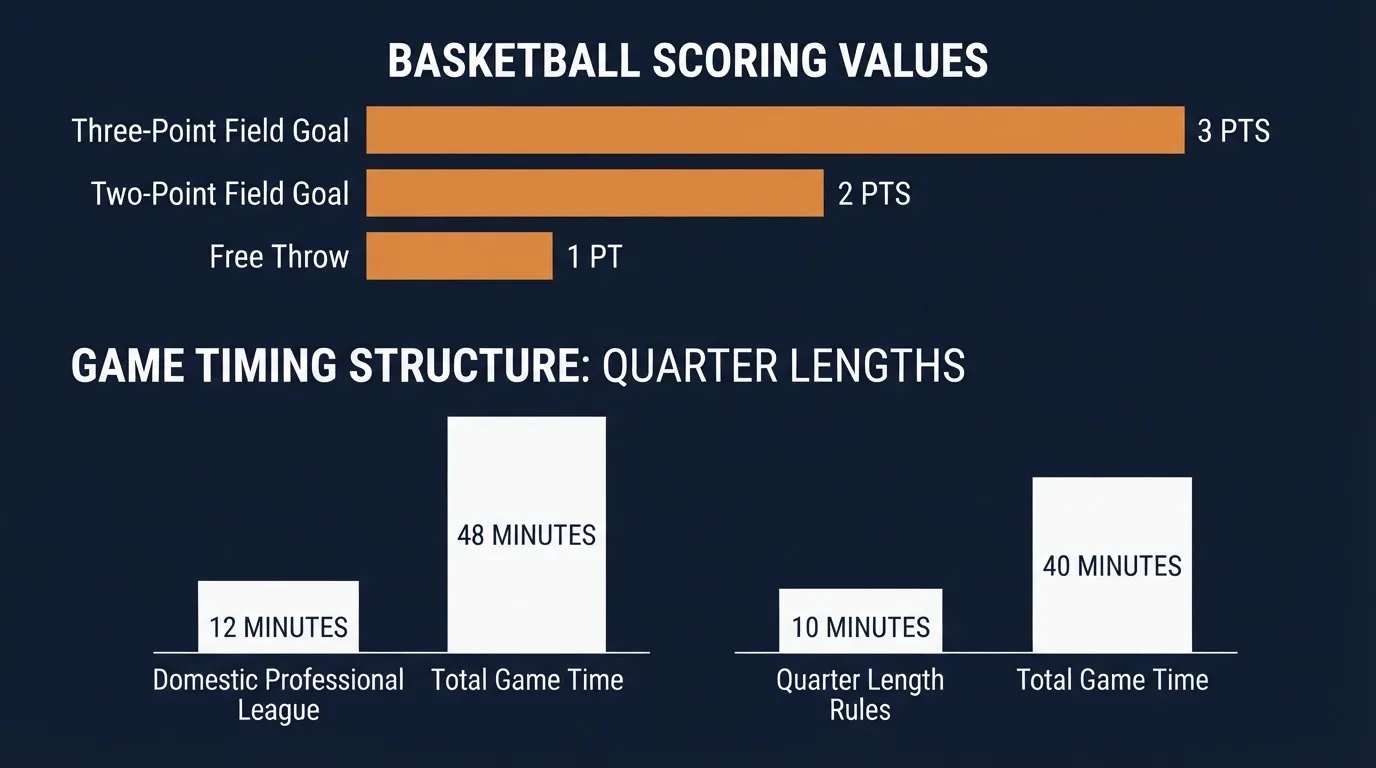
Basketball was invented by James Naismith in 1891 in Springfield, Massachusetts, and the first game is dated 21 December 1891. The game puts five players on court per side, with unlimited substitutions during stoppages. A field goal is worth 2 points, or 3 from beyond the three-point line; a free throw is worth 1 point. The rim is 10 feet (3.05 m) above the court at almost all levels of competition. NBA games run four 12-minute quarters; FIBA games run four 10-minute quarters. Overtime periods last five minutes. Men’s basketball entered the Olympic programme at the 1936 Berlin Games, women’s in 1976, and 3×3 basketball has been an Olympic event since 2020.
The British basketball calendar follows the NBA regular season (October to June) and the NBA Playoffs (April to June), with the NBA Finals in June. The college calendar (the NCAA Tournament, “March Madness”) runs from November to the first week of April. The British Basketball League (BBL) runs a domestic season, and the British women’s leagues run alongside. The EuroLeague and the FIBA Basketball World Cup sit on the international calendar, and the Olympic men’s and women’s tournaments run every four years. The wagering menu follows the calendar: NBA markets are deepest in the British bookmaker’s set, with the spread, total, moneyline, quarter and half markets, and player props. The EuroLeague carries a thinner set. The BBL carries a thinner set still, and the women’s leagues carry the thinnest.
The named tournaments and seasons stay in digits: NBA 2026/27 is the season that tips in October 2026; the 2026 FIBA Basketball World Cup qualifiers run through 2026 and 2027; the 2028 Olympics carry the tournament under its real year. A season named by its calendar years is a season rather than a publication year, and the rule follows. The current season at the page’s reading is the one the calendar is in, and the tournaments that have not tipped are the ones the calendar names next.
The Ten GB-Licensed Bookmakers Compared
The table below lists every operator reviewed on this page, the Gambling Commission account number that proves the licence, and what the operator’s own terms state on the subject of this page. The licence check is the public register, and every brand listed here holds a remote general betting standard (real events) licence. The “Key terms” column is what the operator’s own homepage or app listing states; it is not a recommendation.
| Brand | Licence (UKGC account) | Licence holder | What the operator’s own terms state |
|---|---|---|---|
| Betboro | 44181 | Webmedia Development N.V. | 100% matched free bet to £25 on first qualifying wager; min £10 debit card deposit, min bet £5–£25, three+ selections at 3/5 (1.60) or higher. |
| DragonBet | 64908 | DragonBet Ltd | Welsh football and rugby markets, racing, American football, in-play, bet builder. |
| Midnite | 101839 | Midnite Limited | In-play events, acca builder, popular accas, price boosts with maximum-stake limits; £25 free bets + 50 free spins on £5+ pre-match bet at EVS (2.0)+ within 14 days, 7-day free-bet expiry. |
| Bar One Racing | 56516 | Bar-One Racing Limited | Irish independent bookmaker with shops across Ireland; horse racing sponsorships at Dundalk, Fairyhouse, Navan, The Curragh, Curraheen Park and Cork. |
| Dabble | 65677 | Dabble Sports UK Ltd | “Bet £10, Get £10 in Free Bets” on first deposit; min odds apply, 7-day free-bet expiry, stake not returned. |
| Bet600 | 44731 | Tyche Tech Limited | Best Odds Guaranteed on horse racing: SP paid if bigger than the early or show price taken. |
| Betfred | 39544 | Petfre (Gibraltar) Limited | 21 sports plus over 2,000 casino-style games; Betfred Sports, Casino & Games app. |
| 888sport | 39028 | 888 UK Limited | Pre-match and in-play, Cash Out, Bet Builder, racing streams, BetFinder form tools, live bet feed, daily boosted odds. |
| BetVictor | 39576 | BV Gaming Limited | Best Odds Guaranteed on UK and Irish horse racing; enhanced live race streaming; BetFinder; Smart Stats. |
| Ladbrokes | 54743 | LC International Limited | Pre-match and in-play, Cash Out, Bet Builder, bet boosts; app rated 4.66 across 101,255 GB App Store ratings. |
The table is one half of the comparison. The other half is what the numbers and the licence columns do not say: who the offer suits, what the offer costs, and what the operator’s depth in the market tells a reader about whether the basketball calendar is covered properly.
What Basketball Betting Costs in 2026 — and What Each Bookmaker Is Worth the Fee
This section goes through the ten operators in the order research gives, with each block ending on a verdict that names who the brand suits. The licence is the floor; the offer is the floor’s price; the verdict is the page’s call.
Betboro — the small free bet, the tight qualifying bet
Betboro’s welcome is a 100% matched free bet of up to £25, requiring a debit card deposit of at least £10 and a first bet of £5 to £25 with at least three selections each at 3/5 (1.60) or higher. The free bet is the headline; the qualifying bet is the cost. A first bet of £25 at three legs of 1.60 sits at a combined price of 4.096, and a winning bet pays roughly £102 (stake × combined price) for a £77 net profit, all of which goes back into the customer — the free bet is then matched on top. The qualifying bet is the gate, the matched free bet is the prize, and the three-leg minimum is the rule that turns the headline into something a basketball bettor can clear with an acca on a busy NBA night. The verdict: the offer suits a bettor who already plans a first acca on the night’s slate, not a bettor who would prefer to bet singles.
DragonBet — the Welsh bookmaker with American football on the side
DragonBet’s app is published by DragonBet Ltd and features Welsh football and rugby markets, racing, American football, in-play betting and bet builder markets. The licence is held under account 64908 by DragonBet Ltd. The brand identity sits in the Welsh market, and the basketball depth sits behind that identity: NBA and college markets are present, but the Welsh football and the racing are the headline. The verdict: for a bettor focused on racing and Welsh football who wants an NBA market to hand, the site is a solid pick.
Midnite — the free bet plus free spins, the max-stake limit on the boost
Midnite’s welcome is £25 in free bets and 50 free spins when a new customer bets £5 or more on pre-match odds of EVS (2.0) or greater within 14 days of sign-up, with the free bets valid for 7 days. The site cites Gambling Commission licence 101839 and shows in-play events, an acca builder, popular accas and price boosts with maximum-stake limits. The maximum-stake limit on the price boost is the rule that decides who the boost suits — a small-stake bettor can take the boosted price; a high-stake bettor is capped. This site is a match for the bettor prioritising free spins and a boosted price on smaller stakes.
Bar One Racing — the Irish bookmaker with a British licence
Bar One Racing has rebranded as BAR 1 Betting, an Irish independent bookmaker with shops across Ireland and horse racing sponsorships at Dundalk, Fairyhouse, Navan, The Curragh, Curraheen Park and Cork. The licence is held under account 56516 by Bar-One Racing Limited, and the brand’s identity sits in Irish racing. Basketball markets are present on a British-licensed platform, but the racing is the headline. The verdict: this is an option for the racing-first bettor who keeps the occasional basketball wager on the same account.
Dabble — the matched free bet with a 7-day expiry
Dabble’s welcome is “Bet £10, Get £10 in Free Bets” on a first deposit for new customers, with minimum odds applying, a 7-day free-bet expiry and the stake not returned. The licence is held under account 65677 by Dabble Sports UK Ltd. The stake not returned is the cost the operating frames a £10 free bet at: at decimal odds of 3.00, a winning free bet pays £20 of profit, and the £10 stake stays with the operator. This operator serves the bettor who prioritises a quick turnaround on the free bet over a longer-horizon staking plan.
Bet600 — the Best Odds Guaranteed on racing
Bet600 pays Best Odds Guaranteed on horse racing: if the starting price is bigger than the early or show price taken, the bet is paid at the SP. The licence is held under account 44731 by Tyche Tech Limited. The BOG is a racing feature, and the basketball menu sits behind it. The verdict: the brand is for the bettor whose weekly bets include UK and Irish racing and who wants the SP-paid-if-bigger guarantee as the main reason to bet here.
Betfred — the wide sports book with a casino attached
Betfred’s app is published by Done Brothers (Cash Betting) Ltd and covers 21 sports plus over 2,000 casino-style games. The licence is held under account 39544 by Petfre (Gibraltar) Limited. The 21 sports are the headline, and basketball sits inside a wide pre-match and in-play menu. The verdict: this operator is a strong contender for the bettor who wants a single account for both sports and casino.
888sport — the bet builder and the boosted odds
888sport offers pre-match and in-play betting, Cash Out, Bet Builder, racing streams, BetFinder form tools, a live bet feed and daily boosted odds. The licence is held under account 39028 by 888 UK Limited. The bet builder and the daily boosts are the headline features, and the basketball depth runs through the builder. The verdict: the brand suits a bettor who builds player-prop and team-prop bets on a single game and wants a daily boost to layer on top, not a bettor who bets only the moneyline.
BetVictor — the BOG and the Smart Stats
BetVictor offers Best Odds Guaranteed on UK and Irish horse racing, enhanced live race streaming and a BetFinder feature for finding racing bets, alongside Smart Stats. The licence is held under account 39576 by BV Gaming Limited. Smart Stats is the racing analytics feature, and the basketball menu sits alongside. The verdict: the brand suits a bettor who wants analytics on the racing and a full book on the basketball, not a bettor whose staking plan needs a basketball-specialist tool.
Ladbrokes — the rating and the Bet Builder
The Ladbrokes app is published by Entain Operations Limited and holds a 4.66 rating across 101,255 GB App Store ratings. The licence is held under account 54743 by LC International Limited, and the categories on the register include remote betting intermediary (the exchange licence) as well as remote general betting standard (real events). The depth of the menu and the high app rating are the headline, and the basketball offer sits inside the wider pre-match and in-play set with Cash Out, Bet Builder and bet boosts. The verdict: the brand suits a bettor who wants a high-rated app, a wide market set and the option of the exchange side, not a bettor looking for a free-bet headline.
Overview: What Basketball Betting Is in Great Britain in 2026
Basketball betting in Great Britain is a Gambling Commission-licensed market of ten operators and several hundred more besides, with no statutory list of permitted events or markets and no cap on the number of licences. The bookmaker sets the price, the margin sits inside the price, the offer sits on top of the price, and the player pays no tax on the winnings. General Betting Duty is the operator’s tax at 15% on gross profits, and from 1 April 2027 a new remote betting rate of 25% applies within it, while remote bets on UK horse racing, bets on self-service betting terminals, pool betting and in-person betting stay at 15%. Until 1 April 2027 the remote rate stays at 15%; whether operators pass the duty on through odds is not established. The page makes no claim either way.
The sport is a four-quarter game with two- and three-point field goals, a free-throw line at one point and a 10-foot rim, and the calendar runs October to June for the NBA, November to early April for the NCAA, and the international windows for EuroLeague, the FIBA World Cup and the Olympics. The British Basketball League runs a domestic season, and the British women’s leagues run alongside. The wagering menu follows the calendar: NBA and college markets carry the deepest set, EuroLeague a thinner set, the BBL thinner still and the women’s leagues the thinnest. The legal grounds are that a Gambling Commission licence is needed wherever the operator is based if its remote facilities are used in Great Britain (sections 33 and 36 of the Gambling Act 2005 as amended by the Gambling (Licensing and Advertising) Act 2014), and the Commission’s public register is the test of who holds one.
Legality and Regulation: The Licence, the LCCP and the Bonus Cap
The Gambling Commission licenses the whole commercial market under the Gambling Act 2005, which covers Great Britain (England, Scotland and Wales); Northern Ireland is outside the Act and has its own older law, so a GB licence does not regulate Northern Ireland. The Licence Conditions and Codes of Practice (LCCP) sit beneath the Act and set the operational rules: social responsibility, marketing, identity verification, the financial vulnerability check, the GAMSTOP membership. The Remote Technical Standards (RTS) set the technical rules.
The five licences a remote operator can hold are remote general betting standard (real events), remote general betting standard (virtual events), remote general betting limited, remote pool betting and remote betting intermediary (the exchange licence). Every brand in this comparison holds remote general betting standard (real events); Ladbrokes’ account 54743 also includes remote betting intermediary. A financial spread betting firm is regulated by the Financial Conduct Authority, not the Commission — Spreadex, for example, holds an FCA licence for spread betting and a Commission licence for fixed-odds betting, and its terms state that spread betting losses can exceed the deposit. That dual regulation is the rule for spread betting; the page leaves it there.
The promotion rules in force since 19 January 2026 cap wagering requirements on bonuses at 10x and ban mixed-product promotions. The credit-card ban has been in force since 14 April 2020 and applies to credit-card-funded payments through an e-wallet as well as direct credit-card deposits. Debit cards and bank-based payments are not covered. The advertising rules sit in the CAP Code (non-broadcast) and the BCAP Code (broadcast), enforced by the ASA, alongside the LCCP marketing conditions: marketing must be socially responsible, must not be of strong appeal to under-18s, and no one who is or seems to be under 25 may feature gambling or play a significant role in a betting advertisement (with an exception for marketing placed where a bet can be made directly). The whistle-to-whistle ban on betting ads around live sport has applied since 1 August 2019. The Premier League clubs’ voluntary withdrawal of gambling branding from matchday shirts runs from 2026/27 (sleeves and hoardings remain).
The offshore picture is the other side of the legal test. A Curaçao, Maltese or Gibraltar licence is not a substitute for a GB licence, and providing gambling facilities in Great Britain without the GB licence is an offence under section 33 of the 2005 Act (on summary conviction up to 51 weeks’ imprisonment, a fine up to level 5, or both; six months in Scotland), aimed at the operator. No offence aimed at a customer who merely bets on an unlicensed site was found: state the loss of protection — no GAMSTOP coverage, no Commission complaints route, no approved dispute-resolution body, no British consumer redress if funds are withheld, not bound by the 10x bonus cap or the £150 vulnerability check. Enforcement is disruption rather than ISP blocking: cease-and-desist notices, search-engine referrals, work with registrars and payment providers, and court-order DNS blocking powers that have been given or are about to be. Honest framing: licensed = checks, limits, GAMSTOP, bonus cap, but also verification before the first bet; unlicensed = none of those protections and possible loss of funds.
The Payout, the Margin and the Closing Line — A Worked Example
The page runs one calculation, and the worked example is the margin of an illustrative two-way market at decimal odds of 1.90 / 1.90 (fractional 9/10), used as an example rather than a quoted price. The arithmetic is the standard two-way margin: payout share = 1 ÷ (1/1.90 + 1/1.90), margin = 1 − payout share.
For a market priced 1.90 / 1.90, the reciprocal of each side is 1 ÷ 1.90 = 0.5263, the sum is 1.0526, and the payout share is 1 ÷ 1.0526 = 0.95, or 95%. The margin is 1 − 0.95 = 0.05, or 5%. A bet of £100 on this market returns £95 to bettors on average, and £5 stays with the bookmaker, regardless of which side wins. That 5% is the cost of the bet, hidden inside the headline price.
The result is a band rather than a single figure. Depending on the market and the operator, a basketball moneyline sits between roughly 4% and 6% margin. Deeper markets — player props, alternate spreads, combination bets — carry wider margins, because they are harder to price and fewer bettors price them, and the bookmaker keeps a larger share of every unit bet on those markets. A multi-leg bet at 4.00 (four legs of roughly 1.414 each) has a margin that compounds across the legs, and the bettor pays the cost of every leg multiplied.
The bettor’s tool is the closing line. A long-run record of beating the closing line is the strongest signal that the bettor is finding something the market has not priced, because the closing line is the most efficient price available. The price at kick-off is the test of the bet; the margin is the test of the price.
Frequently asked questions
How do you bet on basketball?
Pick a licensed bookmaker from the Gambling Commission’s public register, complete the identity verification (name, address, date of birth), deposit by debit card or bank transfer, and choose a market — moneyline, point spread, total points, or a player prop. Place the bet from the bet slip, and the bet settles when the event settles. The minimum stake is set by the operator; the maximum stake depends on the market and the customer’s history.
How do you bet basketball?
The mechanics are the same as any sport: a stake, a price, a market. The basketball menu runs deepest on the NBA and the NCAA, with thinner coverage of the EuroLeague, the BBL and the women’s leagues. A point spread gives the favourite points and takes points from the underdog; a total points market settles on the combined score; a moneyline settles on the winner. In-play markets settle on the live score, with the bookmaker’s margin widening around timeouts and the end of quarters.
How do you bet on basketball and win?
No system wins. A method beats the closing line over the long run, and a unit size of 1% to 3% of the bankroll per bet keeps a bad run from ending the bankroll. The bookmaker’s margin sits inside every price; the bettor pays 4% to 6% of every unit bet on a typical basketball moneyline, on average, regardless of the outcome. The page makes no prediction of a winner; the strategy is a method for pricing the bet the reader chooses.
How do you check a bookmaker holds a Gambling Commission licence?
Search the Commission’s public register by business name, trading name, domain or account number. The register lists the licence type (remote general betting standard (real events), remote betting intermediary, etc.), the account number, and the licence holder. Every brand reviewed on this page holds a remote general betting standard (real events) licence, and the licence-holder column names the company that holds it. A licence number alone does not prove the brand is licensed; the licence holder and the trading name must match.
How is the return on a bet worked out from the stake and the odds?
For a single bet, return = stake × decimal odds, and net profit = stake × (odds − 1). A £10 single at 2.50 returns £25, a net profit of £15. For a combination bet, the odds of the legs multiply into one price: a double at 2.00 and 3.00 is a price of 6.00, and a £10 double returns £60 if both legs win. A free bet returns profit only — a £10 free bet at 3.00 pays £20 of profit, and the £10 stake is not paid back. The stake is at risk across the whole bet; one losing leg and a combination bet loses.
US & other team sports – Best betting exchange
Content created by the «Best betting exchange» team
