
Football accumulator bets — what an acca really costs
 Available in US
An accumulator is a single bet that links two or more selections and pays only if every leg wins. The trade it offers is well understood: the odds multiply, the stake stays one figure, and a small outlay returns a multi-figure sum when the book comes in. The trade it conceals is the one this page works through. Each leg carries the bookmaker’s margin, and the more legs a punter adds, the more margins stack into the price. A treble at 6/1 looks like a 14% return on a winning stake; the same treble, once the market’s true hit rate is folded back in, is something quieter. That gap between the price on the slip and the price the market actually offers is what an accumulator costs — before any selection is even settled.
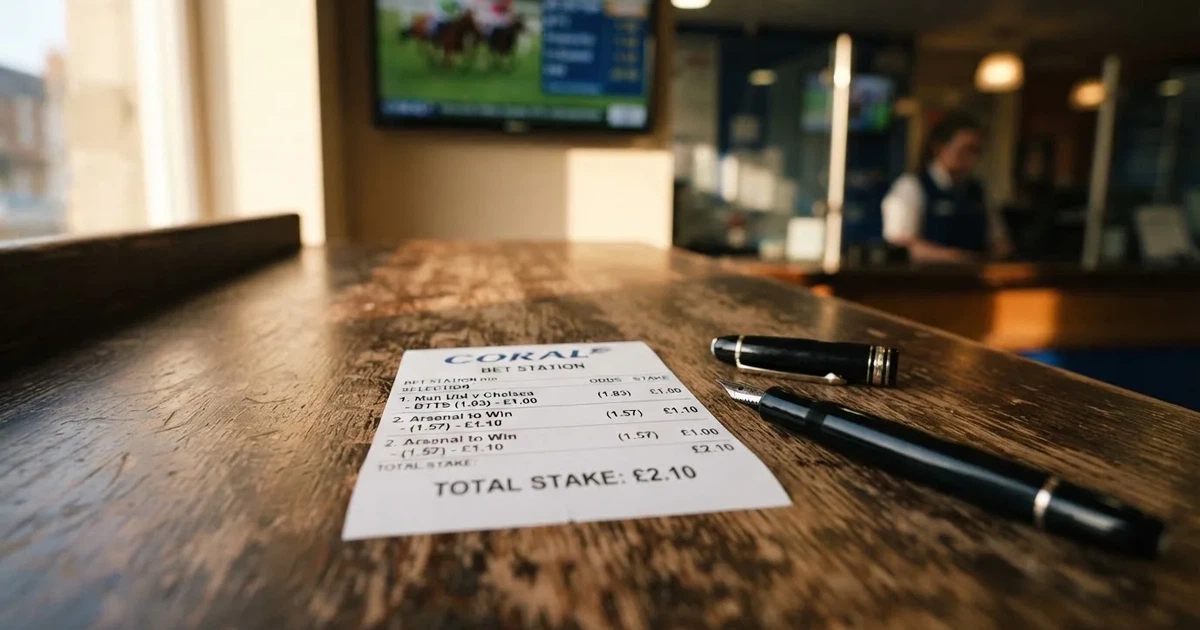
This page reads accumulators from that side: the cost first, the offer second. It covers how an acca is built, how a leg that ties or voids is handled, which full-cover combinations branch off the same idea and how a payout is worked out from the stake and the odds. It then places ten Gambling Commission-licensed bookmakers side by side for what each one states about accumulator betting and the related features — acca boosts, acca insurance, Bet Builder — on the public record, and reads those statements against the rules and licence conditions that govern the offer. The angle is the punter’s. The framework is the Gambling Act 2005 and the Licence Conditions and Codes of Practice that turn it into day-to-day rules.
How current this is: prices and product features on licensed UK bookmakers refresh continuously; the data below is current as of 27 October 2026 and was checked against the Gambling Commission’s public register and each operator’s own published terms.
Safer gambling and the accumulator in Great Britain
An accumulator is built for a small stake to chase a larger win, and that shape sits exactly where the gambler’s protection regime points. The first section is therefore the protection that surrounds the bet, because no calculation of an accumulator’s value holds if the bet ought not to have been placed at all.

GAMSTOP is the national multi-operator self-exclusion scheme and a mandatory licence condition for every online operator licensed by the Gambling Commission in Great Britain, in force since 31 March 2020. A punter who registers with GAMSTOP is blocked from opening a new account and from logging in to an existing account with every participating operator for the period they choose: six months, one year, five years or five years with auto-renewal. After the minimum period ends the exclusion stays in place for a further seven years unless the punter actively asks GAMSTOP to remove it. GAMSTOP covers online sites and apps; betting shops run a separate service and are not part of the scheme. Because every brand on the shortlist below is GB-licensed and online, every one of them honours a GAMSTOP registration.
Identity verification before the first deposit is itself a protection, even though it can read as friction. The Commission’s rules, in force since 7 May 2019, require name, address and date of birth to be verified before a customer can deposit or gamble — including with a free bet or a bonus. There is no anonymous play at a licensed GB bookmaker, and a punter who plans to fund an accumulator from a new account will sit through that check on first deposit. The same rules require a financial vulnerability check when a customer’s deposits minus withdrawals cross £150 in any rolling 30-day period (the threshold has applied since 28 February 2025). The check is a public-record look-up — bankruptcy or county court judgments, for instance — not an income check or a credit-reference check. Wider financial risk assessments have been announced by the Commission in a staged plan, with no start date set.
Deposit limits under the Remote Technical Standards (RTS 12) require operators to offer a gross deposit limit on a fixed time frame; the first changes have applied since 31 October 2025, with a second phase postponed to 30 September 2026. There is no statutory cap on the stake a punter places on a single accumulator, and there is no state-set ceiling on what they may deposit or lose in a year. What the rules require is that operators offer the limit and that the punter is the one who sets it. A punter who wants a hard rail on accumulator staking sets it themselves, on the account, and the bookmaker is bound to honour it.
Credit cards have been banned for gambling in Great Britain since 14 April 2020, including credit-card-funded payments made through an e-wallet. Debit cards and bank-based payments are not covered by that ban. A punter funding an accumulator is paying from a debit card, a bank transfer or an e-wallet that was itself topped up by a debit card — never directly from a credit facility. That distinction is a second rail, set by the rules rather than by the punter: it is the harder of the two to lift, because lifting it means applying to the card issuer and overturning a card-level block.
Where to turn when gambling stops being a choice: GamCare runs the National Gambling Helpline; GambleAware signposts counselling and treatment; the NHS runs gambling clinics across the regions; Gamblers Anonymous holds local meetings. The page itself is not a service — it describes how an accumulator is built and what it costs and which licensed bookmakers to compare for it. Where the cost becomes more than the punter can carry, the right service is the one named above, and the bookmaker account itself can be set to deposit-limit, time-out or self-exclude through GAMSTOP.
Strategy, predictions and the punter’s bankroll
The search around football accumulator bets is heavy on tips and predictions, and the second cluster is where that traffic is met. The angle is not to issue tips — a tipster cannot know an outcome and a punter who acts on one loses real money on a page’s word — but to explain what a tip can and cannot do for the punter who follows one.

A prediction identifies a selection it expects to win. Stacked into an accumulator, several predictions are bundled into one bet at a multiplied price. The maths that connects them is straightforward: each prediction has a probability of landing, and the probability that all of them land is the product of the individual probabilities. The bookmaker’s odds, before margin, are the inverse of those probabilities. Three selections at decimal odds of 1.50, 2.00 and 2.50 imply hit rates of 66.7%, 50% and 40% — a combined hit rate of 13.3%, against a fair decimal price of about 7.50. The price the bookmaker offers on the slip is the inverse of that 13.3% minus the margin. The trade for the punter is the gap between those two numbers, and it shrinks fast as legs are added: a four-fold with a similar shape drops the combined probability into single digits, and the marginal cost of the next leg is heavier than the last.
A punter who treats tips as probabilities rather than certainties is doing what a serious tipster would already have done. The public tipping record of most football tipsters is short of the closing price on a long enough sample, and a tipster who picks 30 winners from 100 picks at average odds of 2.50 has produced value but not certainty. The accumulator amplifies the variance: a tipster record of 30% winners is generous as a single, and crushing as a four-fold. The punter who follows tips on an accumulator is taking the thinnest edge in the tipster market and asking it to clear four independent hurdles in a row.
Bankroll management is the discipline that protects the punter when the variance swings. A flat staking rule — the same unit on every accumulator, scaled to a fixed percentage of the bankroll — is the discipline that absorbs a run of losers without forcing a stake increase. A common rule is one unit per accumulator, with a unit sized at 1% to 2% of the bankroll. Increasing the stake after a loss (chasing) is the discipline failure that tips accelerate into: a tipster record that runs below its own average for two weeks is the entry point at which a punter who has been raising stakes finds themselves with a deficit and a list of justifications.
The strategy section above names what an accumulator cannot do: it cannot make a poor tipster profitable, and it cannot make an honest bookmaker pay out more than the price on the slip. The strategy it can support is one where every leg is read as a single in its own right, where the stake on the accumulator is the same stake the punter would have placed as singles, and where the additional legs are adding confidence in the outcome rather than inflating the price to chase a result. Read the slip row by row as a set of singles, and the question of whether to add the next leg becomes a question of whether the next leg is worth its weight in additional probability.
Bet types, odds and how a payout is settled
The accumulator is the headline product; the full-cover bets branch off it; the single bet is the unit the accumulator is built from. The mechanics are explained here, in that order, because the accumulator’s quotation follows from the single’s.
The single, the double and the accumulator
A single is one wager on one selection at one price. A stake of £10 at decimal odds of 2.50 returns £25 — £15 of profit on top of the £10 stake. The UK displays odds in fractional form (3/2 is decimal 2.50, evens is decimal 2.00, 6/4 is decimal 2.50) and in decimal form alongside; the fractions are an older convention, and the accumulator’s maths reads more naturally in decimals. The conversion is mechanical: a/b in fractions becomes a/b + 1 in decimals. 5/1 in fractions is 6.00 in decimals — five units of profit for one unit of stake, plus the stake back.
A double links two selections into one bet; a treble links three. The accumulator extends the pattern to four or more, and the rule for the price is the same in every case: the decimal prices of each leg multiply into a single price. Two legs at 1.50 and 2.00 combine to a price of 3.00; three legs at 1.50, 2.00 and 2.50 combine to a price of 7.50. The stake is one figure on the whole bet, and the return is the stake multiplied by the combined price. A successful accumulator pays its full return in one settlement; a punt over multiple singles pays each leg separately, but the same stake per leg spends several times the single stake the accumulator would have used.
When a leg ties — a push, in the American vocabulary — the leg is removed and the price is recalculated from the legs that remain. A three-fold at decimal odds of 1.50, 2.00 and 2.50 where the middle leg is a push settles as a double at 1.50 × 2.50 = 3.75. The stake is returned in full; the win is paid as if the third leg had never been there. The same treatment applies to a selection that becomes a non-runner or is voided: the leg drops out, the price drops by one factor, the bet stands on what is left. A bet that loses a single leg loses the whole bet, regardless of how the other legs are running. That last rule is what gives the accumulator its character: a treble at 7.50 looks generous until a 2.00 favourite fails to win, and the bet is settled at zero.
Illustrative payout on a £10 stake
Three illustrative legs at fractional odds of 1/2, evens and 6/4 — decimals 1.50, 2.00 and 2.50 — combine to a price of 7.50. A stake of £10 on the treble returns between £60 and £75 if all three win, with the profit variation dictated by the bookmaker’s margin on the selections. As a four-fold at the same illustrative prices with a fourth leg added at 3.00, the combined price rises, and the same stake returns a multiple of that initial treble figure. The figure climbs steeply with each leg, because each leg multiplies the price rather than adds to it — and that is the side of the trade the accumulator advertises.
The same trade reads differently from the other side. The combined probability of three independent outcomes at 1.50, 2.00 and 2.50 is 13.3%, against the 7.50 fair price; a 10% margin on the market compresses that to a price around 6.80. That is the price the punter is betting into, and the gap between 7.50 and 6.80 is the bookmaker’s take on the same bet. The four-fold’s combined probability drops into single digits and the gap widens: at the same margin the four-fold pays about 19.50 against a fair 22.50. The pattern is the same at every leg count: each leg carries its own margin, and the accumulator’s effective margin grows with the number of legs stacked on the slip. The treble’s payout on a £10 stake lands in a band between roughly £60 and £75 depending on the market’s margin, with the higher figure inside reach only when the underlying prices are themselves generous.
Full-cover bets that branch off the accumulator
The full-cover bets place multiple accumulators across the same set of selections in one stake. A Trixie covers three selections across four bets — three doubles and one treble. A Yankee covers four selections across eleven bets — six doubles, four trebles and one four-fold. A Heinz covers six selections across fifty-seven bets; a Super Heinz covers seven across one hundred and twenty. The unit stake is multiplied by the number of bets in the combination, and that total stake is the outlay: a £2 unit on a Trixie costs £8, on a Yankee £22, on a Heinz £114, on a Super Heinz £240. The trade is that the punter wins something even when not every leg lands — a Yankee still pays out on the doubles if the four-fold loses one leg, where a straight four-fold would settle at zero.
The cost of the cover is the multiplication it forces on the stake. A Lucky 15 — fifteen bets on four selections, including four singles — multiplies the unit stake by fifteen. A Goliath on eight selections runs to two hundred and forty-seven bets and costs £247 per unit. The same four legs as a Yankee, a Lucky 15 and a straight accumulator illustrate the trade: the four-fold alone is cheapest in stake but forfeits the whole stake if one leg loses; the Yankee pays something back on that loss but multiplies the stake by more than five; the Lucky 15 pays on every single too but multiplies the stake by more than seven. Each rung on the ladder buys back a portion of variance at the cost of the next layer of stake. A punter moving from singles to a Lucky 15 on the same four legs is paying about fifteen times the stake for a structure that pays each single by itself and on top of that runs the doubles, trebles and four-fold. The full-cover is the structure that lets a punter stay in the bet when a leg wobbles — and the price of that insurance is the stake multiplication that sits in the slip.
Cash Out, Bet Builder and acca insurance
Several features attach themselves to the accumulator product and change the way it settles. Cash Out lets the punter close the bet before the final leg has been settled, at a price the bookmaker offers at the moment of the request; the offer reflects the current state of the bet and the current state of the unsettled legs, and the punter either takes it or lets the bet run. Cash Out availability is not guaranteed at every moment, and where it is unavailable the bet stands. Bet Builder is a same-game multi — a market the bookmaker offers that combines several selections from one match into one bet at a multiplied price, with a margin of its own. Acca insurance is a promotion, usually tied to a marketing offer, that refunds the stake as a free bet or bet credit when a single leg lets down a four-fold or larger.
Each of these features attaches a cost to the accumulator. Cash Out’s price is the bookmaker’s, and the price on offer is rarely the fair price of the remaining legs. Bet Builder’s margin sits inside the multiplied price and is usually wider than the bookmaker’s margin on the singles from which it is built; the convenience of building one match’s bet on one slip is paid in margin. Acca insurance is a promotion rather than a feature, and its terms — the minimum number of legs, the maximum refund value, the wagering requirement on the refunded free bet — determine whether it leaves the punter better off than a plain accumulator would have done. The terms published by each operator on their public site are the version the punter reads.
The shortlist: ten licensed UK bookmakers for acca betting
The block that follows ranks ten operators by the public record they keep on accumulator betting and on the related features the search traffic follows alongside it. The list is taken from the Gambling Commission’s public register: each brand below holds a remote betting licence for Great Britain as listed on the register, and the licence categories — remote general betting standard (real events), remote betting intermediary — are the categories that permit accumulator betting to be offered to GB customers. The order is editorial; a place in the comparison is not a licence and it is not a recommendation. Several brands can run under one licensee — Ladbrokes and Coral share LC International Limited as licensee, Paddy Power and Betfair share Flutter Entertainment’s UK arm — and the list respects those groupings by listing each brand once.
The comparison below is read in three columns. The licence column carries the Gambling Commission account number and the registered licence holder. The accumulator feature column carries what each operator’s own published terms state on acca betting as a product, on acca boosts, acca insurance, Bet Builder and on Cash Out where the operator’s help pages describe it. The last block of each entry is the verdict: a one-paragraph judgement of the brand against the angle this page takes, which is the punter’s cost.
| Brand | Gambling Commission remote licence (account number, holder) | What the operator’s own terms say on accumulators |
|---|---|---|
| Betfred | 39544, Petfre (Gibraltar) Limited | Bet Builder is built into the app, alongside Sub Switch, Racing Post data and Extra Places; the site lists in-play and acca features as part of its standard sportsbook product |
| Lottoland | 38991, EU Lotto Limited | The app combines casino, lottery betting, scratchcards and a sportsbook; accumulator betting is offered as part of the sportsbook product, alongside the lottery-led catalogue the brand is best known for |
| Sporting Index | 27343, Sporting Index Limited | Spread betting and fixed-odds betting sit together on the account; fixed-odds accumulators are offered alongside the Total Goals, Winning Favourites and Race Index spread products, with separate stake mechanics for spread legs |
| Swifty Sports | 58957, Swifty Global (UK) Ltd | Best Odds Guaranteed on horse racing, Cash Out across horse racing and football, daily price boosts, in-play and live streaming are listed; Bet Builder is marked as coming soon on the app store listing at the date of capture |
| BetMGM | 39198, LeoVegas Gaming PLC | New-customer sports welcome offer pays four £10 free bets (two on football accumulators of 4+ selections and two on sports multiples of 2+) when a £10+ deposit is followed by a sports bet within 7 days, with minimum odds and 7-day free-bet expiry applying |
| Fafabet | 57385, Taichi Tech Limited | Best Odds Guaranteed on UK and Irish horse racing win and each-way bets from 9am on race days; the larger football and acca product is built around the standard sportsbook, with horse racing the more prominent feature |
| Ladbrokes | 54743, LC International Limited | Odds boosts on horse and greyhound bets, Best Odds Guaranteed on UK and Irish horse racing, in-play and Acca Boosts feature as headline products; the brand runs under one of the largest sportsbook licences in GB |
| DAZN Bet | 48756, DZBT Limited | Cash Out, Bet Builder, daily bet boosts and in-play feature on the help pages; the help page also states that Cash Out availability is not guaranteed and that bets stand when it is unavailable |
| Dabble | 65677, Dabble Sports UK Ltd | New-customer sports welcome offer pays £10 in free bets on a £10 first-deposit qualifying bet, with a 7-day free-bet expiry and minimum odds; the stake on the free bet is not returned with a winning settlement |
| Fitzwilliam Sports | 48760, SBKI Limited | Prices are described as based on Oddschecker averages for each selection, with Apple and Google mobile apps; the sportsbook’s product surface is accumulator-friendly, with average-priced selections as its selling point |
Betfred — the high-street sportsbook with an acca builder attached
Betfred is the GB high-street bookmaker that has built its online sportsbook around the same shape: in-play, cash out, Best Odds Guaranteed on horse racing, and a Bet Builder inside the app. Petfre (Gibraltar) Limited holds the GB remote licence as account 39544, with remote general betting standard (real events) on the register, and the brand’s app store presence lists Bet Builder, Sub Switch, Racing Post data and Extra Places among its features. The acca product is built around the standard sportsbook: selections stack, the price multiplies, and Bet Builder lets the punter combine selections from one match on the same slip.
For a punter who wants the high-street familiarity of Betfred on the device they bet from, this is the closest match in the comparison. The acca product is mature, the licence is on the public register, and the support for the acca-adjacent features (Cash Out, Bet Builder, price boosts) is in the app. The cost is the brand’s own margin on its markets, and the punter pays that in the price on the slip. The verdict: a safe default for a GB punter who wants the full feature surface on a familiar licence.
Lottoland — a lottery-led app where the acca is one product among many
Lottoland’s licence account is 38991, held by EU Lotto Limited for the GB market, and the brand’s app store presence describes a product that combines casino, scratchcards, lottery betting and sports betting on one account. Accumulator betting is part of the sportsbook product, but the brand’s identity is set by its lottery-led catalogue — jackpot betting on international and EuroMillions-style draws, scratchcards and instant-win games.
The punter who opens a Lottoland account for the lottery product and stays for the sportsbook is the brand’s natural customer; the punter who opens it for the acca alone is paying for a product surface they will mostly leave unused. The verdict: a fair sportsbook on a fair licence, less compelling than the lottery-led catalogue the brand leads with.
Sporting Index — spread and fixed-odds on one account
Sporting Index is a hybrid: fixed-odds betting and spread betting sit on the same account, under Gambling Commission account 27343 held by Sporting Index Limited. The fixed-odds acca is built the standard way, while the spread bets on the same account — Total Goals, Winning Favourites and Race Index — settle on a different basis entirely. A £10 fixed-odds bet at minimum odds of 1/2 unlocks three £10 fixed-odds free bets and the spread bet bundle as a new-customer welcome; the qualifying bet cannot be placed in-play or cashed out early.
The cost of the hybrid is clarity. A punter whose acca experience is the fixed-odds slip will recognise the fixed-odds product immediately; a punter who clicks into Total Goals or Winning Favourites for the first time is in a market whose mechanics run differently, with losses that can exceed the deposit. The verdict: the fixed-odds acca is good value for a punter who wants it, and the spread product on the same account demands a separate read of the rules.
Swifty Sports — feature-led with Bet Builder still on the way
Swifty Global (UK) Ltd holds Gambling Commission account 58957 and runs the Swifty Sports brand on the public register. The app store listing for the brand features Best Odds Guaranteed on horse racing, Cash Out across horse racing and football, daily price boosts, live streaming and in-play, with Bet Builder listed as coming soon at the date of capture. The acca product is built around the standard sportsbook, with the price-boost and Cash Out features layered on top.
The cost of the feature-led approach is the wait for the features the page does not yet offer. A punter who wants a same-game multi on Swifty Sports today will not find it; a punter who wants Cash Out and price boosts will. The verdict: a credible feature surface for the standard acca, with the same-game multi still on the roadmap.
BetMGM — welcome offer weighted towards football accumulators
BetMGM UK is published by LeoVegas Gaming PLC under Gambling Commission account 39198, and the new-customer sports welcome offer is paid in four £10 free bets. Two of the four free bets are routed to football accumulators of 4+ selections and two to sports multiples of 2+, with a 7-day expiry on the free bets, a minimum-odds requirement and an opt-in. The brand’s identity is the casino product; the sports welcome offer is a route into that product for punters who would otherwise arrive at it from a casino promotion.
The cost of the offer is the structure it pushes: an accumulator of 4+ selections on football, with a margin that compounds across four legs and a free-bet settlement that does not return the stake. The punter who values the welcome offer is a punter who is going to place a 4-fold football acca anyway; the punter who does not is funding the welcome offer for the next customer. The verdict: a familiar casino-rooted brand on a familiar UK licence, and the welcome offer is shaped for the football acca punter specifically.
Fafabet — Best Odds Guaranteed on the horse racing, acca on the sportsbook
Taichi Tech Limited holds Gambling Commission account 57385 and runs Fafabet. Best Odds Guaranteed applies to UK and Irish horse racing win and each-way bets from 9am on race days — if the starting price is bigger than the price taken, the bigger one is paid. The football product is the standard sportsbook, with the acca built in the usual way and Cash Out, Bet Builder and in-play listed on the help pages.
The cost is the horse-racing-led catalogue: a punter who bets football accas as the main act will not be on Fafabet’s strongest product. A punter who mixes horse racing and football will find the BOG rail on the racing side and the acca available on the football side. The verdict: a credible sportsbook with a strong racing product and a plain accumulator on top.
Ladbrokes — a flagship GB licence with Acca Boosts in the bundle
LC International Limited holds Gambling Commission account 54743 for the Ladbrokes brand, with both remote general betting standard (real events) and remote betting intermediary on the register — the second category is the licence for betting exchanges, and the Ladbrokes parent group operates the Coral and Ladbrokes retail estate alongside the online sportsbook. Acca Boosts, odds boosts, Best Odds Guaranteed and in-play are headline features. The licence is one of the largest in GB by the volume of brands under it.
The cost of the largest footprint is the same as for any operator that runs every kind of bet on every kind of sport: the catalogue covers everything, which means there is no single product the Ladbrokes brand is sharper on than the rest of the field. The punter who values the catalogue’s breadth gets the catalogue; the punter looking for the sharpest price on a single market may not. The verdict: a flagship GB licence for a punter who wants the full feature surface on a single account, with the price edge concentrated on the brand’s headline markets rather than across the catalogue.
DAZN Bet — Cash Out, Bet Builder and the publish-honest help page
DZBT Limited holds Gambling Commission account 48756 for the DAZN Bet brand. The help pages list Cash Out, Bet Builder, daily bet boosts and in-play — and the same help pages state plainly that Cash Out availability is not guaranteed and that bets stand when it is unavailable. The honesty is the stand-out feature: a help page that names the feature’s limit on the same page as the feature itself is rare in this market.
The cost of the unnamed margin sits in the slip as it does at every other operator; the value of the publish-honest help page is that the punter reads the limit before the bet. The verdict: a credible sportsbook with a transparent feature list on its own help pages, and that transparency is the part the punter notices on the day the cash-out button is grey.
Dabble — a £10 in, £10 in free bets welcome with a football acca attached
Dab Sports UK Ltd holds Gambling Commission account 65677 and runs Dabble. The new-customer sports welcome offer pays £10 in free bets for a £10 first-deposit qualifying bet, with minimum odds, a 7-day expiry on the free bets and the free-bet stake not returned with a winning settlement. Acca-friendly, mid-sized sportsbook with social-betting features; the welcome offer is structured around the sportsbook’s main product.
The cost of the welcome offer is the small print on the free bet: stake not returned, 7-day expiry, minimum odds — each of which costs the unwary punter a few percent of the offer’s headline. The punter who reads the small print extracts the offer; the punter who does not leaves part of it on the table. The verdict: a fair welcome offer attached to a credible sportsbook, with the value concentrated in the small print rather than the headline.
Fitzwilliam Sports — average-priced selections across the standard acca
SBKI Limited holds Gambling Commission account 48760 and runs Fitzwilliam Sports. The brand’s pricing approach is to base prices on Oddschecker averages for each selection, with Apple and Google mobile apps. The acca product is built the standard way, with the price on each leg sitting at or near the market average.
The cost of the average price is the absence of an edge. A punter who wants the best price on each leg is the brand’s customer; a punter who wants the best acca price across the field is the customer’s next door neighbour. The verdict: a credible sportsbook on a fair licence for the punter who wants to read the average price once and pay it across the slip.
Overview: what an accumulator is in Great Britain
The headline cluster sits behind the strategy and the bet-types clusters in this site’s order, by design: the mechanics of an accumulator make more sense once the calculation, the full-cover bets and the protection regime are introduced, and the overview is the natural home for the plain-English summary.
An accumulator is a single bet that links two or more selections, pays only if every leg wins, and settles the stake at zero on a single losing leg. The price on the slip is the product of the legs’ prices; the stake is one figure on the whole bet; the return is stake times price. Full-cover bets extend the same idea across every combination of the same selections at the cost of multiplying the stake by the number of bets in the combination. Cash Out, Bet Builder, price boosts and acca insurance each layer a feature on the standard accumulator, with the feature’s cost in the slip rather than outside it.
The same product is sold as parlay, acca, combo bet and multi in different markets; in Great Britain the brand-name is acca and the offer is the same in every shop window. The mechanics are identical at every UK-licensed bookmaker; the differences are in the catalogue, the in-play depth, the acca boost structure and the welcome offer each brand wraps around the product.
An accumulator in the GB market sits on a Gambling Commission-licensed site because the alternative is no consumer protection: no GAMSTOP coverage, no Commission complaints route, no approved dispute-resolution body, no British consumer redress if funds are withheld, no protection from the 10x bonus wagering cap, no £150 vulnerability check. The protection the licensed site provides is the second half of the trade an accumulator offers — the bet on the slip, and the rules that govern who offers it.
Legality, regulation and the framework that licenses the market
The framework that licenses the market in Great Britain is the Gambling Act 2005, with the Gambling (Licensing and Advertising) Act 2014 closing the point-of-consumption gap from 2014 onwards. The Commission, sponsored by the Department for Culture, Media and Sport, is the regulator; the register is on the Commission’s public site and is searchable by business name, trading name, domain or account number.
The framework operates by category. A remote general betting standard (real events) licence covers accumulator betting on football and the rest of the major sports; a remote betting intermediary licence covers exchanges; a remote pool betting licence covers pool products. Spread betting that is a financial product is regulated by the Financial Conduct Authority, not the Commission. Spread betting on sports events that is not a financial product is inside General Betting Duty and sits on a Gambling Commission licence. The licence is granted for a category; the markets are offered under the operator’s own rules within that category and the conditions in the LCCP.
The Commission’s public register is the whole test of who is licensed: every brand on the shortlist above is searchable on it. The register can carry the same brand name twice (one trading name, one legal entity), and several brands can run under one licensee. The Commission’s account number is on every licence and is the field the punter uses to confirm the licence is in force.
Northern Ireland is outside the 2005 Act and is governed by separate, older law. A GB-licensed bookmaker’s licence to serve customers in Northern Ireland follows a separate route; the page writes “Great Britain licence” or “GB-licensed” and does not extend the GB licence to Northern Ireland. The same caveat applies to any reference to a Commission rule: a GB licence controls GB customers, and a Northern Irish customer on a GB-licensed site sits inside a different framework.
No statutory list of permitted bets or markets exists in Great Britain. An operator holds a licence for a category and offers markets under its own rules and the LCCP. In-play betting is offered by GB bookmakers and is controlled by the operator’s licence conditions and customer-protection duties; the question of whether in-play is “unrestricted” is the operator’s, not the law’s. Esports are treated like any other event; virtual events are a separate licence category; bets on politics, TV shows and novelty markets are offered by GB bookmakers, and no statutory prohibition was found in the public record. No statutory cap on sports-betting stakes exists: operators set their own maximum stakes and may restrict customers.
The bonus and promotion regime affects every accumulator the punter funds with a free bet. Wagering requirements on bonuses are capped at 10x (a £10 bonus with a 50x wagering requirement would need £500 of bets; under the cap no more than £100), in force since 19 January 2026. Mixed-product promotions — an offer that requires gambling on two or more product types, for example a “bet on football to get free spins” — are banned. Whether the cap applies to free bets with no wagering condition, and any cap on the money value of a bonus, are not established from the public record: a punter reads the operator’s own terms on these points.
Advertising falls outside the Commission’s remit and runs through the CAP Code (non-broadcast) and BCAP Code (broadcast), enforced by the ASA. CAP Code section 16 requires gambling marketing to be socially responsible and of no strong appeal to under-18s; no one who is or seems to be under 25 may feature gambling or play a significant role (the rule concerns who may appear in the advertisement, not who may bet). Whistle-to-whistle is an industry code, not law: since 1 August 2019 betting advertisements are not shown on TV from five minutes before a live sporting event to five minutes after it, before the 9pm watershed (horse and greyhound racing excluded). The Premier League clubs’ voluntary withdrawal of front-of-shirt gambling sponsorship from 2026/27 is voluntary, not statutory. The bonuses that fund the punter’s first accumulator sit inside that framework.
The tax the operator pays is General Betting Duty, currently 15%; from 1 April 2027 a remote betting rate of 25% applies within it for online bets other than on UK horse racing, pool betting and bets at self-service terminals. The punter pays no tax on betting winnings in Great Britain (general information, not tax advice; a professional gambler should ask HMRC or an adviser). Whether operators pass duty on through odds is not established from the public record.
Offshore, the rules look and read differently. A GB licence is compulsory at the point of consumption, and providing gambling facilities in Great Britain without the licence the Act requires is an offence under section 33 of the Gambling Act 2005, aimed at the operator. A customer of an unlicensed offshore brand forfeits the protections the licensed brand provides: no GAMSTOP coverage, no Commission complaints route, no approved dispute-resolution body, no British consumer redress if funds are withheld, no protection from the 10x bonus cap, no £150 vulnerability check. Enforcement is disruption rather than blocking: cease-and-desist notices, search-engine referrals, registrar and payment-provider work. The Commission has been given, or is about to receive, court-order DNS blocking powers; ISP blocking is not in operation at the time of writing, and the page does not write as though it were.
Frequently asked questions
How does a football accumulator actually settle?
An accumulator pays only if every leg wins, and the price on the slip is the product of each leg’s decimal odds. A stake of £10 on three legs at decimal odds of 1.50, 2.00 and 2.50 returns £75 if all three legs win (£65 profit on the stake), and settles at zero if any single leg loses. A leg that ties is removed and the price is recalculated from the remaining legs; a leg that becomes a non-runner is treated the same way.
Which licensed UK bookmakers offer accumulators on football?
Every brand on the Commission’s public register with a remote general betting standard (real events) licence can offer accumulators on football. The comparison above is a sample of ten such brands — Betfred, Lottoland, Sporting Index, Swifty Sports, BetMGM, Fafabet, Ladbrokes, DAZN Bet, Dabble and Fitzwilliam Sports — and the Commission’s register is the whole test of who is licensed. The order is editorial; a place in the comparison is not a recommendation.
How does an accumulator differ from a single at one bookmaker?
A single is one wager on one selection; a stake of £10 at decimal odds of 2.50 returns £25 on a win. An accumulator links several selections into one bet at a price that is the product of the legs’ prices, and the stake stays at one figure. The accumulator pays more on a win but loses the whole stake on a single losing leg; the single pays its stake back on a loss.
How can a punter check a bookmaker’s Gambling Commission licence?
The Commission’s public register is searchable by business name, trading name, domain or account number, and is the whole test of whether a brand holds a GB licence. The Commission’s account number is printed on every licence entry, and the operator’s own help or about page usually reproduces it. A licence category (remote general betting standard, remote betting intermediary) tells the punter what products the operator may offer; a brand with the licence to offer a product is not the same brand as the operator offering the sharpest price.
How is the return on a winning bet worked out from the stake and the odds?
For decimal odds, the return on a winning bet is the stake multiplied by the price; the profit is the stake multiplied by the price minus one. For fractional odds of a/b, the decimal price is a/b + 1; a £10 stake at fractional 5/1 (decimal 6.00) returns £60 if it wins (£50 profit on the stake). An accumulator’s return is worked out the same way, with the price on the slip as the product of the legs’ prices.
Bet types & in-play – Best betting exchange
Content created by the «Best betting exchange» team
