
MMA Betting Odds 2026: What They Cost, How They're Built
 Available in US
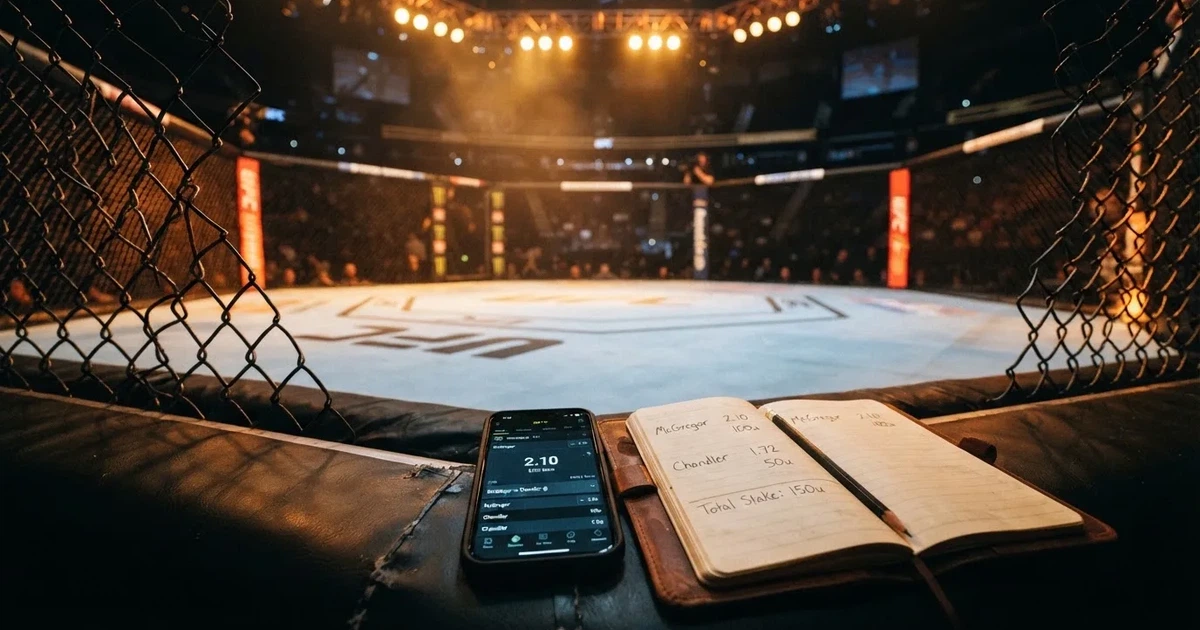
Walk into a UK bookmaker’s MMA section on fight night and you will see three or four prices per fighter, a method-of-victory market, a “go the distance?” line, and possibly a round group. The prices look like a snapshot of who wins. They are not. They are the bookmaker’s opinion of who wins, plus a margin that quietly lifts every number above what a fair payout would be. The sport underneath — eight men and three women in weight classes, five-minute rounds with one minute of rest, three judges applying the ten-point must system round by round — is the part the punter can read on a card. The price is the part that has to be read against the margin that built it.
Current as of 27 October 2026 and verified against the Gambling Commission’s public register of remote betting licence holders.
This page works through what an MMA price contains, what it costs the bettor to clear an offer attached to one, and which GB-licensed operators carry the kind of MMA market a reader comparing sites actually wants. The cost-first angle is deliberate: a headline price is only worth a fraction of a penny once the margin of the market it sits in is named beside it, and a “free bet” is only worth what the underlying odds are willing to give it back.
The order below leads with safer-gambling controls, because no honest reading of cost starts anywhere else; then crypto and anonymity (where the regulator’s net is and is not), bonuses and free bets (the rollover and minimum-price arithmetic that decides what the offer is actually worth), mobile and app, live and in-play, predictions and tips, bet types and odds, the sport itself and its tournaments, the ten-bookmaker comparison, an overview that names the legal frame, and finally a legality section that closes the loop on what a Great Britain licence buys the punter, and what it does not.
Responsible gambling: the controls that already sit between you and the next deposit
A GB-licensed bookmaker cannot let a customer deposit without checking name, address and date of birth first, and the check applies to a free bet or bonus as much as to a real-money bet. That is the first cost: time, and a document. The second cost is the deposit limit every licensed remote operator must offer, and the third is GAMSTOP, the multi-operator self-exclusion scheme that has been a licence condition for online operators since 31 March 2020. Periods run six months, one year, five years, or five years with auto-renewal; after the minimum period the exclusion stays in place for a further seven years unless the customer asks GAMSTOP to remove it. Betting shops use a separate service, which means excluding online does not exclude the shop on the high street.

A financial vulnerability check has been in force on remote betting since 30 August 2024, applied once a customer’s deposits minus withdrawals cross £150 in a rolling 30 days (in force since 28 February 2025). It is a public-record check, not an income check, and not a credit-reference check — bankruptcy, county court judgments, and similar registers are the kind of thing it looks at. It is not a tax on the punter. The wider “affordability check” debate was reshaped in a Commission article of 7 July 2026, with no start date and a staged plan, so it is honest to describe that as announced and staged rather than as in force.
The help lines sit behind the controls, not in front of them. GamCare runs the National Gambling Helpline, the NHS runs gambling clinics, GambleAware funds treatment and research, and Gamblers Anonymous runs meetings. Fitzwilliam Sports, one of the operators reviewed below, links all four from its home page. The point of naming them here is that the rest of this page — the odds, the bonuses, the price boosts — only matters if the controls are working. A bookmaker that lets a punter skip identity verification, or one that is not on GAMSTOP, is not the saving it looks like on a first deposit.
The cost to the reader of a licensed site is therefore a known set of small frictions: a few minutes of verification, a deposit ceiling the punter sets, a self-exclusion route that closes every GB site at once. The cost of an unlicensed one is invisible until it is not — funds that can be held, complaints that go nowhere, no British dispute-resolution body, and a bonus that can carry a fifty-times wagering requirement because no ten-times cap applies outside the LCCP.
Crypto, bitcoin and the question of anonymity at the betting counter
The four keys in this cluster — bitcoin MMA betting, crypto MMA betting, MMA betting with bitcoin, MMA betting with crypto — share a single honest answer for a reader in Great Britain. Identity verification runs before the first deposit at every licensed remote operator, and the source-of-funds questions that follow are the operator’s money-laundering duty, not a marketing choice. A deposit made in bitcoin or any other cryptocurrency is not anonymous to the bookmaker; it is pseudonymous on a public ledger, and the operator that takes it is required by its licence to identify the person behind the wallet. The “anonymity” the cluster’s phrasing suggests is the anonymity of the wallet, not the anonymity of the punter.
The Gambling Commission’s public register does not name a state list of permitted payment methods. A British named-account rule, a rule for or against cryptocurrency deposits at licensed operators, and any cap on the value of a crypto deposit were not established in the inputs. The honest line for a GB-licensed operator is to describe the payments it accepts from its own terms, and to be sceptical of any site that markets “anonymous crypto betting” while it asks for no documents, because that site is almost certainly not on the register. The Commission has powers of disruption — cease-and-desist notices, search-engine referrals, work with registrars, hosts and payment providers — and has been given, or is about to receive, court-order DNS blocking powers. ISP-level blocking is not in operation as a permanent state of the market.
The price of pseudo-anonymity on a blockchain is volatility. A bitcoin deposit at one price is a different bitcoin deposit at the next, and the punter who values a stake in pounds has to convert twice: once into the coin, once out. The price of real anonymity — an unlicensed site that does not check — is the absence of every protection the previous section named, and the absence of any route back if a withdrawal stalls. Neither is a saving. The choice is between a verified punter with a £150 vulnerability check, and an unverified punter with no GAMSTOP coverage, no approved dispute-resolution body, and no British consumer redress if funds are withheld.
Bonuses and free bets: what the marketing line leaves out
Three of the four core keys in this cluster — MMA betting offers, MMA betting bonuses, MMA betting promotions — describe the same kind of product from three angles. The fourth, MMA bet offers, is the shorthand a punter uses. The honest reading is that an offer is a marketing wrapper around a number, and the number is whatever the operator’s own terms say it is. Three of the ten operators reviewed below carry a free-bet welcome worth naming in full: Octobet’s sportsbook welcome is 50% back as a free bet up to £50, plus a £10 casino bonus for new customers; BetUK’s is four £10 free bets (two football accumulators of 4+ selections and two multiples of 2+) for new customers who deposit £10 and place a sports bet within 7 days of registering; Dabble’s is “Bet £10, Get £10 in Free Bets” on a first deposit for new customers, with minimum odds applying, a 7-day free bet expiry and the stake not returned. None of these are bonuses in the matched-deposit sense; they are free bets, and the difference matters.
A free bet is not a bonus. A bonus adds credit that the punter wagers; a free bet is a single stake the operator gives, whose value is on the winnings, not the stake. The arithmetic is sharp. On a free bet of £10 at decimal odds 3.00 the bookmaker gives back £30 if the bet wins — but the £10 stake is not returned, so the punter’s net profit is £20, not £30. The same £10 staked with the punter’s own money, at the same odds, returns £30 with a £20 net profit. The free bet has cost the punter the return of the stake, and that is a structural feature, not a special case. The minimum-odds condition on Dabble’s offer is the second cost: winnings on bets that settle below the floor do not count, and the floor is set high enough to push the punter into longer prices where the bookmaker’s margin is wider. The 7-day expiry on both Dabble’s and BetUK’s free bets is the third: a punter who does not use the free bet inside a week loses it, and there is no goodwill extension.
The LCCP cap on wagering requirements is the regulator’s own number, in force since 19 January 2026. Wagering requirements on bonuses are capped at 10x — a £10 bonus at 50x needs £500 of bets; under the cap no more than £100. The cap does not, on the present reading, apply to free bets that carry no wagering condition. The cap also does not save the punter who picks a bonus with a 10x requirement, because 10x the bonus on a small bonus base is still a turnover requirement that takes volume to clear. The expected cost of clearing a bonus, on the inputs named, is the required turnover multiplied by the margin of the market the punter bets into. Where a market’s margin runs at 5%, a £100 turnover costs the punter £5 of expected value; where the market’s margin is 8%, the same turnover costs £8. A bonus with a 10x requirement on a £10 bonus is therefore not a free tenner; it is a small, fully-priced loan the punter works off at the bookmaker’s table.
The third kind of offer is the price boost. Bet365 carries Super Boosts, Winnings Boosts on Bet Builders and selected singles, and daily Bet Boosts. A price boost raises the headline price of one selection for one window. The cost is that the boosted leg is single-use, the maximum stake is capped low, and a winning boosted bet that is part of an accumulator is usually boosted only on the single, not on the combined price. The comparison the punter has to do is the boosted price against the unboosted price of the same selection elsewhere, with margin included. The marketing line “best odds” sits uneasily beside a market whose unboosted margin was already over the round number.
The fourth kind is the acca insurance — usually a free-bet refund if one leg of an accumulator lets the punter down. This is a marketing wrapper around a free bet, with the same stake-not-returned feature, the same minimum-odds condition, and usually the same kind of 7-day expiry. Its expected value is the value of the free bet multiplied by the probability of one leg losing on a multi-leg accumulator. A four-fold at decent prices is a low-probability event; a refund that fires only on that event is a low-value product in expected terms, however loud the marketing line. The reader is better off with the unboosted four-fold at a margin-friendly bookmaker than with the “insured” four-fold at a margin-heavy one, and the section on margins below shows why.
Mixed-product promotions — an offer that requires gambling on two or more product types such as betting, casino, bingo and lottery, the obvious example being “bet on football to get free spins” — are banned under the LCCP rules in force since 19 January 2026. That is the single most useful fact for a punter who has been talked into a casino bonus to release a sportsbook offer. The rule closes a real cost.
Mobile and app: the screen most UK MMA bets are actually placed on
The honest line is that a GB-licensed app is the same regulated product as the desktop site, and the differences between operators are in market depth, in-play latency, bet-builder flexibility, and cash-out speed.
bet365’s app is described in the GB App Store as the most downloaded sports betting app in the UK, and the same listing names it as the official global betting partner of the UEFA Champions League. The sponsorship is a brand fact, not a price fact; the depth of the app is what matters for MMA. On the inputs reviewed, bet365 carries in-play betting and live streaming of events worldwide, plus Bet Track, Match Live and a Live Golf Tracker for following bets in play. Spreadex’s app combines fixed-odds and spread betting in one screen, with one-click, auto and partial cash out, Bet Builder across fixed odds or spreads, and live streaming of UK and Irish horse racing, greyhounds, tennis, NFL and selected football. LiveScore Bet’s app carries a Bet Builder that allows up to 10 selections and covers match result, both teams to score, corners, total goals, player scoring and card markets — a football-shaped tool, but useful as a benchmark for what a builder on a sportsbook can do. Sporting Index’s app lets customers switch between fixed odds and spread betting, with in-play betting, Bet Builder for football, auto cash-out and Multi-Markets. Midnite’s site shows in-play events, an acca builder, popular accas and price boosts with maximum-stake limits. Kwiff carries a 17+ App Store age rating and is described as a trademark operated by Spryme Ltd. Lottoland UK’s app combines casino, lottery betting, sports betting and scratchcards and states it is licensed by the Gambling Commission for customers in Great Britain.
The MMA cost of the app is in two places. The first is market depth — whether the operator carries method-of-victory, round group, “go the distance?”, and the in-play version of each. The second is latency — how quickly the in-play price updates between rounds, and how wide the suspension window is when a fighter is cut and the fight is paused. The inputs reviewed do not give per-second latency figures, and no app slot below names an MMA-specific latency, so the comparison is qualitative. A punter who bets in-play on MMA will find the app whose in-play page lists the markets above and whose cash-out works between rounds the more useful tool, regardless of the brand on the splash screen.
Live betting and cash out: the price that moves round by round
The marketing line is “watch the fight, place the bet”; the cost is the margin of the in-play market, which is wider than the pre-match margin on the same fight.
Live MMA betting at a GB-licensed bookmaker is offered under the operator’s licence conditions and customer-protection duties; the controls are the operator’s, not the regulator’s. There is no statutory list of permitted in-play markets and no statutory cap on in-play margin. The punter who watches the price of a fighter shorten after a first-round knockdown is watching the bookmaker’s view of the fight update, and the spread on either side of that view is the in-play margin. The cash-out price is the bookmaker’s mid-market quote at the moment the punter presses the button, less a cash-out margin the operator does not have to publish. One-click, auto and partial cash out, as Spreadex describes, is the same mechanism under a faster button.
The punter cost is in the timing. A cash-out placed during the one-minute rest is at a different price from a cash-out placed between clinches, and the bookmaker’s suspension window around a knockout stops the price moving for the seconds the punter most wants it to. The honest reading of an in-play MMA offer is that the pre-match research is what gave the punter the edge; the in-play market is the bookmaker’s home turf, with the wider margin, the faster feed, and the cash-out spread on top.
Live streaming is the third cost. Where the operator streams a fight, the punter is locked to the operator’s app and cannot easily compare in-play prices elsewhere. Where the operator does not stream, the punter pays the latency of a second screen. The GB-licensed set reviewed here has different combinations: bet365 streams worldwide, Spreadex streams UK and Irish horse racing, greyhounds, tennis, NFL and selected football — the inputs do not name MMA streaming at any of the ten operators specifically. The reader who wants a streamed MMA fight should check the operator’s live-streaming page on the night, because the rights change fight by fight.
Predictions, tips and the language of “value”
The phrase “top value” is the marketing line. The honest line is that a tip is a forecast, a forecast is a probability, and a probability is what a price is built from. A punter who knows the probability of a fighter winning can read a price; a punter who only knows the price has no edge over the bookmaker.
A tipster’s record is a number, and the number is rarely audited. The punter cost of following an unaudited tipster is the bookmaker’s margin on the bets the punter places, paid in full, with no edge to offset it. The punter cost of following an audited tipster with a published return-on-investment is the same margin, less the tipster’s edge if it is real. The honest framing is that “value” is a margin-relative term: a price is good value if it is bigger than the true probability would imply, and a tip is a value tip if its long-run return on investment is positive after the bookmaker’s margin is taken out.
The “this weekend” framing is the part that costs the punter most. A weekend’s MMA card is two or three events deep at best, and a punter’s bankroll is not a tool for finding edges across a handful of fights. A punter who waits for a card, prices every market on the card by hand, and bets only where the price is wider than the punter’s own number is doing the work. A punter who follows a “weekend acca” with seven legs is paying seven bookmaker margins on a combined product that compounds each one, and a free-bet refund on one leg is not the edge the marketing line names. The compound of seven margins at 5% each is not 35% — the math is a multiplication, not an addition — but it is the kind of value a punter loses by treating a tip like a coupon.
A second, smaller cost: a tip that names a method of victory, a round group, or a “go the distance?” line is a tip into a market with a wider margin than the moneyline. The moneyline at a 1.50 / 2.60 fight carries a margin the punter can read; the round-3 group market on the same fight carries a margin that is wider, and the punter pays the difference. A punter who follows a tip into a prop market without pricing the prop market is paying a tax the headline number did not name.
Bet types and odds: the markets on a card and the prices they carry
Four of the four core keys in this cluster name the product from four angles — MMA betting odds, where to bet on MMA fights with high odds, Bellator MMA betting odds — and the supporting keys are “betting odds MMA”, “MMA betting odds tonight”, “MMA tonight betting odds”, “best MMA betting sites with high odds”, “best MMA betting odds”. The “high odds” framing is the second half of the value question. The honest reading is that a high price is only a high price if the underlying probability is not higher; a high price on a heavy favourite is a trap, and a high price on a live underdog is a long shot with a reason.
The bet types on an MMA card at a GB-licensed bookmaker are the same shape across operators, with depth varying. The moneyline is the price on each fighter to win; the method-of-victory market splits the result into KO/TKO, submission, and decision; the round group market splits the result into round 1, round 2, round 3, and so on; the “go the distance?” market is a yes/no on whether the fight sees the judges’ scorecards; and the in-play versions of each are the same markets re-priced round by round. The bet builder on some operators combines a moneyline with a method-of-victory leg or a round group leg into a single price; the cost of the builder is the multiplied margin of each leg, not the sum, and a two-leg builder at 6% per leg is not 12% — it is closer to 11.6%, which is not a saving a punter can spend.
The odds themselves, in British reading, are written in fractional form for horse racing (5/1, 11/4, evens) and in decimal form for most other sports including MMA, with conversion a/b → a ÷ b + 1. “Odds-on” is shorter than evens; a 4/6 price is odds-on, a 6/4 price is odds-against. The punter who can read both formats is a punter who can compare prices across the bookmaker that publishes one and the one that publishes the other. The punter who reads only decimal is a punter who is locked to the format the bookmaker chose.
The “best odds” line that recurs in this cluster is the marketing line for the price-boost section above. The honest version is “the best price for this selection, after the margin of the market it sits in is named beside it.” The punter who reads a price without the market’s margin is reading a number; the punter who reads the same price next to the same market’s margin at three operators is reading a comparison. The arithmetic of margin is in the calculation block below.
The cost of a bet type is in the vig. A method-of-victory market is built from three outcomes plus a fourth — “other” or “draw” — and the four prices multiplied back into a payout share give the margin. A round group market is built from as many outcomes as the operator lists. A “go the distance?” market is a two-outcome market that compounds the favourites’ tendency to win early in title bouts and the underdogs’ tendency to need the judges. A punter who can name the market’s margin in advance of placing the bet is a punter who has priced the bookmaker’s edge; a punter who cannot is a punter who is paying the bookmaker’s edge blind.
The sport, the tournaments, the divisions: what an MMA card is built from
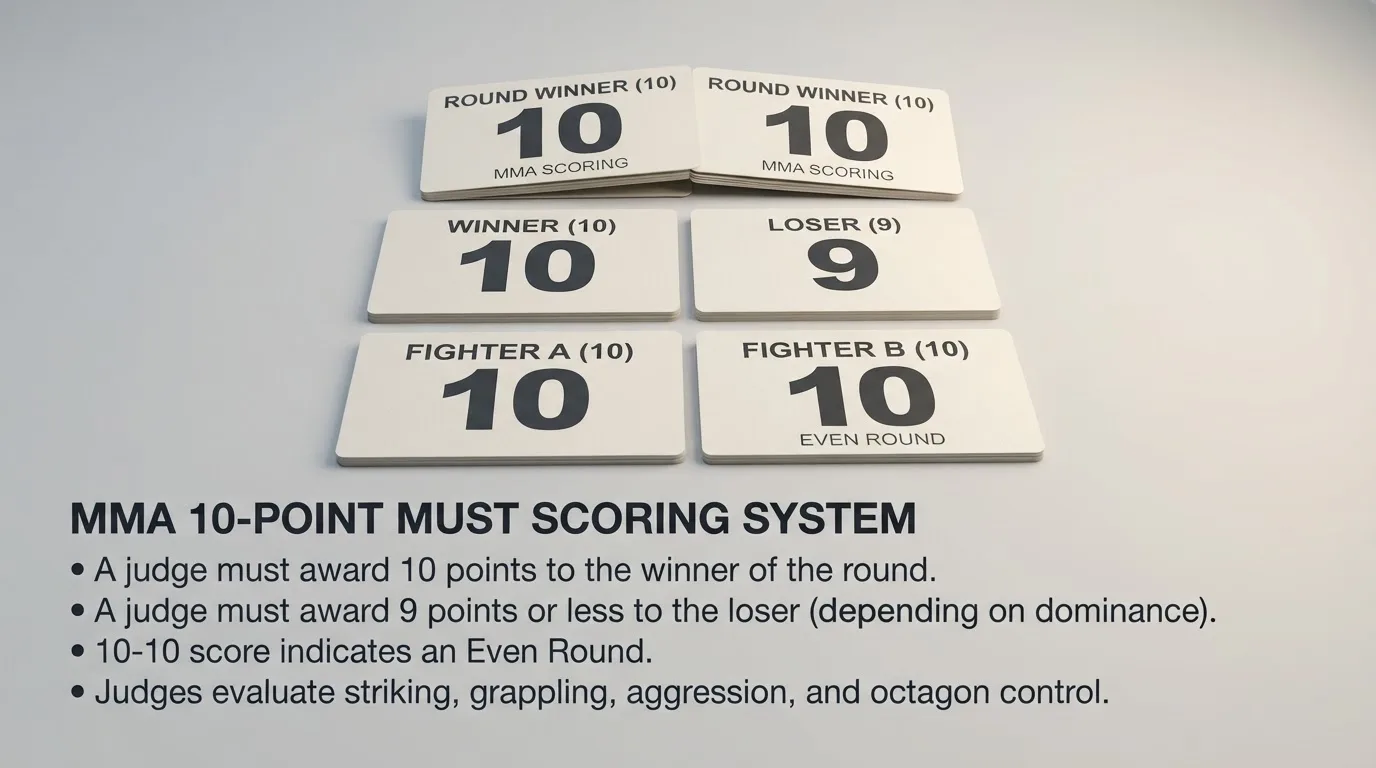
The Ultimate Fighting Championship was founded on 12 November 1993, when UFC 1 was held at McNichols Sports Arena in Denver, Colorado. That is the only founding date the sport has. The UFC has 11 weight divisions, eight men’s and three women’s, which is the structural fact behind every weigh-in, every cut, and every late-notice replacement. Each round under the Unified Rules of mixed martial arts lasts five minutes with a one-minute rest between rounds; non-title bouts normally go no more than three rounds, while title bouts can be sanctioned for five rounds. Three judges score each round on the ten-point must system: the round winner gets 10 points, the loser 9 or fewer, and an even round is scored 10–10. A decision can be unanimous, majority or split, and a draw can also be unanimous, majority or split. A bout ends in disqualification if an intentional foul incapacitates a fighter, and in a no contest if an unintentional foul incapacitates a fighter.
Those are the rules. The cost to the punter of knowing them is real, because each rule is a market. The “go the distance?” market is built on the number of rounds and the standard of judges’ scorecards. The method-of-victory market is built on the rules around fouls, referee stoppages, and the difference between a technical knockout, a corner stoppage, and a doctor’s stoppage. The round group market is built on the round length, the rest interval, and the championship-vs-non-championship distinction. A punter who cannot name the rules cannot price a market that depends on them, and a punter who cannot price the market is paying the bookmaker’s margin for the privilege of guessing.
Outside the UFC, the cards a GB-licensed bookmaker will list are Bellator, ONE Championship, PFL, and a long tail of regional promotions whose coverage varies. The “Bellator MMA betting odds” key in this cluster names the second most-covered promotion, and a punter comparing Bellator odds across operators is doing the same work as a punter comparing UFC odds. The market depth on a Bellator card is thinner than on a UFC card, the in-play coverage is shorter, and the prop-market line is shorter still. A punter who bets Bellator at a bookmaker whose prop coverage is the same as its UFC prop coverage is paying the same margin for a thinner market; a punter who bets Bellator at a bookmaker that has a dedicated Bellator trader is paying a different margin for a deeper market. The comparison is qualitative on the inputs reviewed, and a punter should check the operator’s MMA hub before a card.
The cost to the reader of the sport section is the reminder that MMA is not football. Football has a regular season, a fixture list, and a settled team-sheet. MMA has a card, a weigh-in, a late notice, and a fight that can end in the first round. The punter who treats MMA betting like football betting — same markets, same margin, same bankroll — is paying a tax the comparison did not name.
The ten GB-licensed operators, ranked by what each brings to an MMA card
The ten brands below are all listed on the Gambling Commission’s public register against a remote general betting standard (real events) licence. That is the test of being a licensed GB operator; it is not a ranking, and the order below is not a quality order. Each review closes on what the operator actually does for an MMA punter, and what it costs.
| Brand | Gambling Commission licence | Licence holder | What the operator’s own terms say about the key subject |
|---|---|---|---|
| Octobet | 062545-R-337248-006 (account 62545) | Octopus Game Limited | Sportsbook welcome: 50% back as a free bet up to £50, plus a £10 casino bonus for new customers |
| Tote | 054779-R-331321-008 (account 54779) | TDCO Limited | Best Odds Guaranteed on UK and Irish horse racing from 8 AM on the day of the race, on single and multiple bets; not ante-post, tote or pari-mutuel |
| BetUK | 039198-R-319450-029 (account 39198) | LeoVegas Gaming PLC | Four £10 free bets (two football accumulators of 4+ selections and two multiples of 2+) for new customers depositing £10 and placing a sports bet within 7 days |
| LiveScore Bet | 056859-R-332720-005 (account 56859) | LiveScore Betting and Gaming (Gibraltar) Limited | Bet Builder allows up to 10 selections across match result, both teams to score, corners, total goals, player scoring and card markets |
| Sporting Index | 027343-R-308898-011 (account 27343) | Sporting Index Limited | Customers can switch between fixed odds and spread betting, with in-play betting, Bet Builder for football, auto cash-out and Multi-Markets |
| Spreadex | 008835-R-104580-022 (account 8835) | Spreadex Limited | Combines fixed-odds and spread betting in one app, with one-click, auto and partial cash out, Bet Builder across fixed odds or spreads, and live streaming of UK and Irish horse racing, greyhounds, tennis, NFL and selected football |
| bet365 | 055148-R-331498-002 (account 55148) | Hillside (UK Sports) ENC | Official global betting partner of the UEFA Champions League; described as the most downloaded sports betting app in the UK; in-play betting and live streaming of events worldwide, plus Bet Track, Match Live and a Live Golf Tracker; Bet Builder+ combining markets from one event, Super Boosts, Winnings Boosts on Bet Builders and selected singles, and daily Bet Boosts |
| Dabble | 065677-R-340363-005 (account 65677) | Dabble Sports UK Ltd | Welcome: Bet £10, Get £10 in Free Bets on a first deposit for new customers, with minimum odds applying, a 7-day free bet expiry and the stake not returned |
| Fafabet | 057385-R-333191-006 (account 57385) | Taichi Tech Limited | Best Odds Guaranteed on UK and Irish horse racing win and each-way bets from 9am on race days; if the starting price is bigger than the original price, the bigger odds are paid |
| Kwiff | 044448-R-323408-017 (account 44448) | Eaton Gate Gaming Limited | Licensed by the UK Gambling Commission; trademark operated by Spryme Ltd; app carries a 17+ age rating |
Octobet — the welcome that is two products bolted together
Octobet’s sportsbook welcome is 50% back as a free bet up to £50, plus a £10 casino bonus for new customers. Two things follow. The first is that the headline number — “up to £50” — is a refund, not a matched deposit, and the punter has to lose the qualifying bet to trigger it; the stake on the qualifying bet is the punter’s own money, and the free bet is paid only on a loss. The second is that the £10 casino bonus is a separate product with its own terms, and the LCCP ban on mixed-product promotions that took effect on 19 January 2026 does not catch a casino bonus attached to a sportsbook loss — the offer is a sportsbook offer, with a casino sweetener, not a sportsbook-and-casino rollover. The cost of the welcome is therefore the qualifying loss on the sportsbook bet, and the value of the free bet is what the free bet is worth on a price the punter chose, which is a different number from the £50 headline. For a punter with a tight bankroll the offer is not a £50 free bet; it is a refund on a first loss up to £50, with a small casino side bet the punter may or may not want to use.
Tote — the horse-racing house that also covers MMA
Tote’s stand-out feature is Best Odds Guaranteed on UK and Irish horse racing from 8 AM on the day of the race, on single and multiple bets; it does not apply to ante-post, tote or pari-mutuel bets. That is a horse-racing feature. For a punter whose MMA interest is a side interest, Tote is a pool-betting house first and a sportsbook second, and the MMA market depth is what a punter should check on the operator’s site before a card. The licence is held by TDCO Limited under account 54779. For a punter whose primary interest is horse racing and whose MMA interest is a weekend add-on, Tote’s BOG is the reason to be there; for a punter whose primary interest is MMA, the comparison is on the depth of the MMA hub, which requires a check of the site’s market lists.
BetUK — the four-free-bet welcome with a football shape
BetUK’s sports welcome is four £10 free bets — two football accumulators of 4+ selections and two multiples of 2+ — for new customers who deposit £10 or more and place a sports bet within 7 days of registering, with opt-in required. The shape of the offer is football-shaped: two of the four free bets are explicitly football accumulators, and a punter whose first deposit is on MMA is taking free bets whose names say football. A bookmaker’s free bet is usually single-use and tied to the markets the bookmaker names, and a punter who reads the small print will see whether the football-named free bet can be used on an MMA market. The licence is held by LeoVegas Gaming PLC, the operator behind a number of UK-facing brands. For a punter who bets football and MMA in roughly equal measure, the offer is four £10 free bets; for a punter who bets MMA only, the offer is two £10 free bets, as the others are tied to football accumulators. The offer is essentially football-focused and rewards multi-sport usage.
LiveScore Bet — the Bet Builder benchmark
LiveScore Bet’s Bet Builder allows up to 10 selections and covers match result, both teams to score, corners, total goals, player scoring and card markets. The market list is a football list. The punter cost is that a builder of 10 football-shaped selections is a builder on a sport whose markets the operator has priced, and a punter who tries to build a 10-leg MMA accumulator at the same operator is using a tool built for football on a sport the operator has priced differently. The 10-selection cap is, however, a useful benchmark for what a builder at the top of the market can do. The licence is held by LiveScore Betting and Gaming (Gibraltar) Limited. For a punter whose primary interest is football builders, LiveScore Bet is a strong offering; for a punter whose primary interest is MMA, the builder is one of the inputs the punter should price on the night.
Sporting Index — fixed odds and spread in the same app
Sporting Index’s app lets customers switch between fixed odds and spread betting, with in-play betting, Bet Builder for football, auto cash-out and Multi-Markets. Spread betting on a sporting outcome is a different product from fixed-odds betting: a spread is a quote around a number, the punter buys or sells the spread, and the winnings or losses are the difference between the spread and the result multiplied by the stake. A punter on the wrong side of a spread can lose more than the deposit, which is the standard spread-betting caveat. The licence is held by Sporting Index Limited. For a punter who understands spread betting, Sporting Index is a useful second product; for a punter who only bets fixed odds, the fixed-odds book is the primary offering to compare.
Spreadex — fixed odds, spread, and a one-click cash out
Spreadex combines fixed-odds and spread betting in one app, with one-click, auto and partial cash out, Bet Builder across fixed odds or spreads, and live streaming of UK and Irish horse racing, greyhounds, tennis, NFL and selected football. Spreadex is regulated by the FCA for spread betting and by the Gambling Commission for fixed-odds betting, and states that spread betting losses can exceed the deposit. The punter cost is in the spread-betting exposure for any punter who does not understand the spread product, and the punter benefit is in the one-click cash out for fixed-odds bets in-play. The licence is held by Spreadex Limited. For a punter who wants both products in one app and is willing to read the spread-betting terms, Spreadex is a useful offering; for a punter who wants fixed odds only, the cash-out speed is the part to test, and the rest of the spread-betting product is not needed.
bet365 — the deep-market benchmark with the most downloads
bet365 is the official global betting partner of the UEFA Champions League and its app is described as the most downloaded sports betting app in the UK. The same listing names Bet Builder+ (combining markets from one event into a single bet, available pre-match and in-play), Super Boosts, Winnings Boosts on Bet Builders and selected singles, and daily Bet Boosts, and in-play betting and live streaming of events worldwide, plus Bet Track, Match Live and a Live Golf Tracker for following bets in play. The depth of the in-play product is the reason a punter benchmarks against bet365: the bet tracker lets the punter follow a bet in play on a single screen, the live stream brings the fight to the app, and the builder combines markets from one event into a single price. The cost is the price-boost dependence: a punter who follows the boost marketing on a weekly basis is paying the boosted leg’s wider margin and the cap on the boosted stake. The licence is held by Hillside (UK Sports) ENC. For a punter who bets across multiple sports and wants the deepest in-play product, bet365 is the benchmark; for a punter who bets MMA only, the MMA-specific depth remains a key factor, and the operator’s scale means the market lists are generally the most complete.
Dabble — the straight £10 for £10 free bet
Dabble’s welcome is “Bet £10, Get £10 in Free Bets” on a first deposit for new customers, with minimum odds applying, a 7-day free bet expiry and the stake not returned. The shape is the cleanest of the four free-bet welcomes: one free bet of £10, no casino side, no four-bet structure. The minimum-odds condition is the cost the punter has to read, and the 7-day expiry is the timer. The stake-not-returned feature is the structural cost named in the bonuses section above: a winning £10 free bet at decimal odds 3.00 pays £30 in total, but the punter’s net profit is £20, not £30. The licence is held by Dabble Sports UK Ltd. For a punter who wants a clean free-bet welcome, Dabble is the most legible of the four; for a punter who wants a casino sweetener alongside, the £10 Octobet side bet is the difference.
Fafabet — Best Odds Guaranteed from 9am
Fafabet pays Best Odds Guaranteed on UK and Irish horse racing win and each-way bets from 9am on race days: if the starting price is bigger than the original price, the bigger odds are paid. BOG is a horse-racing feature, and the cost of the offer to an MMA punter is zero if the punter does not bet horse racing. The licence is held by Taichi Tech Limited. For a punter who bets horse racing and MMA, Fafabet is a useful BOG option; for a punter who bets MMA only, the comparison is on the MMA market depth alone, with Fafabet being one of several options in a competitive market.
Kwiff — the surprise-prize brand with a 17+ rating
Kwiff is licensed by the UK Gambling Commission and describes itself as a trademark operated by Spryme Ltd; the app has a 17+ App Store age rating. The 17+ age rating is a US-style age gate that is higher than the UK minimum of 18, and the punter cost of a higher age gate is a faster check on the operator’s side. The licence is held by Eaton Gate Gaming Limited. For a punter who values the trademark’s surprise-prize marketing (the “kwiff” is the trade name for a randomly-enhanced price), the offering is a different product; for a punter who wants a steady MMA market, the comparison is on the MMA hub’s depth and the inputs reviewed do not give that depth for Kwiff specifically.
Overview: what an MMA price is, and what it contains
A price on an MMA fight is a decimal number that says what a winning £1 stake returns. A price of 2.50 means a £1 stake returns £2.50 if the bet wins, of which £1.50 is net profit. A price of 1.40 means a £1 stake returns £1.40, of which £0.40 is net profit. A price of 1.10 means a £1 stake returns £1.10, of which £0.10 is net profit — a heavy favourite, where the punter is paying for the certainty of the win rather than the size of the payout. The number on the screen is the bookmaker’s view of the fight, plus a margin that quietly lifts every price above what a fair payout would be. The fair payout on a two-way market, with no margin, is what the calculation block below works out.
A method-of-victory market — KO/TKO, submission, decision — is a three-outcome market, plus a fourth for “other” or “draw” on a championship card. A round group market is built from as many outcomes as the operator lists. A “go the distance?” market is a two-outcome market that compounds the favourites’ tendency to win early in title bouts. The punter cost of a market is the margin, and the margin of a market is the same number whatever the selection — it is a property of the bookmaker’s book on the fight, not a property of the bet the punter places.
The arithmetic is straightforward. A market’s payout share is the inverse of the sum of the inverse prices — 1 ÷ (1/odds₁ + 1/odds₂ + …) — and the margin is 1 minus the payout share. On an illustrative two-way market at 1.90 / 1.90, the payout share is 1 ÷ (1/1.90 + 1/1.90) = 1 ÷ (0.5263 + 0.5263) = 1 ÷ 1.0526 = 0.95, and the margin is 1 − 0.95 = 0.05, or 5%. The fair payout on a 1.90 / 1.90 market, with no margin, would be 1.00 ÷ 0.50 = 2.00 on each side, and a punter who backs either side at 1.90 is paying 5% of stake in expected value. On a real-world MMA moneyline the two prices are rarely equal — a 1.40 / 2.80 favourite-and-underdog market has a payout share of 1 ÷ (0.7143 + 0.3571) = 0.935, and a margin of about 6.5%. On a method-of-victory market the three or four prices are usually wider on the favourite’s method than on the underdog’s, and the margin of the market is correspondingly wider. The punter cost is the same in shape — a percentage of stake — but a higher number.
A “free bet” at 1.90 / 1.90 is worth, in expected value, the free-bet amount multiplied by (odds − 1) divided by odds, multiplied by the payout share of the market. A £10 free bet at 2.50 is worth £10 × (2.50 − 1) ÷ 2.50 × 0.95 = £10 × 0.60 × 0.95 = £5.70. A £10 free bet at 1.50 — a heavy favourite — is worth £10 × 0.50 ÷ 1.50 × 0.95 = £10 × 0.333 × 0.95 = £3.17. A punter who uses a free bet on a short price is paid less in expected value than a punter who uses the same free bet on a longer price, and the minimum-odds condition on the operator’s offer is the bookmaker’s way of pushing the punter into a price band where the expected value is low.
A “100% bonus” of £10 with a 10x wagering requirement takes £100 of qualifying bets to clear, and the expected cost of clearing the bonus is the turnover multiplied by the margin of the market the punter bets into. At 5% margin the cost is £5; at 8% margin the cost is £8; at 10% margin the cost is £10. A punter who clears a £10 bonus at 10x is taking a £5 to £10 expected cost, with the bonus as the only offset, and the bonus therefore nets to a small loss in expected value. A punter who clears the same bonus on a market with a 5% margin nets to a small gain. The honest reading is that a small bonus at a tight margin is the closest a welcome offer comes to a real bargain, and the marketing line “100% bonus” is a sales wrapper around a number that depends on the market the punter chooses.
The expected cost of any of these products is, by construction, an average over many bets under the stated assumptions. It promises no win, no payout, and no return. A punter who clears a bonus and lands a winning bet is not vindicated; a punter who clears the same bonus and lands a losing bet is not undone. The expected cost is the long-run cost, and the long run is the only place it is a real number.
The bigger point is that the price and the margin are two halves of the same product. A bookmaker’s headline price is what the punter sees; the bookmaker’s margin is what the punter pays. A punter who reads one without the other is reading a marketing line. A punter who reads both is reading a comparison.
Legality and regulation: what a Great Britain licence buys, and what it does not
The Gambling Commission (UKGC) is a non-departmental public body sponsored by the Department for Culture, Media and Sport. It licenses the whole commercial market under the Gambling Act 2005, which covers Great Britain (England, Scotland and Wales); Northern Ireland is outside the Act and has its own older law, so the honest line is “Great Britain licence” or “GB-licensed”, never that a GB licence regulates Northern Ireland. Since the Gambling (Licensing and Advertising) Act 2014 an operator whose remote facilities are used in Great Britain needs a Commission licence wherever it is based; a Curaçao, Maltese or Gibraltar licence is not a substitute. There is no state monopoly and no cap on the number of licences.
The licence types relevant to a punter are remote general betting standard (real events), remote general betting standard (virtual events), remote general betting limited, remote pool betting, and remote betting intermediary (the licence for betting exchanges). All ten brands reviewed above hold a remote general betting standard (real events) licence. The Commission’s public register can be searched by business name, trading name, domain or account number and is the whole test of whether a brand holds a licence; the table above carries the account number against each operator.
Financial spread betting is regulated by the Financial Conduct Authority, not the Commission. Spreadex’s split — FCA for spread betting, Gambling Commission for fixed-odds betting — is the reason the licence line on the brand is longer than the line on a fixed-odds-only operator. A punter who spreads on a sporting outcome is in the FCA’s territory; a punter who backs a sporting outcome at fixed odds is in the Commission’s territory; the operator that does both is licensed by both.
The minimum age is 18, and name, address and date of birth are verified before a customer can deposit or gamble, including with a free bet or bonus. The verification is a one-time cost the punter pays in time, and the operator that skips the check is not on the register. Identity verification before the first deposit means no anonymous play at a licensed site, and the punter cost of a licensed site is the verification; the punter cost of an unlicensed site is the absence of every protection the verification enables.
The player protection frame is in three parts. GAMSTOP is the national multi-operator online self-exclusion scheme and a mandatory licence condition for online operators since 31 March 2020. A financial vulnerability check (LCCP condition 3.4.4, in force since 30 August 2024) applies to licensed remote betting when a customer’s deposits minus withdrawals cross £150 in a rolling 30 days (since 28 February 2025); it is a public-record check, not an income check, and not a credit-reference check. Financial risk assessments — the “affordability checks” of the press — were reshaped in a Commission article of 7 July 2026, with no start date, and the honest line is “announced, staged, no start date”, never “in force”. Deposit limits (RTS 12) require operators to offer a gross deposit limit on a fixed time frame; the first changes have applied since 31 October 2025, a second phase was postponed to 30 September 2026, and whether the second phase is live is not established. There is no state-set deposit or loss ceiling for betting: limits are the customer’s choice.
Advertising is not licensed by the Commission; it runs through the CAP Code (non-broadcast) and BCAP Code (broadcast), enforced by the ASA, alongside the LCCP marketing conditions. CAP Code section 16: marketing must be socially responsible, must not be of strong appeal to under-18s, and no one who is or seems to be under 25 may be featured gambling or play a significant role; the rule concerns who may appear in the advertisement, not who may bet. The promotion rules in force since 19 January 2026 cap wagering requirements on bonuses at 10x and ban mixed-product promotions. The “whistle-to-whistle” rule is an industry code, not law; since 1 August 2019 betting advertisements are not shown on TV from five minutes before a live sporting event to five minutes after it, before the 9pm watershed, with horse and greyhound racing excluded. The Premier League clubs’ withdrawal of gambling sponsorship from the front of matchday shirts (from 2026/27; sleeves and hoardings remain) is voluntary, not law. Operators are responsible for marketing by their affiliates.
Tax: the player pays no tax on betting winnings in Great Britain (general information, not tax advice; a professional gambler should ask HMRC or an adviser). General Betting Duty is the operator’s tax on gross profits, currently 15%; from 1 April 2027 a new remote betting rate of 25% applies within it, while remote bets on UK horse racing, bets on self-service betting terminals in licensed premises, pool betting and in-person betting stay at 15% (HM Government policy paper of 26 November 2025). Spread betting has its own rates (3% financial, 10% other). Until 1 April 2027 the remote rate stays at 15%; whether operators pass duty on through odds is not established, and the honest line is never that the player is charged duty. The Commission’s statutory levy is a separate charge, not a tax.
Payments: credit cards are banned for gambling in Great Britain (since 14 April 2020, LCCP condition 6.1.2), including credit-card-funded payments through an e-wallet; debit cards and bank-based payments are not covered by that ban. Identity verification before the first deposit means no anonymous play at a licensed site, and source-of-funds questions at higher spend are normal under the money-laundering rules. A British named-account rule, a state list of permitted payment methods and any rule for or against cryptocurrency deposits at licensed operators are not established: payments are described qualitatively and from each operator’s terms.
Offshore: a GB licence is compulsory at the point of consumption. Providing gambling facilities in Great Britain without the licence the Act requires is an offence under section 33 of the Gambling Act 2005 (on summary conviction up to 51 weeks’ imprisonment, a fine up to level 5, or both; six months in Scotland) — aimed at the operator. No offence aimed at a customer who merely bets on an unlicensed site was found in the inputs. The honest framing is to state the loss of protection — no GAMSTOP coverage, no Commission complaints route, no approved dispute-resolution body, no British consumer redress if funds are withheld, not bound by the 10x bonus cap or the £150 vulnerability check — and never “legal to use”. Enforcement is disruption, not blocking: cease-and-desist notices, search-engine referrals, work with registrars, hosts and payment providers; the Commission has been given, or is about to receive, court-order DNS blocking powers — never write that ISP blocking is in operation.
The honest framing, in two lines: licensed equals checks, limits, GAMSTOP, a 10x bonus cap, but also verification before the first bet; unlicensed equals none of those protections and possible loss of funds. Neither is “the safe choice” by default — the licensed choice is the one with the protections, and the unlicensed choice is the one without.
Calculation: what a margin of 5% actually looks like on a £10 stake
The cost analysis shows what a margin means in pounds, not just percentages. For example, on a two-way market with decimal odds of 1.90/1.90, a £10 stake on each side results in a small net loss, representing the operator’s margin.
The payout share of the market is 1 ÷ (1/1.90 + 1/1.90) = 1 ÷ 1.0526 = 0.95, or 95%. The margin is 1 − 0.95 = 0.05, or 5%. A winning £10 bet at 1.90 returns £19, of which £9 is net profit. A punter who backs each side once at the same stake and the same price, in a fair market, breaks even; in this market, the punter loses £1 across the two bets, because the £20 returned on a winning £20 staked is a £1 shortfall against the stake. That £1 is 5% of the £20 staked, and the percentage is the margin.
Stated as a band with its condition: on a two-way market at 1.90 / 1.90, the margin sits at 5%, and a punter who bets into the market in the long run pays 5p of every pound staked in expected value. A heavier favourite at 1.40 / 2.80 — closer to a real-world MMA moneyline — has a payout share of 1 ÷ (0.7143 + 0.3571) = 0.935, and a margin of about 6.5%. A method-of-victory market with three or four outcomes and a wider spread on the favourite’s method typically carries a margin between 7% and 12%. A round group market is usually wider still. The punter cost of any MMA bet is the market’s margin, not the headline price, and the headline price is the same number whether the punter backs the favourite or the underdog.
A £10 free bet at decimal odds 2.50, on a market with a 95% payout share, is worth £10 × (2.50 − 1) ÷ 2.50 × 0.95 = £5.70 in expected value. The same £10 free bet at 1.50 is worth £10 × 0.50 ÷ 1.50 × 0.95 = £3.17. A punter who uses a free bet on a long price is paid more in expected value than a punter who uses the same free bet on a short price, and the minimum-odds condition on a free-bet welcome is the bookmaker’s way of pushing the punter into a price band where the expected value is low. A £10 bonus with a 10x wagering requirement takes £100 of qualifying bets to clear; on a market with a 5% margin the expected cost of clearing the bonus is £5, and the bonus therefore nets to a £5 gain in expected value; on a market with an 8% margin the cost is £8, and the bonus nets to a £2 gain. A welcome bonus on a tight market is the closest a marketing offer comes to a real bargain; the same welcome on a wide market is a marketing wrapper around a small loss.
The expected cost is an estimate, not a guarantee. It is an average over many bets under the stated assumptions, and it promises no win, no payout, and no return on any single bet. A punter who reads the margin of a market before placing a bet is reading the same product the bookmaker priced, and the comparison is honest on both sides.
Frequently asked questions
How does MMA betting work?
MMA betting is fixed-odds wagering on the outcome of a mixed martial arts bout. A price is offered on each fighter, on the method of victory (KO/TKO, submission, decision), on the round group, and on whether the fight goes the distance. Three judges score each round under the ten-point must system, and the result can be a unanimous, majority or split decision, or a draw. A winning bet returns the stake multiplied by the decimal odds, with the net profit being the stake multiplied by the odds minus one.
Where can I bet on MMA fights with high odds?
A “high odds” fight is a long price on an underdog, and the price the punter sees at one operator is rarely the same as the price at another. The honest comparison is the same selection at three or four GB-licensed operators, with each operator’s margin on the market named beside the price. A price is only “high” if the underlying probability is not higher; a high price on a heavy favourite is a trap, and a high price on a live underdog is a long shot with a reason.
What counts as a top value MMA bet for this weekend?
“Value” is a margin-relative term. A price is good value if it is bigger than the true probability would imply, and a “weekend value” tip is a tip with a positive long-run return on investment after the bookmaker’s margin is taken out. A punter who reads the margin of a market before placing a bet is reading the same product the bookmaker priced, and the value of a tip is the difference between the punter’s number and the bookmaker’s price. A weekend card is two or three events deep at most, and a punter’s bankroll is not a tool for finding edges across a handful of fights.
How can I check that a bookmaker holds a Gambling Commission licence?
The Commission’s public register can be searched by business name, trading name, domain or account number. The ten brands reviewed above are all listed on the register, and the table in the ranking section carries each operator’s account number, licence number and licence holder. The register is the whole test of whether a brand holds a GB licence; a Curaçao, Maltese or Gibraltar licence is not a substitute.
How is the return on a bet worked out from the stake and the odds?
A winning bet returns the stake multiplied by the decimal odds, with the net profit being the stake multiplied by the odds minus one. A £10 stake at decimal odds 2.50 returns £25, of which £15 is net profit. A combination bet multiplies the odds of the legs into one price, and the return is the stake multiplied by the combined odds. A free bet’s stake is usually not returned with the win, and the net profit on a winning £10 free bet at 2.50 is £15, not £25.
What is the bookmaker’s margin and how can it be seen in the odds?
A market’s margin is the percentage of every pound staked that the bookmaker keeps on average. The payout share of a market is the inverse of the sum of the inverse prices — 1 ÷ (1/odds₁ + 1/odds₂ + …) — and the margin is 1 minus the payout share. On an illustrative two-way market at 1.90 / 1.90, the payout share is 95% and the margin is 5%. A punter who reads the margin of a market before placing a bet is reading the same product the bookmaker priced, and the headline price is only worth a fraction of a penny once the margin of its market is named beside it.
Combat & motorsport – Best betting exchange
Content created by the «Best betting exchange» team
