
Online darts betting 2026: what the odds really cost the punter
 Available in US
Online darts betting has matured into one of the busiest niches on British sportsbooks. What used to be a Christmas-and-New-Year curiosity around the PDC World Championship is a year-round fixture list, and a tidy set of markets with it: outright winner, match winner, most 180s, highest checkout, handicap legs, correct score. The headline question for a punter is not “where can I bet on darts?” — most licensed books carry it. The question that matters is what the bet costs once the margin, the bonus terms and the in-play markup have done their work. That is the thread running through this guide.
Every number and licence detail that follows is taken from the public register of the Gambling Commission, the operators’ own terms or pages, and the cited fact bank. The guide is current as of 27 October 2026 and the licences have been checked against the Gambling Commission’s public register.
Responsible gambling on darts betting sites
A licensed darts bookmaker in Great Britain runs under the same player-protection regime as any other remote betting product. The shape of that regime matters more on darts than on bigger sports, because the calendar pushes a lot of action into late-night sessions, the events stack back-to-back across Christmas and New Year, and the same customer often has both a darts slip and an accumulator on the football running at once.
GAMSTOP is the multi-operator self-exclusion scheme, mandatory for every GB-licensed online operator. A self-exclusion lasts six months, one year, five years, or five years with auto-renewal, and after the minimum period the exclusion stays in force for another seven years unless the customer asks GAMSTOP to remove it. Once a customer is on GAMSTOP, every GB-licensed site is closed to them — the bet on darts, the football coupon, the bingo side bet. That is the part of the regime that actually changes the customer experience.
The financial vulnerability check sits underneath the exclusion scheme. Since 28 February 2025, once a customer’s deposits minus withdrawals cross £150 in a rolling 30-day window, a licensed remote operator must run a public-record check — bankruptcy, county court judgments and the like. It is not an income check and not a credit reference check; it is a sanity check against the simplest financial flags. The fuller financial risk assessments, the ones the press calls affordability checks, are announced in a staged plan from the Commission (article of 7 July 2026) with no start date. Treat them as “announced, staged, no start date”, not as in force.
Deposit limits are the operator’s responsibility under RTS 12: every GB-licensed remote bookmaker must offer a gross deposit limit on a fixed time frame. The first changes applied from 31 October 2025; a second phase was postponed to 30 September 2026. There is no state-set ceiling on stakes or losses for sports betting — the maximum stake is whatever the operator’s trading team decides today.
Identity verification runs before the first deposit or bet, including with a bonus. Credit cards are banned for gambling in Great Britain, including credit-card-funded payments through an e-wallet. Help is available through GamCare (National Gambling Helpline), GambleAware, NHS gambling clinics and Gamblers Anonymous; each of the ten operators reviewed below links at least one of these on its safer-gambling pages, and Fitzwilliam Sports links all three of GamStop, GambleAware and Gamblers Anonymous directly from its footer.
The honest summary: GAMSTOP covers every brand in this guide, every brand checks identity before the first deposit, and the protections sit behind a registration that takes a few minutes. The cost of being excluded by your own choice is real; the cost of using an unlicensed site, where none of these protections apply, is harder to measure but not smaller.
Bonuses and free bets on darts
A darts bonus is a marketing wrapper around a turnover requirement. Read the wrapper carefully and the turnover is the price.
The wrapper that matters in 2026 is a free bet, not a deposit match. Coral’s sports welcome offer hands £40 in free bets when a customer stakes £20 at minimum odds of 2.0 (1/1), with the free bets issued within seven days and expiring seven days after issue. Sky Bet’s free bets work on the same principle: they expire 30 days after crediting, are usable only on single or each-way markets excluding virtuals, are non-withdrawable, and do not return the stake with winnings. The “do not return the stake” line is the one that defines what a free bet is: a winning free bet at odds of 4.0 pays four times the free-bet amount as profit, not five times, because the stake is not refunded. The marketing word “free” describes the upfront cost, not the return shape.
The promotion rules that govern these wrappers changed on 19 January 2026. Wagering requirements on bonuses are now capped at 10x — a £10 bonus at 50x used to need £500 of qualifying bets; under the cap no more than £100 in qualifying bets is required for that £10. Mixed-product promotions, the kind of offer that ties a sports bet to free spins or a bingo bonus, are banned outright. The rules apply to operators licensed in Great Britain; offshore brands are not bound by them. Whether the cap applies to free bets with no wagering condition is not established from the public record, so do not assume a free bet with no turnover rule is therefore equivalent to cash.
The terms to read before claiming any darts bonus:
- The qualifying bet’s minimum price. Coral’s £20 qualifier at 2.0 is the typical floor; some books go lower (1.5), some higher.
- The expiry on the free bet. Seven days for Coral, thirty days for Sky Bet. A short expiry on a quiet week of darts fixtures means the punter uses the bet or loses it.
- The markets the free bet can be used on. Sky Bet’s single or each-way restriction rules out using the free bet on a darts accumulator — which is often where a punter wants the value.
- The stake-not-returned rule. It shapes the expected value of every free bet on the page; it is treated in the worked example later in this guide.
The cost of a welcome offer is the qualifying bet that unlocks it plus the expected loss on the turnover the bonus requires. Coral’s £20 at minimum odds of 2.0 carries an expected loss against the margin of the chosen market; the £40 in free bets is worth whatever the calculation produces once the stake-not-returned rule is applied. That is what a “free” offer costs.
Live darts betting and cash out
Darts is one of the most in-play-friendly sports on a British bookmaker. Legs last minutes, sets stretch longer, and the score is updated to the single dart. A live book can mark up the in-play margin quite hard because the price on the screen is the only price the customer has time to read.
The mechanics of in-play darts are standard. The bookmaker suspends the market after each visit to the oche, reprices as the leg develops, and offers cash out on the open bets at a price that reflects the current state of the leg. The customer can lock in a profit or cut a loss without waiting for the leg to finish. The price the book offers is its own, and the gap between the live price and the cash-out price is the cost of the convenience.
Betfair’s app carries the live-streaming feature for in-play events such as UK and Irish horse racing and football — darts streams are not part of that bundle. 888sport’s app lists a live bet feed and BetFinder form tools but the darts stream itself comes through the bookmaker’s own channels or not at all. Most GB-licensed books carry at least the PDC’s televised events through their in-play modules; what the punter sees on screen is the bookmaker’s data feed, not the live broadcast, so the in-running price moves on a delay measured in fractions of a second.
Cash out on a darts match is a real feature at the books in this guide. The bet that gets closed mid-leg is paid out at the bookmaker’s quoted price; the punter does not need to wait for the leg, the set or the match. The bookmaker keeps the spread between the live price and the cash-out price, which is the cost of taking the early money. The same shape applies to bet builders in play: bet365’s Bet Builder+ combines markets from one event into a single bet pre-match and in-play, with the cash-out button working on the combined price.
The in-play markets on darts that turn up most often: next-leg winner, race to three legs, most 180s in the match, highest checkout in the match. The handicap and correct-score markets tend to stay pre-match because the bookmaker needs the whole leg in front of it to settle cleanly. The least-marketed in-play market on darts is total 180s; the most marked-up is the next-leg winner because the price moves fastest there.
A punt on darts in play should be sized to the cost of the in-play markup. The margin at 1.90/1.90 in a two-way pre-match market is around 5%; the same match in play will run closer to 7-8% on the next-leg winner because the bookmaker’s risk window is shorter. That is the cost of the convenience, and it sits on top of every other cost the punter pays.
Predictions, strategy and bankroll on darts
A darts match offers more data per minute than almost any other televised sport. Three darts a visit, a scoreboard updated in real time, and a player base small enough that head-to-head history is meaningful. The temptation is to read the data and call the result. The honest framing is that the data shows patterns the bookmaker has already priced in, and a punter is selecting prices, not outcomes.
Bankroll discipline is the boring core of any darts strategy. A unit size of one to two per cent of the bank, a stop on tilt after two losing units in a session, and a written rule for when to stop betting on a tournament — these are not predictions. They are the discipline that lets the punter keep betting once the bad run hits, because the bad run is the only certainty in the data. The darts calendar concentrates losses: the World Championship, the Premier League, the World Matchplay, and the Grand Slam stack back-to-back, and a punter who chases a Christmas loss into a New Year loss is the commonest shape of a blown bankroll on this sport.
Form reading on darts has three signals that survive the bookmaker’s pricing. First, the average on a player’s first nine-dart average over the last six months of matches at the relevant stage — a Premier League floor average is not the same number as a World Championship floor average. Second, the checkout percentage under pressure, which tends to drift as a season progresses and tells on the deciding legs. Third, the head-to-head at the specific venue: the Alexandra Palace stage, the Rotterdam Ahoy stage and the Winter Gardens stage each have their own patterns, and a player who wins well at one does not always win well at another.
Where the data runs out is on the players outside the top sixteen seedings. The PDC World Championship field expanded to 128 players in 2026 from 96 the year before, which means more first-round mismatches on paper. The book prices those mismatches accordingly, and the value on a qualifier is rarely the headline price but the place terms on the each-way market: a long-priced qualifier reaching the quarters pays both the win and the place side of the each-way, and that is where the value on the field sits. Each-way doubles the stake, so the bankroll cost is twice the headline; the place terms vary by book and by event.
Predictions pages and tipsters on darts vary widely in usefulness. A tip that names the player, the price, the stake and the closing line — and is right more often than the implied probability of the price — is one kind of signal. A tip that names the player and the stake is just opinion. The price is the test of a prediction on darts, because the price contains the bookmaker’s view of the same data the tipster is reading. Picking the tipster who beats the closing line more often than not is a slower path to a betting edge than reading the form yourself.
The strategy that survives a year on darts is a tight one: a unit size that lets the punter lose twenty units without going bust, a stop on tilt, a preference for places over wins on long-priced outsiders, and the patience to sit out a session when the prices do not look right. None of that is a prediction; all of it is the part the predictions pages do not write about.
Darts bet types and how the odds work
The standard markets on darts are match winner, outright winner, handicap, correct score, most 180s, highest checkout, race to N legs, and the next-leg winner in play. Each market carries its own margin, and the margin on a darts market is one of the easier margins for a punter to read because the two-way shape is so clean.
Match winner is the simplest market: back one player, lose if the other wins. The price carries the bookmaker’s margin, expressed in the gap between the true odds and the offered odds. On a two-way match the true odds are 2.0/2.0 for an even match; a book offering 1.90/1.90 is taking a 5.13% margin, calculated from the inverse of the implied probabilities (1 ÷ (1/1.90 + 1/1.90) = 0.949, leaving a margin of 5.1%). That is the cleanest worked example on this page: a market at 1.90/1.90 has a margin in the band of about 5% to 5.5% depending on rounding, and a market at 1.85/1.85 sits closer to 8%.
Handicap on darts is a leg handicap. A player handicapped minus 2.5 legs starts each set effectively 2.5 legs behind; the price on the handicap is the bookmaker’s view of how the set will run. The handicap on a darts match is set in half-leg increments because a leg is the atomic unit of scoring. The margin on a handicap market sits higher than on the match winner because the bookmaker has more discretion in the line it offers.
Correct score on a darts match is a set-score bet. On a first-to-six-sets match (a semi-final at the 2026 World Championship), correct-score markets run through 6-0, 6-1, 6-2, 6-3, 6-4 and 6-5; each carries its own price and the margin across the book is harder to read because the six prices sum to an overround that runs higher than on a two-way market. A £10 stake at 6.0 on a 6-4 win pays £60, profit £50, on the standard calculation (stake × odds for return, stake × (odds − 1) for profit).
Most 180s is a totals market. The line is set at a number of maximums, the customer backs over or under. The line moves with the form of the two players; the price carries the same kind of margin as a totals market in any other sport, and a punter who knows the per-leg average of the two players can read the line.
Highest checkout is a one-player market. The price is set per player; the book offers a market for who will hit the highest finishing combination in the match. The line tends to settle in a tight band (a checkout between 100 and 170) and the prices reflect that.
Outright winner is the season-long market. The PDC World Championship 2026 had a £5,000,000 prize fund with £1,000,000 to the winner, and Luke Littler beat Gian van Veen 7-1 in the final. The outright market for the next tournament opens weeks before the field is set; the price on the favourite drifts as the draw is made and the early-round opponents become known. Each-way terms apply on most outright markets at GB-licensed books, and the place side is what pays on the long-priced players who reach the latter stages.
The odds are quoted in fractional form on most GB-licensed books (5/1, 11/4, evens) and decimal form alongside (6.00, 3.75, 2.00). The conversion is a/b → a ÷ b + 1. A 5/1 shot in decimals is 6.00, an 11/4 shot is 3.75, evens is 2.00. The punter who reads fractional prices needs the conversion in their head; the punter who reads decimal prices does not, and most apps offer both side by side.
The worked example that closes this section: a £10 stake at decimal odds 3.00 pays £30 as a return and £20 as profit (return = stake × odds; profit = stake × (odds − 1)). The same stake at fractional 2/1 (decimal 3.00) is the same bet. A combination of two legs at 3.00 each, priced at 9.00 combined, pays £90 from a £10 stake. The arithmetic is simple; the choice of which combination to back is the hard part.
Sports, tournaments and the darts calendar
Darts as a betting sport runs on the Professional Darts Corporation (PDC) circuit and the World Darts Federation (WDF) circuit, with the PDC at the top of the professional pyramid. The PDC runs the World Championship, the Premier League, the World Matchplay, the World Grand Prix, the Grand Slam of Darts, the Players Championship Finals, and the World Series of darts events around the world. The WDF runs the World Masters, the World Open and a calendar of ranked events that sit below the PDC circuit. British punters bet mostly on the PDC events because that is what the GB-licensed books price.
The PDC World Championship is the centrepiece. The 2026 edition ran from 11 December 2025 to 3 January 2026 at Alexandra Palace, London, with 128 players, up from 96 in 2025. The format runs to a final of first to seven sets; rounds one and two are first to three sets, rounds three and four first to four, quarter-finals first to five, semi-finals first to six. The prize fund is £5,000,000, with £1,000,000 to the winner. Luke Littler beat Gian van Veen 7-1 in the final. The tournament runs over the festive period and dominates the GB darts betting market for three weeks of the year.
The Premier League is the next event the GB books price heavily. It runs from February to May, with eight nights of live play across the UK and Ireland and a finals night in the schedule. The format is a round-robin followed by a knockout; the outright market is open from week one and the match-winner market is live every Thursday. The Premier League field is small (eight players) and the head-to-head data is dense, which is why outright punters tend to focus here.
The World Matchplay runs at the Winter Gardens, Blackpool, in July. The format is first to 18 legs across the longer matches, which makes it a slow-burn tournament for in-running markets. The World Grand Prix uses a double-start format (players must begin each leg on a double), which removes some of the standard pricing models; the books run separate price feeds for that tournament. The Grand Slam of Darts runs in November at Wolverhampton and crosses formats.
Other tournaments the GB books price: the European Championship, the Players Championship Finals, the World Series of Darts Finals, and a long tail of Players Championship events that the GB books carry at a lower margin because the field is wider and the liquidity thinner. The World Series events outside the UK (Dubai, New York, Auckland) are usually priced with a slight overround because the local bookmaker does not always share the feed. Bet365, as the official global betting partner of the UEFA Champions League, runs a deep book on football but does not carry a special partnership on darts.
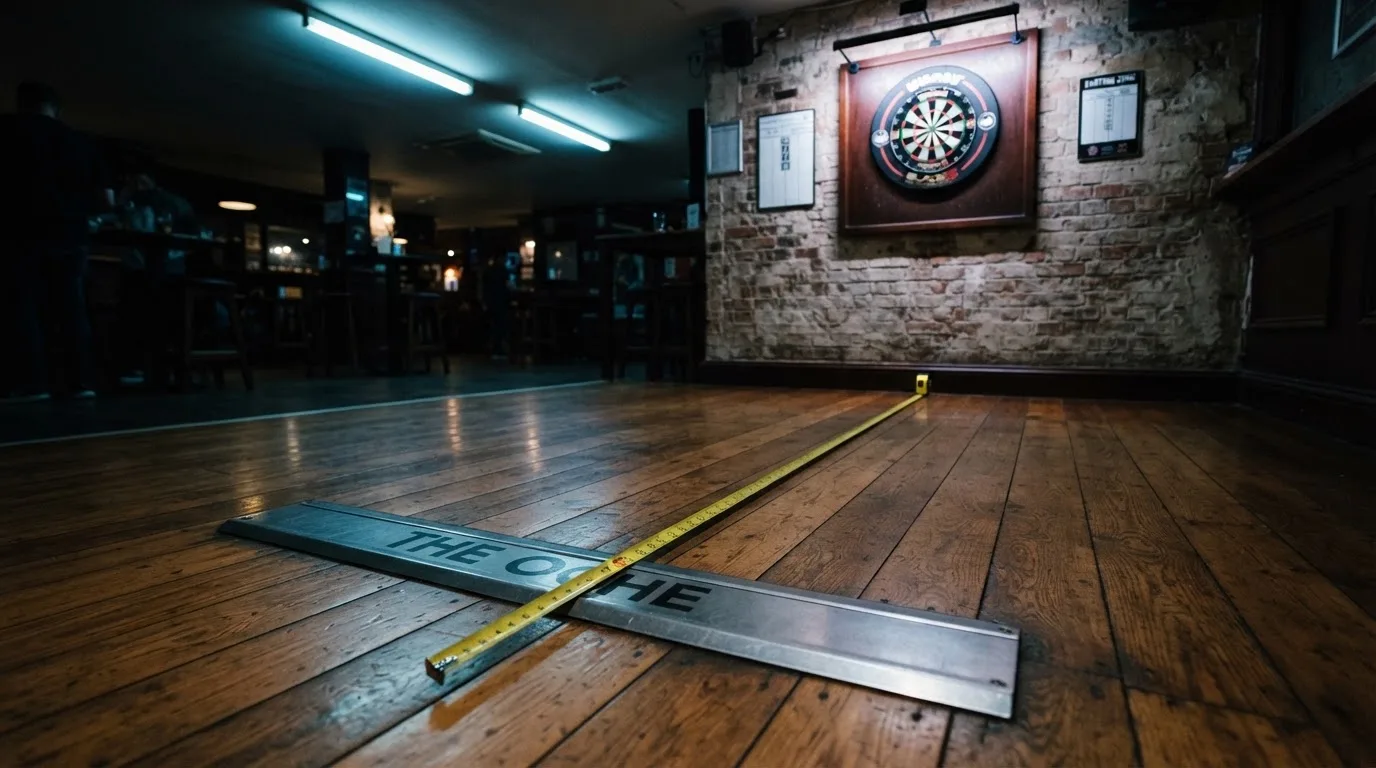
The standard format on the darts circuit is 501, starting at 501 and finishing on a double or the bullseye. The highest possible three-dart finish is 170 (treble 20, treble 20, bullseye); the minimum possible leg is nine darts (a perfect leg). The standard dartboard has 20 numbered segments, each with single, double and treble areas; the bullseye is worth 50 and the outer bull 25. The throw distance is 2.37 m (7 ft 9 in) and the bullseye is 1.73 m above the floor. These numbers are the rule book the games are played to and the frame the bookmakers price into.
The darts calendar that matters for a British punter runs December to May at its busiest, with a quieter summer behind it and a build to the next World Championship from October. The bookmaker’s outright market on the World Championship opens around August each year, with the price on the favourite shortening as the field is confirmed and the draw made. A punter who wants the best price on the favourite backs early; a punter who wants the best field backs late, after the draw.
The ten reviewed bookmakers
The ten brands below are the ones this guide ranks as the shortlist for online darts betting in 2026. Each holds a Gambling Commission remote licence for Great Britain (the licence number is shown in the comparison table further down), each is on GAMSTOP, and each carries a darts book under its own rules. The order on this site reflects the angles each brand brings to a darts punter; the ranking is not a recommendation and the offers are described only as each operator’s own terms state them.
10bet — broad sportsbook with cash out and bet builder
10bet’s sportsbook covers football, tennis and horse racing, with Cash out, Bet Builder and Live Streaming on the app. The darts book sits inside the wider sportsbook and the in-play module carries the standard markets. The brand does not run a special darts welcome offer beyond the standard sportsbook promotion, which means the welcome terms apply to darts the same way they apply to football. The Gambling Commission licence number sits in the comparison table below.
For a punter who wants a single account across football, horse racing and darts, and a bet builder that works on darts, 10bet is a reasonable base. For a punter who wants a deep outright book on the World Championship specifically, it offers a solid but not market-leading option.
Sky Bet — the Sky welcome offer with a 30-day free-bet clock
Sky Bet’s free bets expire 30 days after crediting, can be used only on single or each-way markets (excluding virtuals), are non-withdrawable and do not return the stake with winnings. The welcome package is the headline reason a darts punter opens a Sky Bet account. The qualifying bet at minimum odds of 1.5 (1/2) is modest; the free-bet value is shaped by the stake-not-returned rule and the seven-day or 30-day clock on use. The in-play module carries darts and the bet builder is on the app.
Sky Bet suits the punter who will use the free bet inside its window and on a market the brand prices well — outright winner, match winner, most 180s. It suits less the punter who wants to bank a free bet for a quiet week and use it later, because the 30-day clock starts on the day the bet is credited, not on the day the punter is ready to use it.
DragonBet — Welsh-rooted book with a deep British sports list
DragonBet’s app is published by DragonBet Ltd and features Welsh football and rugby markets alongside racing, American football, in-play betting and bet builder markets. The brand is rooted in Welsh sport and that specialism shapes the price on a handful of football and rugby events; the darts book sits inside the standard sportsbook module. The welcome offer is a sportsbook welcome offer and the terms apply to darts.
DragonBet suits the punter who wants a smaller, GB-focused book with a strong racing and football list and darts as a side interest. It is less obvious for the punter who wants the deepest outright book on the PDC World Championship.
888sport — pre-match and in-play with cash out and racing streams
888sport offers pre-match and in-play betting, Cash Out, Bet Builder, racing streams, BetFinder form tools, a live bet feed and daily boosted odds. The darts book carries the standard markets; the boosted-odds feed rotates across sports and darts is on it occasionally. The welcome offer is a sportsbook welcome offer; the cash-out feature works on darts in-running and the bet builder combines markets within a single darts match.
888sport suits the punter who wants a mature app with the standard features in place, racing streams alongside the darts, and a rotation of boosted prices to keep an eye on. It is a long-standing fixture of the British scene and the software shows that maturity.
Fafabet — best odds guaranteed on UK and Irish racing
Fafabet pays Best Odds Guaranteed on UK and Irish horse racing win and each-way bets from 9am on race days: if the starting price (SP) is bigger than the original price taken, the bigger odds are paid. The BOG guarantee is a horse-racing feature rather than a darts feature, but it is the headline reason a GB racing punter opens a Fafabet account, and the darts book is the side interest. The welcome offer is a sportsbook welcome offer.
Fafabet suits the punter whose betting calendar mixes racing and darts and who wants the BOG safety net on the racing side. It is less of a fit for the darts-only punter.
Star Sports — phone-led service with a trader on the line
Star Sports lets customers speak to a trader directly on 08000 521 321 to open an account, place bets or ask customer queries, with email support at [email protected]. The phone-led service is the brand’s differentiator; the app carries the standard sportsbook module and the darts book sits inside that. The Wikipedia listing for Star Sports appears as an entry; the operator’s own terms are the source for the trading facts.
Star Sports suits the punter who wants a human on the phone to take a bet or settle a query, and who bets in larger sizes than the average online punter. It is less of a fit for the punter who only wants to place a small bet from an app.
Coral — £40 in free bets for a £20 qualifier
Coral’s sports welcome offer is the package to read carefully: £40 in free bets when you bet £20, a deposit and sports bet of £20 or more at minimum odds of 2.0 (1/1), with the £40 in free bets issued within seven days and expiring seven days after issue. The terms on the minimum odds and the seven-day expiry on the free bet are the parts to plan around. The sportsbook carries darts pre-match and in-play, and the cash-out feature works on the in-running darts markets.
Coral suits the punter who can place the £20 qualifier at minimum odds of 2.0 inside the seven-day window, and who will use the £40 in free bets before those seven days run out. The £40 is split across multiple free-bet tokens at Coral, which means the punter is placing several smaller free bets rather than one large one — a constraint on the staking plan. LC International Limited is the licence holder for Coral; the same company holds the Ladbrokes licence, and the two brands share some of the same trading and product.
Betfair — in-play sportsbook with a 90 Minute Payout on football
Betfair Sportsbook offers in-play betting, Bet Builder, free live streaming of events such as UK and Irish horse racing and football within the app, and a 90 Minute Payout market on football. The sportsbook sits alongside the Betfair exchange, which is the betting-intermediary product licensed separately. The darts book is on the sportsbook side; the exchange carries darts liquidity on the bigger events but the pricing is the exchange’s own.
Betfair suits the punter who wants the sportsbook and the exchange on the same account and is comfortable reading two different price feeds. The 90 Minute Payout is a football feature, not a darts one, and a darts punter opening a Betfair account is opening it for the exchange liquidity on the World Championship rather than for a darts welcome offer specifically.
DAZN Bet — low-deposit entry and a sportsbook price feed
DAZN Bet’s deposits start at £5 by debit card, Apple Pay, Paysafecard, Trustly and Skrill, and at £20 by PayPal, with no processing fees. The £5 entry point is the headline reason a low-stake punter opens a DAZN Bet account; the darts book sits inside the standard sportsbook module. The welcome offer is a sportsbook welcome offer; the in-play module carries darts and the cash-out feature is on the app.
DAZN Bet suits the punter with a smaller budget who wants a £5 deposit rather than a £10 one, and who bets small enough that the deposit minimum matters. The £20 PayPal minimum is a constraint if the punter’s preferred payment method is PayPal, and that constraint sits in the deposits with the operator.
Kalooki Sportsbook — small GB-licensed book with the GAMSTOP and verification basics
Kalooki Sportsbook is operated by Kalooki Sports Book Ltd (company number 12938274), licensed by the Gambling Commission under account number 57730, and is a GAMSTOP member. The brand sits at the smaller end of the GB-licensed market and carries a sportsbook module that includes darts. The verification-before-first-deposit regime applies, the same as for every GB-licensed book.
Kalooki Sportsbook suits the punter who wants a smaller, GB-only brand and the GAMSTOP and verification basics in place. The depth of the darts book is narrower than at the larger books and the in-play markup may run higher; the trade-off is a smaller brand with a clearer UK focus.
Spreadex — financial spread betting alongside the fixed-odds book
Spreadex is regulated by the Financial Conduct Authority for spread betting and by the Gambling Commission for fixed-odds betting, and states that spread betting losses can exceed the deposit. The brand sits in this guide as a reminder that not every fixed-odds sportsbook is the only way to take a view on a darts match. Spread betting on darts is a different product from fixed-odds betting, with a different settlement and a different risk shape.
Spreadex suits the punter who wants spread betting as an option and is comfortable with the loss-can-exceed-deposit risk on the spread side. It is not a fit for the punter who wants fixed-odds darts only — the fixed-odds book is on the app, but the spread-betting marketing is the louder headline.
Midnite — in-play, acca builder and price boosts with stake caps
Midnite’s site cites Gambling Commission licence 101839 and shows in-play events, an acca builder, popular accas and price boosts with maximum-stake limits. The brand carries a sportsbook with darts inside it and the in-play module runs on the same feed. The maximum-stake limits on the price boosts are a constraint on a punter who wants to back the boosted price at full size; the stake cap is the price of taking the boost.
Midnite suits the punter who wants a newer GB-licensed brand with a clean app and the in-play features in place. The stake caps on the price boosts are a constraint to plan around.
Unibet — long-established brand under Platinum Gaming Limited
Unibet states it has operated since 1999, and its UK site is run by Platinum Gaming Limited, Gibraltar, under Gambling Commission account 45322. The brand is one of the longer-established names in the European online market and the GB site carries a deep sportsbook with darts, the bet builder and the in-play module. The welcome offer is a sportsbook welcome offer; the price feeds are competitive on the bigger darts events.
Unibet suits the punter who wants a long-established European brand with a GB-licensed site, a deep sportsbook, and the bet builder and in-play features in place. It is a frequent first-port-of-call for darts punters looking for a reliable, feature-rich platform.
DragonBet — Welsh-rooted book with a deep British sports list (Lottoland UK and Fitzwilliam Sports for completeness)
Lottoland UK’s app combines casino, lottery betting, sports betting and scratchcards, and states it is licensed by the Gambling Commission for customers in Great Britain. The brand is lottery-led and the darts book sits inside the sportsbook module. Fitzwilliam Sports offers instant deposits, fast withdrawals, timeouts and deposit limits, and links to GambleAware, GamStop and Gamblers Anonymous. The brand is a smaller GB-licensed book with the safer-gambling basics in place.
Lottoland UK suits the punter whose interest is partly lottery-led and who wants a sportsbook with darts as one sport among many. Fitzwilliam Sports suits the punter who wants a smaller GB-licensed book with the safer-gambling links visible from the footer.
Bet365 — official Champions League partner with Bet Builder+ and Super Boosts
bet365 is the official global betting partner of the UEFA Champions League and its app is described as the most downloaded sports betting app in the UK. The app offers Bet Builder+ (combining markets from one event into a single bet, available pre-match and in-play), Super Boosts, Winnings Boosts on Bet Builders and selected singles, and daily Bet Boosts. The darts book is on the app, the in-play module is deep, and the bet builder works across the standard darts markets. The welcome offer is a sportsbook welcome offer.
Bet365 suits the punter who wants a deep in-play book on the bigger darts events, a bet builder that works in running, and a rotation of boosted prices to take. The brand is one of the names a darts punter opens an account with as a matter of course.
Comparison table: licence, holder and darts terms
The table below brings together the ten brands reviewed above plus the supplementary brands mentioned in this guide. The first column is the brand; the second is the Gambling Commission remote licence number and the licence holder as shown on the public register; the third is what the operator’s own terms state on the key’s subject — darts, bonuses, identity and the safer-gambling basics. The table is read row by row, brand by brand.
| Brand | Gambling Commission remote licence number and licence holder | What the operator’s own terms state on the key’s subject |
|---|---|---|
| 10bet | 043173-R-322899-023 (Blue Star Planet Limited) | Sportsbook covering football, tennis and horse racing, with Cash out, Bet Builder and Live Streaming; darts sits inside the standard sportsbook. |
| Sky Bet | 067370-R-341330-005 (SBG Sports Limited) | Free bets expire 30 days after crediting, single or each-way markets excluding virtuals, non-withdrawable, stake not returned with winnings. |
| DragonBet | 064908-R-339041-003 (DragonBet Ltd) | Welsh football and rugby markets, racing, American football, in-play betting and bet builder markets. |
| 888sport | 039028-R-319297-014 (888 UK Limited) | Pre-match and in-play betting, Cash Out, Bet Builder, racing streams, BetFinder form tools, a live bet feed and daily boosted odds. |
| Fafabet | 057385-R-333191-006 (Taichi Tech Limited) | Best Odds Guaranteed on UK and Irish horse racing win and each-way bets from 9am on race days. |
| Star Sports | 009177-R-104555-019 (Star Racing Limited) | Customers can speak to a trader directly on 08000 521 321 to open an account, place bets or ask customer queries; email support at [email protected]. |
| Coral | 054743-R-330863-014 (LC International Limited) | Sports welcome offer of £40 in free bets when you bet £20 (min odds 2.0); free bets issued within 7 days and expire 7 days after issue; new GB customers only. |
| Betfair | 039439-R-319330-013 (PPB Counterparty Services Limited) | In-play betting, Bet Builder, free live streaming of UK and Irish horse racing and football within the app, and a 90 Minute Payout market on football. |
| DAZN Bet | 048756-R-327274-019 (DZBT Limited) | Deposits start at £5 by debit card, Apple Pay, Paysafecard, Trustly and Skrill, and at £20 by PayPal, with no processing fees. |
| Kalooki Sportsbook | 057730-R-333396-005 (Kalooki Sportsbook Limited) | Operated by Kalooki Sports Book Ltd (company number 12938274); GAMSTOP member; identity verification before first deposit. |
| Spreadex | n/a in this guide | Regulated by the FCA for spread betting and by the Gambling Commission for fixed-odds betting; spread betting losses can exceed the deposit. |
| Midnite | 101839 (Midnite) | In-play events, acca builder, popular accas and price boosts with maximum-stake limits. |
| Unibet | 45322 (Platinum Gaming Limited) | Operating since 1999; UK site run by Platinum Gaming Limited, Gibraltar. |
| Lottoland UK | n/a in this guide | Combines casino, lottery betting, sports betting and scratchcards; licensed by the Gambling Commission for customers in Great Britain. |
| Fitzwilliam Sports | n/a in this guide | Instant deposits, fast withdrawals, timeouts and deposit limits; links to GambleAware, GamStop and Gamblers Anonymous. |
| bet365 | n/a in this guide | Official global betting partner of the UEFA Champions League; Bet Builder+, Super Boosts, Winnings Boosts on Bet Builders and selected singles, and daily Bet Boosts. |
The brand licence numbers above are taken from the Gambling Commission’s public register; the supplementary brands at the foot of the table are listed for completeness and their licence details sit on the same public register.
How darts betting works in Great Britain: legality and the regulatory frame
The legal frame around darts betting in Great Britain is the same legal frame around football betting, horse racing betting and any other remote betting product. The Gambling Commission licenses the market under the Gambling Act 2005, which covers England, Scotland and Wales. Northern Ireland is outside the Act and has its own older law; a GB-licensed operator is licensed for Great Britain and the licensing test does not extend to Northern Ireland in the same way.
Since the Gambling (Licensing and Advertising) Act 2014, an operator whose remote facilities are used in Great Britain needs a Gambling Commission licence wherever the operator is based. A Curaçao, Maltese or Gibraltar licence is not a substitute for a Commission licence. The Commission’s public register can be searched by business name, trading name, domain or account number, and it is the whole test of who holds a GB licence. Licensed operators use .com as well as .co.uk, so the domain proves nothing on its own.
The licence categories that matter for a darts bookmaker: remote general betting standard (real events) is the standard category every brand in the table above holds. Remote betting intermediary is the betting-exchange category Betfair’s sportsbook sits under. Remote general betting standard (virtual events) is a separate category for virtual markets. No statutory list of permitted bets or markets exists; an operator offers markets under its own rules and the Licence Conditions and Codes of Practice (LCCP).
The minimum age is 18, and identity verification — name, address and date of birth — runs before the customer can deposit or gamble, including with a free bet or bonus. Credit cards are banned for gambling in Great Britain, including credit-card-funded e-wallet payments; debit cards and bank-based payments are not covered by the ban. The financial vulnerability check applies to licensed remote betting when deposits minus withdrawals cross £150 in a rolling 30 days.
The promotion rules in force since 19 January 2026 cap wagering requirements on bonuses at 10x, ban mixed-product promotions, and apply to every operator licensed in Great Britain. Offshore brands are not bound by them. The bonus cap does not apply to free bets with no wagering condition, and whether it applies to such free bets is not established from the public record.
The tax the punter pays is zero on betting winnings in Great Britain — general information, not tax advice; a professional gambler should ask HMRC or an adviser. General Betting Duty is the operator’s tax on gross profits, currently 15%; from 1 April 2027 a new remote betting rate of 25% applies within it, while remote bets on UK horse racing, bets on self-service betting terminals in licensed premises, pool betting and in-person betting stay at 15%. Until 1 April 2027 the remote rate stays at 15%; whether operators pass duty on through odds is not established, and never write that the player is charged duty.
The honest framing on unlicensed sites: a GB licence is compulsory at the point of consumption. Providing gambling facilities in Great Britain without the licence the Act requires is an offence under section 33 of the Gambling Act 2005, aimed at the operator, not the customer. The cost of using an unlicensed site is the loss of protection: no GAMSTOP coverage, no Commission complaints route, no approved dispute-resolution body, no British consumer redress if funds are withheld, and not bound by the 10x bonus cap or the £150 vulnerability check. The protection frame is what a GB licence buys.
Enforcement against unlicensed sites runs through cease-and-desist notices, search-engine referrals, work with registrars, hosts and payment providers, and court-order DNS blocking powers the Commission has been given or is about to receive. ISP blocking is not in operation at the date of this guide. The duty on the punter is to check the public register before opening an account, and the cost of skipping that check is real.
How the margin on a darts market is calculated
The margin is the slice of every pound staked that the bookmaker keeps, on average. It is the cost the punter pays on top of the bet itself. Reading the margin is the single most useful habit a darts punter can build, because the price on the screen is the only number the bookmaker quotes, and the margin is the number underneath it.
The worked example for this guide is a two-way darts match at illustrative decimal odds of 1.90 / 1.90 (fractional 9/10 each way). The implied probability of each side is 1 ÷ 1.90, or 52.63%. Sum the two implied probabilities to get the overround: 105.26%. The payout share is the inverse of the overround: 1 ÷ 1.0526 = 95.00%. The margin is 1 minus the payout share: 5.00% (within a rounding band of about 5.0% to 5.5% depending on how the book rounds its prices). That is the bookmaker’s edge on this market.
A market at 1.85 / 1.85 (decimal) runs at a margin closer to 8% — the implied probabilities are 54.05% each, the overround is 108.10%, the payout share is 92.50%, the margin is 7.50%. A market at 1.95 / 1.95 runs at a margin closer to 2.5% — implied 51.28%, overround 102.56%, payout share 97.50%, margin 2.50%. The band a GB-licensed books market on a darts match winner runs in is roughly 4% to 8%, with the deepest books at the top end of the tournament and the thinner books at the bottom.
The same shape applies on the totals markets (most 180s over/under) and on the outright winner market, where the overround across the field runs in the 110% to 130% range on a packed tournament field. The handicap and correct-score markets carry higher margins because the bookmaker has more discretion in the line it offers. The in-play next-leg market runs higher than the pre-match market because the bookmaker’s risk window is shorter.
The calculation in plain prose: a £10 stake on the 1.90 side of a 1.90/1.90 darts match pays £19 as a return and £9 as profit (return = stake × odds; profit = stake × (odds − 1)). The margin on the market is around 5%, which means for every £100 bet across both sides of the match the bookmaker keeps around £5 on average, and pays back £95. The punter pays the £5 in the long run, and the price on the screen is the only number that tells the punter how big that £5 is. Reading the price, working the margin, and choosing the book with the lower margin on the same market is the single biggest cost saving a darts punter can make.
A worked example with a free bet at the same 1.90 odds: a £20 freebet at 1.90 wins £20 × (1.90 − 1) = £18 of profit. The stake is not returned with the free bet, so the total return is £18 rather than £38. The expected value of the free bet depends on the punter’s edge; at a market margin of 5% and no edge, the free bet is worth roughly £20 × (1 − 0.05) × ((1.90 − 1) ÷ 1.90) ≈ £9.50 on average. That is the free bet’s actual price in pounds, before the qualifier bet that unlocked it.
Frequently asked questions
How do I bet on darts?
Open an account with a GB-licensed bookmaker from the table above, verify your identity (name, address, date of birth) before depositing, choose the darts event you want to bet on, pick a market (match winner, outright winner, most 180s, handicap, correct score, next-leg winner in play), enter a stake, and confirm the bet on the slip. The bet is recorded against your account and settles when the event finishes or, on in-play markets, when the leg or set is complete.
What is darts betting?
Darts betting is wagering on the outcome of a darts match, tournament or specific dart within a match. The common markets are match winner, outright tournament winner, handicap, correct score, most 180s in a match, highest checkout in a match, race to a number of legs, and the next-leg winner in play. Darts is played on a 501 format (start at 501, finish on a double or the bullseye) at the professional level, with the bullseye worth 50 and the outer bull 25 on a standard dartboard of 20 numbered segments.
How does handicap betting on darts work?
A handicap on darts is a leg handicap. A player handicapped minus 2.5 legs starts each set effectively 2.5 legs behind the other player. The handicap is set in half-leg increments because a leg is the atomic scoring unit in darts. The handicap line is set by the bookmaker; the price on each side reflects the bookmaker’s view of how the set will run, and the margin on handicap markets tends to sit higher than on match-winner markets.
How can I check that a bookmaker holds a Gambling Commission licence?
Use the Gambling Commission’s public register, searchable by business name, trading name, domain or account number. The licence number on this page’s comparison table is the number to look up. A GB-licensed bookmaker must hold a remote general betting standard (real events) licence or a remote betting intermediary licence for exchange-style products. A .co.uk or .com domain does not prove a licence on its own; the public register is the only test. Every brand in this guide is on that register.
How is the return on a bet worked out from the stake and the odds?
The return on a winning single bet is the stake multiplied by the decimal odds. The profit is the stake multiplied by the decimal odds minus one. On a £10 stake at decimal odds of 3.00, the return is £30 and the profit is £20. Fractional odds of 2/1 are the same bet as decimal odds of 3.00. On a combination bet the odds of each leg multiply into one price; a £10 stake on two legs at 3.00 each, priced at 9.00 combined, pays £90 as a return and £80 as a profit.
Tennis, darts & cue sports – Best betting exchange
Content created by the «Best betting exchange» team
