
Where motorsport betting really lands in 2026 — cost, markets, and the licence behind the price
 Available in US
27 October 2026 · Licence data checked against the Gambling Commission’s public register.
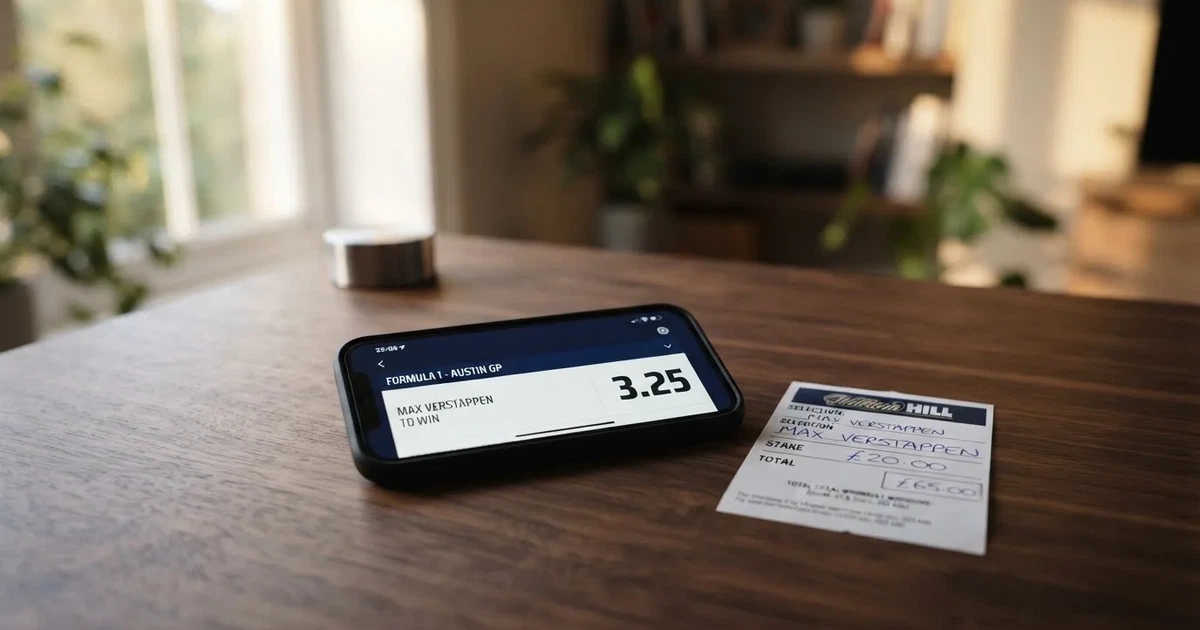
Motorsport sits oddly inside a British betting account. Formula 1 headlines every weekend from March to December, Le Mans runs once a year and clears the screen for a fortnight, NASCAR fills Sunday mornings, and Superbikes, IndyCar, Formula E and rallying all carry their own smaller, loyal betting markets. None of this is hidden, and the bigger the name on the tin the bigger the in-play grid the operator offers. The catch is what sits underneath: a “free bet” that needs eight times its value in qualifying stakes, a margin that quietly lifts a head-to-head price by five percent on the quiet, a bonus whose terms disappear behind a “qualifying bets only” line. Online motorsport betting in 2026 is a market with deep coverage and a thin spread of value, and this page is built around what that costs the person staking the money.
The cost of going first: responsible gambling as a budget line
Safer gambling carries a different weight on a motorsport page than it does on, say, a footballing page, because the calendar is relentless. From the lights going out in Australia in March to the chequered flag in Abu Dhabi in December, an F1 season offers something to bet on almost every weekend, and once Le Mans, the BTCC rounds, MotoGP, NASCAR and Formula E are layered on top, a regular punter can hit the weekend six days out of seven. The interesting line is therefore not “do you need safer gambling tools” but what those tools actually do to a punter’s bankroll.

Every bookmaker routed into this comparison runs under a Gambling Commission remote licence. That brings with it a mandatory seat at GAMSTOP, the national multi-operator self-exclusion scheme, and a duty to verify name, address and date of birth before the first deposit. Since 7 May 2019 the verification step has applied to free bets and bonuses as well as real-money play, so an account cannot even be opened without producing documents. The licence also carries a social responsibility code, and on top of that a deposit-limit requirement (Remote Technical Standards 12) that the operator must offer and that the punter sets themselves.
What that translates to in practice: a punter who registers with a UK-licensed operator and chooses not to set a deposit limit will be asked to set one before the first deposit goes through, and is free to set it as high as the operator allows. There is no state-set ceiling. The “limit” is the punter’s choice, not a regulator’s verdict.
Two further checks have arrived in 2026. A financial vulnerability check applies once a customer’s deposits minus withdrawals cross £150 in any rolling 30 days. It is a public-record check — bankruptcy, county court judgments — not an income check, not a credit reference. Separately, financial risk assessments (the affordability checks of headline news) have been announced in a staged plan with no start date; they are not in force, and any site claiming they are is selling the punter something extra rather than something statutorily required.
The bankroll effect of all this is straightforward. A punter who self-excludes through GAMSTOP is locked out of every licensed online bookmaker for six months, one year, five years, or five years with auto-renewal; after the chosen minimum period the exclusion stays in place for a further seven years unless the customer asks GAMSTOP to lift it. A punter who hits the vulnerability-check threshold is asked for documents. A punter who loses discipline and chases a deficit does not get a hard regulatory stop; they get a soft operator stop, and the operator’s stop depends on the operator.
The clearest framing for the punter who keeps the hobby small: deposit limits and timeouts cost nothing. GAMSTOP, GamCare (National Gambling Helpline), GambleAware, NHS gambling clinics and Gamblers Anonymous are free and confidential. The first call is the cheapest.
A second framing is the one that makes the rest of this page read correctly: every bonus on this page is a marketing spend, not a gift. The 10x wagering cap that landed on 19 January 2026 puts a ceiling on how badly a bonus can treat the punter who takes it, but a cap is a ceiling, not a floor. Most offers still sit at the cap or close to it, and the cheapest offers tend to come with the most restrictions on which markets count.
What a “free bet” actually pays
The welcome offer is the page most punters land on first, and the one most punters misunderstand. Three of the ten bookmakers routed into this comparison publish a “free bet” headline that translates, when the terms are read, into a token that pays out only the profit, not the stake, and a third publish an offer that pays out in cash. The two behave differently.

Where the headline reads “bet £10, get £15 in free bets”, the £15 is broken into three £5 tokens — a sports bet, an accumulator and a “Sub-Cover” bet — each of which pays profit only. A qualifying £10 wager at even money that lands returns £20 in real money; the £15 in free tokens, used at even money and won, returns £15 in profit only, the stake being forfeit. BoyleSports’ £20 in free bets for a £10 stake follows the same logic. BetTom’s 50% back as a free bet of up to £50 is the third shape: a refund on a losing first bet, paid as a free bet whose stake is not returned. None of these are bad deals; they are simply deals whose headline number is not the number in the punter’s account on a winning day.
The arithmetic behind that is what a punter needs to internalise. On a £10 free bet at even money, the punter’s worst case is zero (the bet loses, no money is owed). The best case is £10 in profit. The expected value, at a market margin the bookmaker sets to roughly five percent, is closer to £4.75 than to £10. The headline “£15 free bet” is therefore worth something between £4 and £8 once the odds and the margin are accounted for — a respectable, modest sweetener rather than the headline price.
Two offers in this comparison pay back in cash. Spreadex, which combines a fixed-odds sportsbook with a spread betting arm regulated by the FCA, makes the asymmetry explicit on its homepage: spread betting losses can exceed deposits. William Hill’s Best Odds Guaranteed pays the bigger of the price taken and the starting price on UK and Irish racing from 8 AM on race day, on singles and multiples; it does not apply to ante-post, tote or pari-mutuel bets. Fafabet’s BOG applies from 9 AM on race day on win and each-way bets. These are pricing concessions, not bonus tokens, and they cost the operator per pound staked rather than per offer claimed.
The net effect on the punter’s opening weekend is small. A punter who picks one offer, reads the terms, and uses the token on a market they were going to bet anyway will come out marginally ahead of a punter who picks three offers and chases each one across three bookmakers. The marginal value falls quickly once the punter is no longer betting on the markets they would have bet on anyway.
How the odds are built and what the margin takes
A price is two numbers that don’t add up. On a two-way market at 1.90 / 1.90 in decimal, a £10 stake on either outcome returns £19 if it wins; the two probabilities implied are 1 ÷ 1.90 = 0.5263 each, totalling 1.0526. That excess of 5.26% is the bookmaker’s margin — the slice of every pound staked that the bookmaker keeps across an infinite run of identical bets, before any promotional giveback. The same market at 1.85 / 1.85 carries a margin of roughly 8.1%; the same market at 2.00 / 2.00 carries a margin of exactly 0% (the bookmaker breaks even in the long run and makes money on the vig from elsewhere).
The reason this matters on motorsport more than on, say, Premier League football is that motor racing has fewer reference points. Football has decades of price comparison and tight margins of 2-3% on the major leagues; motorsport, with a thinner betting handle outside the headline Grands Prix, routinely carries 5-8% on outright markets and more on qualifying and fastest-lap props. The punter is paying for the bookmaker’s smaller sample, not for a worse service.
A worked example from the market research sets the band. An illustrative two-way market at decimal odds of 1.90 / 1.90 implies a payout share of 1 ÷ (1/1.90 + 1/1.90) = 0.9506, and a margin of 1 − 0.9506 = 0.0494, or 4.94%. On a stake of £10 returning £19 on a win, the punter’s expected value across an infinite run is £10 × 0.95 = £9.50; the bookmaker’s expected take is 50p per £10 staked. The 5% margin is the figure the bookmaker publishes, in effect, through the prices it offers.
What does 5% cost in real money? On a £10 single bet, nothing changes: the punter wins £9 in profit or loses £10, and the price is the price. Over a season of, say, 23 Grands Prix with an average of three bets per weekend at £10 a bet, the punter stakes £690 in nominal turnover. At a 5% margin the expected loss is £34.50; at 8% it is £55.20. Neither figure is trivial once the punter is running an accumulator habit rather than a singles habit, because the margins multiply through the legs of the bet.
A second consideration is the difference between singles and each-way on outright and podium markets. An each-way bet is two bets of equal stake, one on the win and one on the place; the stake doubles, and the place terms vary by operator and by field size. A £10 each-way bet on a 12-runner race at 10/1 is £20 staked; if the selection wins, the punter collects the win returns plus the place returns on the place half; if it places, the punter collects the place half only. The “free” half is not free — it is half the stake.
A third is the bet builder. Bet365’s Bet Builder+ combines markets from one event into a single bet, available pre-match and in-play, with margins that are typically higher than the underlying markets combined. The convenience has a price, and the punter who uses a builder because the price is “right” is usually paying a margin of 8-12% on the combined selection rather than the 5% of a single market. NetBet’s Bet Builder works on the same principle with instant dynamic odds.
The simple takeaway: a punter who wants the cheapest price in motorsport bets singles on the head-to-heads and skips the builder on the mid-card races. A punter who wants the bet builder is paying for the convenience.
The motorsport calendar and the markets that follow it
The shape of a Formula 1 weekend is a useful map of the markets that follow it. Free practice on Friday carries limited markets and thin liquidity. Qualifying on Saturday carries the grid-position markets that often price more sharply than the race itself. The race on Sunday carries everything: race winner, each-way, podium, fastest lap, head-to-head, safety car yes/no, retirement yes/no, and the team markets. The pre-season in February carries the championship outright, which settles in December and trades like a futures market the whole way through.
The 2026 calendar runs to 23 Grands Prix, from Albert Park on 8 March to Yas Marina on 6 December. The grid has expanded to 11 teams, with Cadillac entering as a new entrant and Audi taking over Sauber as a works team; the team cost cap for 2026 sits at 215 million US dollars. The regulation reset for 2026 drops the MGU-H, raises MGU-K output to 470 bhp (350 kW), and replaces DRS with active aerodynamics including an overtake mode that activates within one second of the car ahead. Lando Norris enters as the reigning Drivers’ Champion. None of these change the betting grid; they change which drivers and constructors the market will shorten and drift through the season, and which team-versus-team matchups will tighten up as the year progresses.
Beyond Formula 1, the FIA World Endurance Championship (which carries Le Mans, held each June in France, as its blue riband event) and the IndyCar Series in the United States both carry head-to-head and outright markets at most of the major bookmakers routed here. NASCAR, MotoGP, Formula E, the BTCC and the World Rally Championship all carry markets on the bigger brands, often with thinner liquidity and higher margins on the outrights. The punter who bets on F1 alone pays the lowest average margin; the punter who chases a smaller series pays more per pound staked.
A useful framing is the FIA itself: the Fédération Internationale de l’Automobile, formed in 1904, is the oldest and most prominent international governing body for vehicles with four or more wheels; the FIM, its counterpart, governs motorcycle sport. The two are independent, and so are their calendars. Main categories under the FIA umbrella include open-wheel (F1, Formula E, IndyCar), touring car, endurance (Le Mans), and motorcycle racing. A punter looking at “motorsport” on a British bookmaker’s site is usually looking at F1, F2 and F3, with Le Mans, IndyCar, NASCAR and MotoGP listed further down the page.
A small calendar point worth noting for 2026: the British Grand Prix sits in July, and a Silverstone weekend is one of the few motorsport weekends in the year where the major British operators run a motorsport-specific price boost, acca insurance or “F1 podium” promotion. The punter who reads the terms ahead of the weekend will be reading the same terms across ten bookmakers; the punter who reads them after will be reading the offer’s small print under time pressure.
How the comparison is built: ten bookmakers, one licence test
The ten bookmakers routed into this comparison were chosen because each holds a Gambling Commission remote licence for general betting on real events in Great Britain, each is reachable on a UK punter’s mobile, and each carries motorsport markets at the time of writing. The order is by licence account number, which is an arbitrary register order rather than a quality ranking: a low account number simply means the licence was issued earlier, not that the operator is better or worse.
The licence test is the whole test. A GB-licensed bookmaker passes it because its name sits on the Commission’s public register against a licensee holding a remote betting licence; the register is searchable by business name, trading name, domain or account number, and any site claiming a GB licence that does not resolve on the register is not licensed. A Curaçao, Maltese or Gibraltar licence is not a substitute; since the Gambling (Licensing and Advertising) Act 2014 an operator whose remote facilities are used in Great Britain needs a Commission licence wherever it is based.
Several of the brands below run under the same parent licence — Ladbrokes and Coral under Entain, Paddy Power and Betfair under Flutter — but each is treated as a separate brand here because that is how the punter encounters them. A brand that runs under a parent’s licence still has to satisfy its own conditions.
What the comparison is not. It is not a “best of” list, because “best” depends on the punter: the best for a casual £5 punter who bets F1 once a season is rarely the best for a £100-per-week accumulator punter who covers NASCAR, F2 and MotoGP. It is not a recommendation to sign up. It is a structured look at what each operator offers, what its terms cost the punter who claims them, and where each operator’s offer suits a particular kind of betting.
The table below carries the licence register line for each operator — the account number, the licence holder and what the operator’s own terms say about the subject of the page. The single subject the table keys on is the operator’s own statement on motorsport coverage; the column is worded from what each operator publishes, and the reader should treat each cell as that operator’s published claim rather than an independent audit.
| Brand | Gambling Commission licence (account · holder) | Operator’s terms on motorsport |
|---|---|---|
| NetBet | 39170 · Netbet Enterprises Limited | Daily Boosts, Profit Boosts, free bet offers, Bet Builder with instant dynamic odds, sports stats for major leagues |
| Star Sports | 9177 · Star Racing Limited | Phone trading on 08000 521 321 and [email protected] for account opening, betting and customer queries |
| DragonBet | 64908 · DragonBet Ltd | Welsh football and rugby markets, racing, American football, in-play and Bet Builder markets |
| William Hill | 39225 · WHG (International) Limited | Best Odds Guaranteed on UK and Irish racing from 8 AM on race day, singles and multiples, not ante-post, tote or pari-mutuel |
| DAZN Bet | 48756 · DZBT Limited | Debit card, Apple Pay, Paysafecard, Trustly and Skrill deposits from £5; PayPal from £20; no processing fees |
| Fafabet | 57385 · Taichi Tech Limited | Best Odds Guaranteed on UK and Irish racing win and each-way from 9 AM on race days; bigger SP paid if it exceeds the original price |
| BoyleSports | 39469 · Boylesports Enterprise | £20 in free bets for a £10 qualifying bet for UK players; €30 in free bets for a €10 bet for Irish players |
| BetTom | 64959 · Bet Tom Limited | 50% back as a free bet up to £50; matching 50% back up to £50 as free slot funds for casino; full terms apply |
| Fitzwilliam Sports | 48760 · SBKI Limited | Dublin bookmaker with capped membership; “High Stakes Welcome” subject to compliance criteria |
| BetGoodwin | 2927 · Goodwin Racing Limited | “Bet £10 & Get £15 in Free Bets”: a £5 sports bet, a £5 acca and a £5 Sub-Cover bet |
The comparison that follows opens the licences up and judges each operator on the offer, the markets and the price.
What each bookmaker actually offers
NetBet — daily boosts and a builder that updates as the slip builds
NetBet runs under Netbet Enterprises Limited on account 39170 and is one of the longer-established UK-facing sportsbooks. The headline is the bonus architecture: Daily Boosts and Profit Boosts sit on top of the standard welcome offer, and the Bet Builder publishes dynamic odds that update as the punter adds a leg. The combination is aimed at the punter who wants to combine a price boost with a multi-leg builder rather than chase a single-event price.
The price is the standard motorsport margin, which on F1 head-to-heads sits in the 5-7% band, with the builder running closer to 10%. The sports stats panel on the major leagues is a useful pre-race reference for the punter who likes to look at sector times and pit-stop history before placing.
The verdict. NetBet is a comfortable fit for the punter who likes to build their own F1 multi and wants the boost architecture around it. It is not the cheapest bookmaker on a single head-to-head, and the punter who bets only on race winners will not get value from the builder.
Star Sports — a phone trader at the end of the line
Star Sports, run by Star Racing Limited on account 9177, is the contrarian operator in this comparison. Where most bookmakers have moved the entire customer journey online, Star Sports keeps a phone line open: 08000 521 321, with [email protected] alongside, for account opening, bet placement and customer queries. The phone line is staffed by traders, and the appeal is for the punter who wants to negotiate a price or place a bet the online slip will not accept.
The trade-off is a thinner online product. The in-play grid on motorsport is narrower than at the larger brands, and the bet builder is less developed. The punter who bets by phone is not inconvenienced; the punter who bets only on the app will not see the same depth.
The verdict. Star Sports is the right fit for the punter with a phone-trading habit and a stake size worth talking to a human about. It is the wrong fit for the punter who wants every market on a single screen.
DragonBet — Welsh football first, motorsport second
DragonBet, run by DragonBet Ltd on account 64908, is the regional specialist of this comparison. The home page foregrounds Welsh football and rugby, with racing, American football, in-play and a Bet Builder behind. Motorsport sits on the page rather than at the front of it.
The implication is straightforward. The Welsh-anchored punter gets a deep home offering; the punter who comes for motorsport alone will find what they need, on a price in line with the rest of this comparison, but will not find anything motorsport-specific that they would not find elsewhere.
The verdict. DragonBet is a fit for the Welsh punter who bets across football, rugby and racing and treats motorsport as a top-up. This is not the choice for the punter focused solely on F1.
William Hill — Best Odds Guaranteed and a long memory
William Hill, run by WHG (International) Limited on account 39225, is the longest-established bookmaker in this comparison, and the BOG concession is the headline. Best Odds Guaranteed pays the bigger of the price taken and the starting price on UK and Irish horse racing from 8 AM on race day, on singles and multiples; it does not apply to ante-post, tote or pari-mutuel bets. The concession is not a welcome bonus; it is a per-pound concession that runs every race day.
For motorsport specifically, William Hill’s grid on F1 is the deepest in this comparison. The pre-season outrights, qualifying head-to-heads, race head-to-heads, podium finishes, fastest lap, safety car, retirement and team markets are all listed through the season. The price is competitive on the singles and standard on the builder.
The verdict. William Hill is a fit for the punter who bets regularly across racing and motorsport and wants the BOG concession as a baseline. The casual punter chasing a one-off bonus will find more headline value elsewhere, because the value at William Hill is the per-pound concession rather than the headline number.
DAZN Bet — the deposit menu is the story
DAZN Bet, run by DZBT Limited on account 48756, is the payments-focused operator of this comparison. The headline is the deposit menu: £5 minimum by debit card, Apple Pay, Paysafecard, Trustly and Skrill, £20 minimum by PayPal, no processing fees. The wider motorsport offer is in line with the rest of this comparison, but the deposit menu is the most accommodating for the small-stake punter.
The £5 minimum is the most permissive in this comparison. The punter who bets in fivers can fund an account at DAZN Bet without paying the £10 minimum that most competitors impose, and the absence of processing fees on every listed method means the punter is not subsidising the bookmaker’s payment costs.
The verdict. DAZN Bet is a fit for the small-stake punter, the PayPal-only punter and the punter who wants the widest deposit menu at the lowest minimum. It is less suited to the punter prioritising a deep motorsport-specific menu.
Fafabet — Best Odds Guaranteed from 9 AM
Fafabet, run by Taichi Tech Limited on account 57385, runs the same BOG concession as William Hill but with a 9 AM start time rather than 8 AM. On UK and Irish horse racing win and each-way bets, Fafabet pays the bigger of the price taken and the starting price if the SP exceeds it. The hour’s difference is a small concession to the punter who places bets at lunchtime rather than first thing.
The motorsport grid sits in the standard mid-market band. The builder and the in-play offer are present without being differentiated, and the welcome offer is a modest token that fits a casual punter. The Fafabet proposition is the BOG plus a reasonable grid, with the head-to-head pricing in the 5-7% band on F1.
The verdict. Fafabet is a fit for the racing-led punter who bets close to race time and wants the BOG on the win and place markets. It is a less obvious choice for the punter who prefers a purpose-built motorsport promotion.
BoyleSports — the £20 free bet headline
BoyleSports, run by Boylesports Enterprise on account 39469, headlines with £20 in free bets for a £10 qualifying bet for UK players, and €30 in free bets for a €10 bet for Irish players. The Irish-facing half is the larger of the two offers and reflects the operator’s Irish heritage; the UK-facing half is a standard small-stake welcome.
The free bet is profit-only; the £20 token returns the profit on a winning bet but not the stake. On a £20 free bet at even money, the punter’s upside is £20 in profit; the expected value, at a 5% margin, is closer to £9.50. The headline number is therefore roughly double what the punter should expect.
The motorsport grid is mid-table. The builder is present, the in-play offer is present, and the pricing on the headline F1 markets is competitive without being aggressive.
The verdict. BoyleSports is a fit for the UK punter who wants the £20 free bet as a small sweetener and treats motorsport as one of several sports on the slip. It is not a fit for the punter who expects the headline number to land in the account on a winning day.
BetTom — 50% back as a free bet, doubled with casino
BetTom, run by Bet Tom Limited on account 64959, runs the 50% back as a free bet up to £50, with a matching 50% back up to £50 as free slot funds for casino play. The dual offer is the point of difference: the punter who loses the first bet gets half back in sportsbook tokens and half in casino tokens.
The shape is built around the punter who loses rather than the punter who wins. A £50 first bet that loses returns £25 in sportsbook free bets (profit-only) and £25 in casino free spins; a £50 first bet that wins returns nothing on top of the £50 in profit. The offer suits the punter who expects to lose the first bet and wants the consolation; it does not suit the punter who expects to win.
The motorsport offer sits in line with the rest of this comparison. Pricing on the F1 head-to-heads is in the 5-7% band, the builder is standard, and the in-play grid is present without standing out.
The verdict. BetTom is a fit for the punter who expects to lose the first bet and wants the consolation paid in two currencies. The punter who expects a winning first bet will not find the value they are looking for.
Fitzwilliam Sports — Dublin, capped, by invitation
Fitzwilliam Sports, run by SBKI Limited on account 48760, is the most distinctive operator in this comparison. It describes itself as a Dublin bookmaker with capped membership and runs a “High Stakes Welcome” subject to compliance criteria. The implication is that the account is not open to every punter; it is a tighter room with a higher per-account ceiling.
The features available inside the room are standard for a UK-licensed operator: instant deposits, fast withdrawals, timeouts and deposit limits, and links to GambleAware, GamStop and Gamblers Anonymous. The motorsport offer is competitive on price, and the in-play grid on the headline F1 markets is present.
The verdict. Fitzwilliam Sports is a fit for the higher-stake punter who wants a tighter book and can satisfy the membership criteria. It is not a fit for the casual punter, who will not get through the door.
BetGoodwin — a £15 welcome that splits three ways
BetGoodwin, run by Goodwin Racing Limited on account 2927, runs a “Bet £10 & Get £15 in Free Bets” welcome split into a £5 sports bet, a £5 accumulator and a £5 Sub-Cover bet. The three tokens are different products with different markets, and the punter who wants to use all three will be reading three sets of terms.
The split is the design. A punter who wants a single £15 free bet does not get one; the punter who wants three £5 tokens on three market types gets the full welcome. The tokens are profit-only, and the expected value across the three, at a 5% margin on each, is in the £7 region rather than the £15 headline.
The motorsport offer sits in line with the rest of this comparison, with a reasonable F1 grid and a builder present. The Sub-Cover token is the unusual element; it is a niche market product whose value depends on the punter’s familiarity with it.
The verdict. BetGoodwin is a fit for the punter who bets across singles, accas and niche markets and wants the welcome spread across all three. It is not a fit for the punter who wants a single token on a single market.
What the licence really means on a Tuesday afternoon
A Gambling Commission remote licence is the cheapest insurance a punter can buy. It costs nothing at the point of purchase, and it carries three things the punter will use if they ever need them: GAMSTOP membership (multi-operator self-exclusion, six months to five years with a further seven-year tail), an approved dispute resolution route through the Commission if the operator fails to pay out, and a slot in the Commission’s enforcement action if the operator behaves badly. It also carries the marketing rules — the 10x bonus cap, the responsible gambling code, the safer gambling messaging — that have changed the shape of the welcome offer over the last two years.
The offshore alternative is not illegal to use as a customer. The Commission’s enforcement is aimed at the operator, not the punter: cease-and-desist notices, search-engine referrals, work with registrars and hosts, and the prospect of court-ordered DNS blocking powers, not ISP blocking in operation. What the punter loses is the protection, not the freedom: no GAMSTOP coverage, no Commission complaints route, no approved dispute resolution, no British consumer redress if funds are withheld, and no 10x bonus cap. The punter who bets on an unlicensed site from Great Britain is not committing an offence they will be prosecuted for; they are giving up the safety net for the sake of a higher bonus or a longer market list.
The honest framing is that neither side is “the safe choice” by default. The licensed side carries the verification burden, the GAMSTOP coverage, the 10x bonus cap, the deposit limits and the dispute resolution; the unlicensed side carries none of those and the possibility of a lost bankroll if the operator decides not to pay. A punter who knows the trade-off can choose; a punter who doesn’t has not been told what they are giving up.
The minimum age is 18 across the licensed market. Identity verification happens before the first deposit; there is no anonymous play at a GB-licensed site. A punter who cannot produce documents cannot open an account, and any operator offering anonymous play to a British customer is offering something outside the licence.
The duty cycle that lands on the operator, not the punter
The punter pays no tax on betting winnings in Great Britain. General Betting Duty is the operator’s tax, currently 15%, charged on gross profits; from 1 April 2027 a new remote betting rate of 25% applies within it, while remote bets on UK horse racing, self-service betting terminal bets, pool betting and in-person betting stay at 15%. The change is a policy paper of 26 November 2025 and is not yet in force. Until 1 April 2027 the remote rate stays at 15%, and whether operators pass duty through to odds is not established; the punter should not be told they are being charged duty, because they are not.
Spread betting carries its own rates: 3% on financial spread betting, 10% on other spread betting. Spreadex, the only operator in this comparison with a spread-betting arm regulated by the FCA, makes the asymmetry explicit on its homepage: spread betting losses can exceed deposits. A punter using the spread side is not a punter using the fixed-odds side, and the duty cycle is different on each.
The Commission’s statutory levy is a separate charge to the operator, not a tax on the punter. Neither the levy nor General Betting Duty affects the price the punter sees on the betting slip, and neither should be conflated with the bookmaker’s margin, which is the slice of every pound the operator keeps through the odds it sets.
For the punter who wants a clean summary: winnings are not taxed; duty is the operator’s problem; the margin is the punter’s. The 5% margin on a 1.90 / 1.90 market is more expensive than General Betting Duty will ever be.
A practical sequence for the punter who opens an account this weekend
Three steps cover most of what a new punter needs in 2026.
First, pick one bookmaker. The comparison above offers ten; one is enough. The cheapest is usually the one whose welcome offer suits the punter’s existing betting habit — a racing punter at William Hill or Fafabet, a builder punter at NetBet, a small-stake punter at DAZN Bet, a higher-stake punter at Fitzwilliam Sports. Adding a second bookmaker for price comparison is sensible; adding a fifth is diminishing returns.
Second, verify before the first deposit. Name, address and date of birth are required, and free bets and bonuses are covered by the verification. The verification is a one-time cost; the cost of failing it later is a frozen withdrawal. A punter who tries to skip verification by betting on an unlicensed site is giving up the safety net.
Third, set a deposit limit before the first deposit. The limit is the punter’s choice, not the regulator’s. A punter who chooses not to set one is asking the operator to set it for them later, and the operator’s limit is rarely as generous as the punter’s. The first call to GamCare (National Gambling Helpline), GambleAware or the NHS gambling clinics is free; it doesn’t need a problem to justify it.
Beyond the three, the practical order through a motorsport weekend is straightforward: pick the race, pick the market, pick the price, place the bet, settle the bet, withdraw if appropriate. The punter who chases the price across three bookmakers for the same selection is paying a transaction cost they have not measured.
Frequently Asked Questions
How can it be checked that a bookmaker holds a Gambling Commission licence?
The Commission’s public register is searchable by business name, trading name, domain or account number, and is the whole test of who holds a GB remote licence. A brand that claims a GB licence and does not resolve on the register is not licensed, and a Curaçao, Maltese or Gibraltar licence is not a substitute. A .com domain proves nothing; a Commission account number on the register proves everything.
How is the return on a bet worked out from the stake and the odds?
Return is stake × odds, and net profit is stake × (odds − 1). A £10 stake at 2.50 returns £25 in total, of which £15 is profit and £10 is the stake returned. On a combination bet the odds of each leg multiply into one price, and the same formula applies to the multiplied price. The bookmaker’s margin is a separate figure, taken from the difference between the implied probabilities and 100%.
What is the bookmaker’s margin and how can it be seen in the odds?
The margin is the slice of every pound staked the bookmaker keeps across an infinite run of identical bets. On a two-way market at 1.90 / 1.90, the implied probabilities are 1 ÷ 1.90 = 0.5263 each, totalling 1.0526; the excess over 1.0 is the margin, here 5.26%. The lower the margin, the cheaper the market is for the punter. A 1.85 / 1.85 market carries a higher margin than a 1.95 / 1.95 market on the same event.
How do fractional odds such as 5/1 convert to decimal odds such as 6.00?
Fractional odds a/b convert to decimal odds a ÷ b + 1, so 5/1 becomes 5 ÷ 1 + 1 = 6.00, and 11/4 becomes 11 ÷ 4 + 1 = 3.75. Evens (1/1) becomes 2.00. The conversion is mechanical and applies in either direction; a punter who reads one form can always see the other.
Which tools for controlling play does a licensed bookmaker have to offer?
Every GB-licensed remote operator must offer GAMSTOP self-exclusion (six months to five years, with a seven-year tail), a deposit limit set by the customer, timeouts, and links to GamCare, GambleAware and Gamblers Anonymous. The verification before the first deposit is also a control, in the sense that anonymous play is not available at a licensed site.
Are betting winnings taxed in Great Britain, and who pays General Betting Duty?
The punter pays no tax on betting winnings in Great Britain, and a professional gambler should ask HMRC or an adviser. General Betting Duty is the operator’s tax on gross profits, currently 15%, with a new remote rate of 25% applying from 1 April 2027. The duty does not appear on the betting slip, and the punter is not charged it directly. The Commission’s statutory levy is a separate charge to the operator, not a tax on the punter.
Combat & motorsport – Best betting exchange
Content created by the «Best betting exchange» team
