
What online table tennis betting actually costs the punter
 Available in US
*Current as of 27 October 2026. Licence status verified against the Gambling Commission’s public register.*
The picture that greets anyone searching for “online table tennis betting” is friendlier than the rulebook behind it. The sport itself is fast, televised all day on dedicated channels, and the match structures are short — a best-of-five can be over in under half an hour — which makes it attractive to live bettors and to anyone whose bankroll wants quick turnover. The reader’s working problem is not where to place the bet. It is how much of every pound the operator keeps, what the welcome offers really demand, and how the licence that supposedly protects them shows up in practice. The next ten sections look at table tennis betting in Great Britain through that lens, in that order.

Safer gambling and the limits that bit in 2026
The first question is not a bookmaker question. It is the question that decides whether the rest of the page applies. Anyone who has signed up to GAMSTOP, the national online self-exclusion scheme, is barred from opening a new account with any GB-licensed operator; existing accounts are also closed. Exclusion lasts six months, one year, five years, or five years with auto-renewal. At the end of the minimum period the exclusion holds for a further seven years unless the customer asks for it to be lifted. The scheme is mandatory at every online operator licensed in Great Britain, so the rule cuts uniformly across the ten bookmakers reviewed further down.
Two controls were added on top of that, and both land in the cost calculation. The first is a financial vulnerability check that fires when a customer’s deposits minus withdrawals clear £150 over a rolling thirty days. The check is a public-record look at things like bankruptcy and county court judgments — not an income check, not a credit check. The second is the requirement to set a deposit limit before the first deposit is allowed, with the next phase of the technical standard scheduled to take effect from 30 September 2026 but not yet established as live. The point that matters for the cost picture is that limits are the customer’s choice: no ceiling is set by statute, but every licensed operator will ask what the customer wants the cap to be.
For help, the National Gambling Helpline runs through GamCare. GambleAware funds treatment and education. NHS gambling clinics operate in several regions, and Gamblers Anonymous groups meet independently. Spreadex’s terms link to GambleAware, GamStop and Gamblers Anonymous.
Crypto, pseudonymity and the loss of every consumer protection
Crypto is offered as if it removed the friction. It does, but only of the regulated part. The two questions for a table tennis punter who wants to deposit in bitcoin or another token are direct: does the operator the punter is looking at accept that coin, and is the operator a bookmaker licensed by the UK Gambling Commission?
A British named-account rule on payment methods was not found, and there is no state list of permitted methods at licensed operators, so whether crypto is accepted depends entirely on each operator’s own payments page. The principle the regulator enforces is separate: since 7 May 2019 a bookmaker has to verify the customer’s name, address and date of birth before the first deposit, including where the deposit will fund only a free bet or a bonus. No anonymous play exists at a licensed site, whatever the currency. Source-of-funds questions at higher spend are routine under the anti-money-laundering rules, and bitcoin purchased through an exchange with full KYC is treated no differently from a sterling bank deposit at that stage.
The cost calculation shifts when crypto is used and the operator is unlicensed. Credit cards have been banned for gambling in Great Britain since 14 April 2020, including credit-card-funded payments through an e-wallet; crypto sits in a different regulatory box from cards, which means an unlicensed site is the more common partner for it. Providing remote gambling to customers in Great Britain without the licence the Act requires is an offence aimed at the operator, not the customer — but the customer pays for that in lost protections: no GAMSTOP coverage, no Commission complaints route, no approved alternative dispute resolution, no recourse if funds are withheld, and the operator’s rules determine everything. Enforcement runs on disruption — cease-and-desist notices, work with payment providers — not blanket ISP blocking, and the Commission has been granted, or is about to gain, court-order DNS blocking powers; none of that returns a lost deposit.
A punter who wants to combine table tennis betting, bitcoin and British consumer protection needs to find the intersection of those three on the operator’s own terms, not assume any of the three.
What welcome offers and free bets really cost
The offers headline “free”, the small print prices them. Reading the bonus section with that shape in mind is what saves a bankroll. The straightforward case is a deposit-matched bonus: a bookmaker credits bonus funds equal to a percentage of the deposit, and the credited amount has to be wagered a set number of times before it turns into withdrawable cash. Standard coupon language calls that the rollover or the wagering requirement; the licence has been talking about both since at least January 2026, when the cap was tightened.
The cap runs at 10x. A £10 bonus whose rollover was 50x would have needed £500 of qualifying bets; under the cap no more than £100 of wagering can be required on a bonus. Where the rollover is calculated on the bonus plus the deposit, the effective multiple rises: a 100% matched bonus with a 10x rollover on bonus plus deposit is really a 20x turnover on the bonus element alone, because every £10 of bonus also forces £10 of deposit to be wagered. The cap and the rollover base are not the same thing, and they interact.
A free bet is a different product. The stake is not returned when the bet wins — a £10 free bet at odds of 3.00 returns £30, not £40 — and free bets usually expire within seven days. “Risk-free” offers are usually free-bet refunds on a losing first bet, not money back, so the bettor takes the hit if the second bet also loses. Cashback and acca insurance have their own rules: a stake returned as cashback with no further turnover is the generous case, while acca insurance that refunds as a free bet is closer to a second free bet than to a safety net. No cap on the money value of a bonus was established, but a cap on the value of bonus winnings is common and worth checking on the operator’s own terms page.
The minimum price for a qualifying bet is where small print quietly removes value. A bet on a table tennis match at odds of 1.10 does not turn over the bonus anywhere near as effectively as one at the operator’s stated minimum, and the standard minimum at most bookmakers sits around 1.50 to 2.00 in fractional terms. Calculating the cost: a £100 bonus at 10x rollover on the bonus alone, played through at a minimum stake of £5, requires twenty single bets. The eventual qualification of those bets against the operator’s market-margin needs to be checked before any deposit is made.
Mixed-product promotions — offers that require play on two or more product types such as betting and casino combined — are banned outright under the rule that has been in force since 19 January 2026. An offer that conditions bonus credit on a combined casino-and-sports turnover will not be found in the standard welcome pages at a licensed bookmaker; readers who see one should treat it as a red flag for licence status.
Live betting, cash out and the price of a move you didn’t quite make
Live betting and cash out are sold as features. The cost story is more particular. In-play on table tennis exists because the set is short and the lead can swing fast, and licensed GB bookmakers offer it as standard; the controls are the operator’s own licence conditions, not a statutory cap. Whether an operator restricts in-play on a particular event — a small international exhibition versus a WTT main-draw event — is the operator’s call.
Cash out lets the punter close a bet before settlement at a price the bookmaker quotes in real time. The quote is the operator’s price, built on the same margin that runs through the rest of the book. The bettor is not arbitraging against the original price; they are taking the operator’s reduced price on a market whose outcome is now partially known. A bet that was placed at decimal odds of 2.20 might cash out at 1.80 when the player who started ahead has dropped a set, and the loss of 0.40 in decimal terms is the operator’s adjustment, not a credit. Where cash out is unavailable — a common silence — the bet runs to settlement, and the bettor waits.
Bet builders and same-game multis carry a similar shape. The bookmaker combines markets from one event into a single price, and the joint price is built by adding implied probabilities before the margin is applied. A bet that would have paid 1.80 on the match-winner market and 1.95 on the over-15.5-points market if staked separately will not necessarily pay 3.51 on the combined selection; the combined price is smaller than the implied multiplication by enough to bake the margin in. Settlement depends on every leg winning. The function is real, but the cost is built into the price, and a punter who treats each leg independently is paying twice.
The cap that matters is the maximum stake. Some bookmakers show a ceiling on price-boost selections and bet-builder stakes at the time of bet, and reading that line is the difference between a £20 stake and a £2 one. A boosted-odds bet of £20 placed against a £20 ceiling is fully staked; the same bet above the ceiling is partially staked, and the rest either laps or is returned depending on the operator’s house rules.
Predictions, strategy and the cost of getting them wrong
The word “prediction” does most of the work in this section, and it is worth naming what it actually means. Nobody knows who wins the next table tennis match. Anyone who tells a reader they do has decided to take their money, and the cases in which that turns out to be true do not pay for the cases in which it does not. A prediction of the form “Player X will win the next WTT Contender event” is either a guess or, where there is a booking model behind it, an output whose accuracy has to be measured against enough settled bets to be meaningful. Most predictions sold as tips do not survive that test.
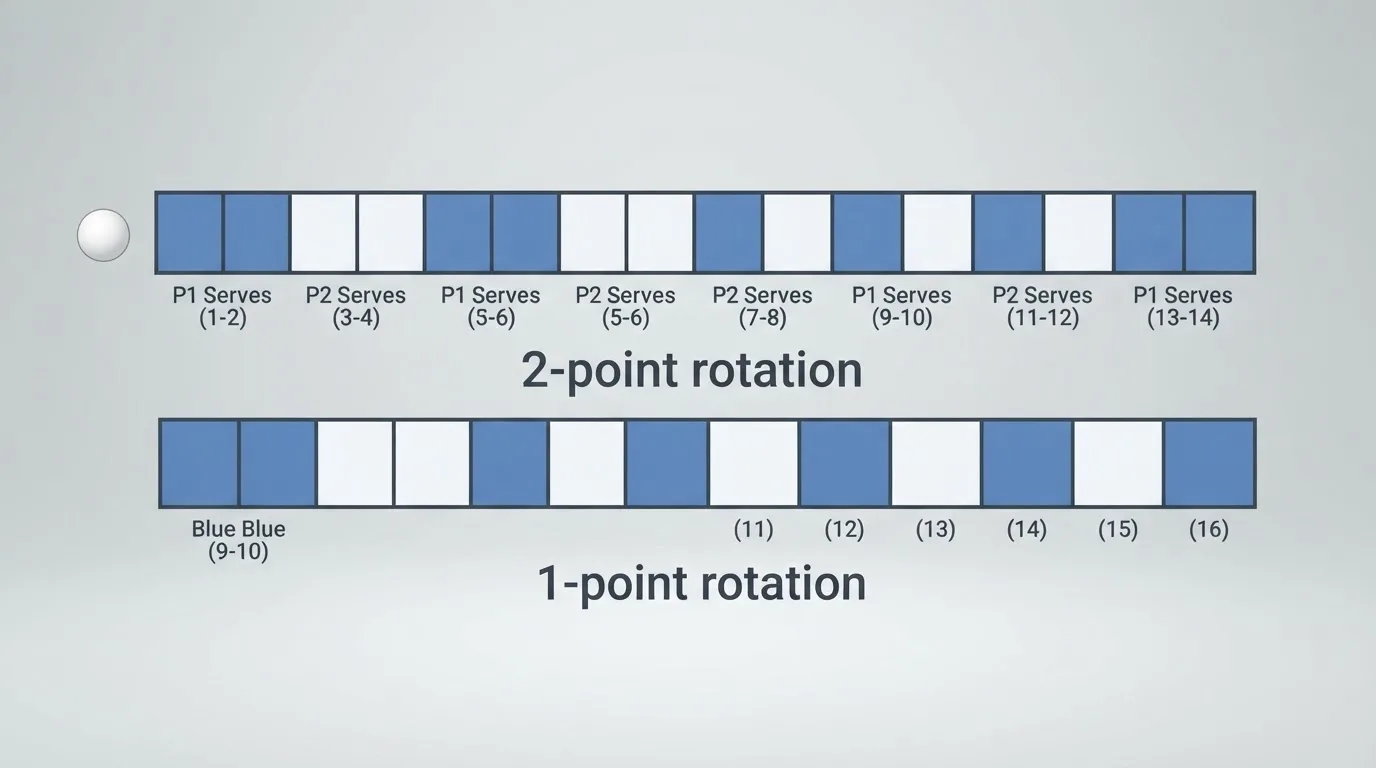
Strategy for table tennis is more limited than for football, where the form book is wider and the data slower. A match is a best of five or seven; service alternates every two points, and once both players have reached 10 each point is served in turn. Long form-study does not pay the same way because there is less of it to study, and live betting on a sport whose contests can hinge on one set of nerves is a tight-margin game even with full information.
The costs and benefits the punter can control are these. Bankroll management, set before the first stake, beats every prediction system on a long enough view; a flat stake as a percentage of bank, regardless of the tip, is what lasts. Keeping records of bets settled, including the ones that lost, gives the punter a measure of whether the strategy is working. And the cheapest move of all is to check the form before the bet is placed, not after: the bookmaker has to quote a margin on every price, and the punter’s edge is comparison, not prediction.
Tipsters and paid tip services are a separate question. A service that charges for tips carries its own economic weight: the service’s own subscription has to come out of the punter’s edge for the tips to be net-positive, and there is no way around that by ignoring it. Where a tip is offered for free the same calculation holds, but the loss is the punter’s time and the price of bad picks, not a subscription.
Bet types, odds and how the margin shows in the price
The cheapest section of this page — in the sense that it costs nothing once read — explains how the bookmaker’s margin shows up in the odds. Every market a bookmaker offers is built as a book: a percentage of every unit bet that the bookmaker expects to keep, called the margin or the overround. A market whose outcomes should add up to 100% in implied probability is quoted so that they sum to more than 100%, and the difference is the operator’s expected take.
Take a clean two-way market such as a moneyline at even odds: each side quoted at decimal odds of 1.90. The implied probabilities are 1 ÷ 1.90 = 0.5263, or 52.63%, on each side, which sums to 105.26%. The payout share — what the bookmaker returns to bettors on this market in proportion to stakes, assuming the prices are in line with outcomes — is 1 ÷ 1.0526, or about 95%. The margin is therefore in the band of 5%.
Where the band sits for a specific match depends on the event. Top-flight table tennis can be priced tighter than exhibition moneyline markets, where the bookmaker’s information about form is thin and the margin rises to compensate. Handicap markets, totals markets and combination bets are priced from the same logic and tend to come out wider than the moneyline, because each extra variable widens the operator’s uncertainty.
Combining several markets — same-game multis, accumulators — multiplies the margins along with the odds. A four-leg accumulator at the margins implied by each leg’s prices adds 4% to 7% of margin per leg in normal football betting; table tennis follows the same shape with the proviso that fixtures are shorter and the live markets thin out faster. A bettor who wants to compare prices picks the lowest-margin single-leg book for the same match and stakes each leg as a single, accepting the loss of the accumulator’s psychological unit. Read the way the result follows from the inputs: the 5% band is the example for a clean two-way market at decimal odds of 1.90 / 1.90 and conditions the bettor on the example prices, not on a real table tennis fixture.
Reading a price is the easiest skill once the principle is right. Fractional odds of 9/10 are the same as decimal odds of 1.90; decimal odds of 6.00 are fractional 5/1, sometimes written 5-to-1. The British habit of writing fractional odds runs through the form and race-card prices; the spread betting firms show them as well, and a price of 49/50 in fractional terms is even closer to evens than the 9/10 example used above.
Tournaments, fixtures and how short a calendar really is
Table tennis has been an Olympic sport since 1988, and the ITTF, founded in 1926, runs the calendar that bookmakers mostly price. The World Table Tennis (WTT) series — Contender, Star, Finals, Champions — fills most of the year, alongside the Olympic cycle, the World Championships, the World Cup, the ITTF World Team Championships and the European Table Tennis Championships. National leagues play most weeks of the calendar in Germany, China and Russia’s top flight, with shorter schedules in Britain and France.
The WTT events are the most heavily priced, and where bookmakers take the most action. Match markets, set betting, total points over and under, handicap lines on games and points and a moneyline market make up the standard book. Outright markets for the tournament winner and each-way places fill the schedule from the quarter-finals. Where a tournament is short — a Contender event with a 32-player main draw — outright markets thin out at the semi-final stage and bookmakers may not price a winner after that point.
The calendar’s narrowness is what makes the cost calculation different. A punter with a flat stake of £10 per match faces ten to twenty matches a week at the busiest point of the season and perhaps six across a quiet week, and the working capital tied up in a single tournament is much larger than in football, where the season is constant. The accumulators sold on table tennis tend to be small — three or four legs — for the same reason.
Fixtures can change at short notice. Player withdrawals, late replacements and venue moves are common in lower-tier events, and bookmakers typically void markets on affected matches. A bet on a player who pulls out two hours before the listed start is usually a losing bet on the player and a winning bet on the opponent at the price the market adjusts to. The rules are the operator’s, and they are stated on the page; the punter’s job is to read them before staking.
Ten licensed bookmakers for table tennis — and what each is worth
The ten brands below are all on the Gambling Commission’s public register against a remote licence holder. Each review is built from the licence record, the operator’s own terms and the public app-store pages that describe the product. Several of the brands run more than one product under the same licence; Ladbrokes and Coral, Paddy Power and Betfair all live that way, but only one of each pair was reviewed. The order below is not a ranking.
| Brand | Gambling Commission licence | What the operator’s terms state |
|---|---|---|
| Betway | Remote licence under account 39372, held by Betway Limited | Free Bet Club pays up to £10 in free bets weekly after £25 of qualifying stakes |
| Dabble | Remote licence under account 65677, held by Dabble Sports UK Ltd | “Bet £10, Get £10 in Free Bets” on first deposit, 7-day free-bet expiry, stake not returned |
| Spreadex | Remote licence under account 8835, held by Spreadex Limited | Fixed-odds and spread betting in one app, with one-click and partial cash out |
| bet365 | Remote licence under account 55148, held by Hillside (UK Sports) ENC | Bet Builder+, Super Boosts, Winnings Boosts and live streaming worldwide |
| Smarkets | Remote licence under account 39173, held by Smarkets (Malta) Limited | Open-bank deposits from £10 to £10,000 instant; withdrawals within 6 hours to £100,000 |
| Bet600 | Remote licence under account 44731, held by Tyche Tech Limited | Best Odds Guaranteed on horse racing pays at starting price if bigger |
| BoyleSports | Remote licence under account 39469, held by Boylesports Enterprise | £20 in free bets when a £10 bet is placed for UK players |
| Betfair | Remote licence under account 39439, held by PPB Counterparty Services Limited | In-play betting, Bet Builder, free live streams and a 90 Minute Payout market |
| NetBet | Remote licence under account 39170, held by Netbet Enterprises Limited | Daily Boosts, Profit Boosts, Bet Builder with dynamic odds and sports stats |
| Swifty Sports | Remote licence under account 58957, held by Swifty Global (UK) Ltd | Best Odds Guaranteed, cash out, daily price boosts, live streaming; Bet Builder listed as coming soon |
Betway fits the standard GB-licensed bookmaker profile. The Free Bet Club hands back up to £10 in free bets a week after £25 of qualifying sports spend, and the terms are the ones to read for any minimisation of dead stake; the offer is light against the rollover-heavy welcome packages some competitors run, which means the cost of entry is closer to the £25 floor than to a deposit match. The punter who values a recurring small bonus over a one-off larger bonus fits the offer; the punter after a fat welcome package will not find it here.
Dabble’s “Bet £10, Get £10 in Free Bets” offer sets the deal shape for a certain type of new-customer pitch: a small free-bet return on a first qualifying stake, minimum odds applying, seven-day expiry, and the stake not returned on a winning free bet. The cost to the punter is the value of the forfeited stake on any winning free bet, and that figure depends on the price the free bet is taken at. A £10 free bet on a 3.00 selection pays £20 profit, not £30; the £10 not returned is the part the marketing does not explain. A punter who likes to use free bets at low prices is paying down the offer’s value.
Spreadex is the only brand on the list that combines fixed-odds betting with spread betting in one app, and that combination changes the cost picture because spread betting losses can exceed the deposit — the warning the operator’s own homepage carries. The Financial Conduct Authority regulates the spread-betting side, the Gambling Commission regulates the fixed-odds side, and a punter who has never used a spread bet should leave that side alone rather than treat it as a regular market. One-click and partial cash out are present alongside Bet Builder on fixed-odds or spreads, and live streaming covers UK and Irish horse racing, greyhounds, tennis, NFL and selected football.
bet365 carries the broadest feature list of the ten: Bet Builder+ combining markets from one event pre-match and in-play, Super Boosts, Winnings Boosts on Bet Builders and selected singles, and Bet Boosts every day. Live streaming covers events worldwide, with Bet Track, Match Live and a Live Golf Tracker all listed for tracking bets in play. The £20-stake cap that some boosted-odds bets show up against is the cost the punter faces when the price looks too generous, and a check on the bet-slip ceiling before pressing the button is worth a few seconds. The licence line is longer because there is more product, but the verdict for table tennis is the same: in-play coverage, wide streaming and the deepest bet builder on the list.
Smarkets is the only exchange among the ten. The licence category differs: remote betting intermediary rather than remote general betting standard (real events), and the product is laid as a betting exchange where the operator matches back and lay bets between users. Open-bank deposits by transfer are instant from £10 to £10,000 and withdrawals run within six hours to £100,000, which is the cash-out edge the exchange keeps on the bookmaker side. A punter who has used an exchange will notice that prices are set tighter and the margin sits lower than on a standard bookmaker sportsbook.
Bet600’s headline is Best Odds Guaranteed on horse racing — early or show price is topped up to the starting price if larger, applied automatically. Table tennis does not get Best Odds Guaranteed and the offer does not stretch across sports, so for a table tennis-only punter the offer is only background. The book is otherwise a standard GB-licensed sportsbook.
BoyleSports’ welcome package pays £20 in free bets when a £10 bet is placed, which is a thicker ratio than Dabble’s £10-for-£10. The shape is familiar: free bets, stake not returned, expiry on the operator’s terms. The Irish and UK legs of the same brand run slightly different offers — €30 in free bets on a €10 bet for Irish players — and the punter’s licensing jurisdiction drives which offer shows up at signup.
Betfair sits under the same group as Paddy Power. The sportsbook is one of the two products the operator runs; the exchange is the other, and is not the product on the GB register entry reviewed here. In-play, Bet Builder, free live streams and a 90 Minute Payout market on selected football events are the four features the product description lists. The 90 Minute Payout is football-specific, so it does not apply to table tennis and earns no points here.
NetBet’s product page lists Daily Boosts, Profit Boosts and free bet offers, a Bet Builder with dynamic odds and sports stats for major leagues. The sports-stats offering is one of the few across the ten to make the cut into table tennis, where it shows up as set-by-set results and head-to-head records. A punter who values stats to read form will find something to work with; the rest is the same bookmaker shape as the others on the list.
Swifty Sports’ offer reads as the standard GB-licensed bookmaker with cash out, live streaming, daily price boosts and Best Odds Guaranteed. Bet Builder is listed as coming soon, which matters for a punter who relies on same-game multis and notices the gap; in the meantime the book is built around the straight match markets and the live book.
What the cover has skipped — and why
Some material is named in the plan and absent from the picture above, on purpose. The most important gap is that the WTT year and the Olympic year move the calendar around, and a fixtures index for a single season is out of date the moment a new draw is published. A reader looking for “fixtures tonight” is better served by the WTT site or the operator’s own schedule page than by a static page. The Operators section above goes back to the licence record for the same reason — the Commission’s public register is updated the moment a licence changes hands.
A smaller gap is that the punters on this page are punters who have decided to bet, with a budget, and the section above is built for them. New readers who want the layout of the odds, the layout of the book and the layout of the licence will find what they need; readers looking for a tip to follow will not, on purpose. The cost of being wrong is real money; the cost of being told what to back by a static page is the same.
What the licence really means — and where the cover stops
The legal frame the regulator runs is the Gambling Act 2005, covering Great Britain (England, Scotland and Wales). Northern Ireland runs under different law; a GB licence does not reach it, and any claim that it does is wrong. The Gambling Commission is a non-departmental public body sponsored by the Department for Culture, Media and Sport, and the public register is the whole test of who holds a licence; the register can be searched by name, trading name, domain or licence number.
Betting exchanges and bookmakers run under different licence categories: remote general betting standard (real events) is the standard bookmaker line, remote betting intermediary is for exchanges, and pool betting, virtual events and limited stakes run under their own categories. Financial spread betting is regulated by the Financial Conduct Authority, not the Commission — which is why Spreadex runs two regulators for two product lines. The minimum age is 18 and identity verification has been a precondition for the first deposit since 7 May 2019, including where that deposit will fund only a free bet.
Advertising runs under the CAP Code (non-broadcast) and BCAP Code (broadcast), enforced by the ASA, with the social-responsibility code of the LCCP on top. CAP Code section 16 sets the under-25s rule for who may appear in an advert, not who may bet. The whistle-to-whistle ban — no betting adverts in TV around live sport from five minutes before to five minutes after, before the 9pm watershed — has been industry code since 1 August 2019, with horse and greyhound racing excluded. Premier League clubs’ voluntary withdrawal of front-of-shirt gambling sponsorship from 2026/27 onwards is sponsorship policy, not law, and sleeves and pitch-side hoardings continue.
The tax position is the one a reader is most likely to misread. The punter pays no tax on betting winnings in Great Britain, which is not tax advice and is not the position of a professional gambler, who is treated differently by HMRC and should ask an adviser. General Betting Duty is the operator’s tax, currently set at 15% of gross profits on most remote bets; from 1 April 2027 a new remote-gaming rate of 25% applies within that framework, while bets on UK horse racing, on self-service betting terminals, on pool betting and in-person bets continue to be taxed at 15%. Until that date the remote rate stays at 15%, and whether the operator passes duty through into lower prices is not established.
The cover the licence actually provides is the cover the punter is buying when they choose a licensed brand. GAMSTOP coverage, the 10x bonus rollover cap, the £150 financial vulnerability check, and a route to approved alternative dispute resolution are the four rights. What the punter gives up is anonymity — verification before the first deposit is the price. What they do not get, and what the next section turns to, is protection when the operator is unlicensed.
What falling outside the licence costs
The contrast is sharp because the regulator has built the protections in one place, and an unlicensed site sits deliberately outside them. The cost calculation for a punter shifts in five places at once.
GAMSTOP does not apply. A customer on the self-exclusion register can still deposit with an offshore brand, which is exactly the case the licence has been designed to catch. The financial vulnerability check does not apply. The 10x bonus rollover cap does not apply; some offshore brands run 40x or higher as standard. The complaint route to the Commission and to an approved ADR body does not apply; in the event of a withheld payout or a voided bet the punter is in the operator’s court, and the only practical recourse is enforcement by another regulator if any.
Identity verification does not always apply either, which is the part the offshore brand sells. The licensed bookmakers verify the customer’s name, address and date of birth before the first deposit; an unlicensed operator that omits this check is breaking its own anti-money-laundering rules in most jurisdictions. The trade-off is the punters’ loss of every British consumer protection.
The regulator’s enforcement is operational, not blocking. Cease-and-desist notices, work with payment-service providers and search-engine referrals are the everyday tools. Court-order DNS blocking powers have been granted, or are about to be granted; none of that returns a lost deposit. Honest framing for the page is that licensed means checks, limits, GAMSTOP and the bonus cap but also verification before the first stake; unlicensed means none of those protections and a real risk of loss of funds; neither is the automatically safe choice.
What a winning bet pays — the working calculation
The concrete question every reader carries is what a winning bet returns, and the calculation is short. For a single bet at decimal odds O and stake S, the return on a win is S × O. The net profit is S × (O − 1), so the stake comes back as part of the return. A £10 bet at decimal odds of 1.90 returns £19 in total — £9 of profit on top of the £10 stake. A £10 bet at decimal odds of 3.50 returns £35. The bettor’s exposure on the day is the £10 stake; the upside is the £9 or the £25 of profit depending on the price.
A combination bet works the same way with the odds of the legs multiplied together. A two-leg combination at odds 1.80 and 2.50 carries a combined price of 4.50 (1.80 × 2.50), so a £10 stake returns £45 if both legs win. The catch is the same one the bookmaker’s margin creates: each leg’s price already carries the operator’s edge, and the two margins compound. Two legs at 5% each are not a 10% combined margin on the bet because the compounding runs in implied-probability space, not in percentage terms; the combined margin is closer to 9.75%, and three or four legs raise it further.
A free bet whose stake is not paid back works out to value = free-bet amount × (odds − 1) ÷ odds × payout share of the market. The payout share is 1 minus the margin; on the clean two-way 1.90 / 1.90 example used earlier the share is 95%, so a £10 free bet at odds of 4.00 (chosen at a price well above the typical minimum) has a worth of £10 × (4.00 − 1) ÷ 4.00 × 0.95, or £7.13 on average. That is the value of the offer at expectation across many such bets; an individual bet will pay £30 on a win and £0 on a loss, and the average is what the offer is worth as a starting point.
The expected cost of clearing a bonus, where the bonus carries a turnover requirement, is the required turnover × margin of the market the bonus is cleared on. A £100 bonus with a 10x rollover on the bonus alone is £1,000 of qualifying bets; at a margin of 5% on the market the expected cost is £50. The £100 bonus carries an expected cost of £50 to clear, and the gap between them — the £50 of expected net value — is the starting point for a decision, before minimum-odds restrictions and qualifying-market exclusions shrink the offer further.
The shape that holds across the four calculations is the same: the numbers in, the number out, the qualifier that the calculation assumes and the gloss that tells the reader what the calculation does not claim. None of the four promises a win, a payout or a return; they are averages across many bets under the stated assumptions. A punter who treats them as forecasts loses the principle the calculation is built on.
Frequently asked questions
How is the return on a bet worked out from the stake and the odds?
Multiply the stake by the decimal odds to get the total returned on a winning single. Net profit takes the stake off the top, so a £25 bet at decimal odds of 3.50 returns £87.50, of which £62.50 is profit. The same rule applies in fractional odds: a £25 bet at 5/2 returns £25 plus £62.50 in winnings. Combination bets multiply the leg prices together before the stake is applied.
What is the bookmaker’s margin and how can it be seen in the odds?
The margin is the percentage of every unit bet the bookmaker expects to keep, baked into the prices. On a two-way market at decimal odds of 1.90 / 1.90 the implied probabilities are 52.63% on each side, summing to 105.26%; the gap above 100% is the margin, about 5%. Tighter prices mean a smaller margin; wider prices mean a larger one. Comparing margins across bookmakers for the same match is the comparison that pays.
How can a reader check that a bookmaker holds a Gambling Commission licence?
Use the Commission’s public register. Search by the operator’s full business name, its trading name, the listed domain or the licence account number. The register shows the licence category (remote general betting standard real events for most sportsbooks, remote betting intermediary for exchanges), the licence holder and any conditions the Commission has attached. A brand not on the register is not licensed to serve customers in Great Britain.
How does a reader place a bet on a table tennis match with a GB-licensed bookmaker?
Open an account, complete the verification step (name, address, date of birth and a proof-of-address document in most cases), deposit through one of the operator’s accepted methods and pick a market from the table tennis book. Stake confirmation and the bet slip are the operator’s. Withdrawal is the same process in reverse, and the licensing pace governs how fast it moves: licensed operators handle withdrawals on their published timetable and can be held to it through the Commission and an ADR body.
Is there a winning strategy for table tennis betting?
No strategy with a positive expected return at the reader’s scale has been set out on this page, and none will be. The shape of the cost calculation — the bookmaker’s margin sits inside every price — is the same at every stake. What lasts is bankroll management as a percentage of the pot, settling for the lowest-margin book on a given match, keeping records of every bet placed and treated as a working session, and never staking against a budget that cannot absorb the loss of a streak. The promotional terms on the offers above shift the calculation only to the extent that they break even or close to it; the punter’s job is to find the offers where they do.
Tennis, darts & cue sports – Best betting exchange
Content created by the «Best betting exchange» team
